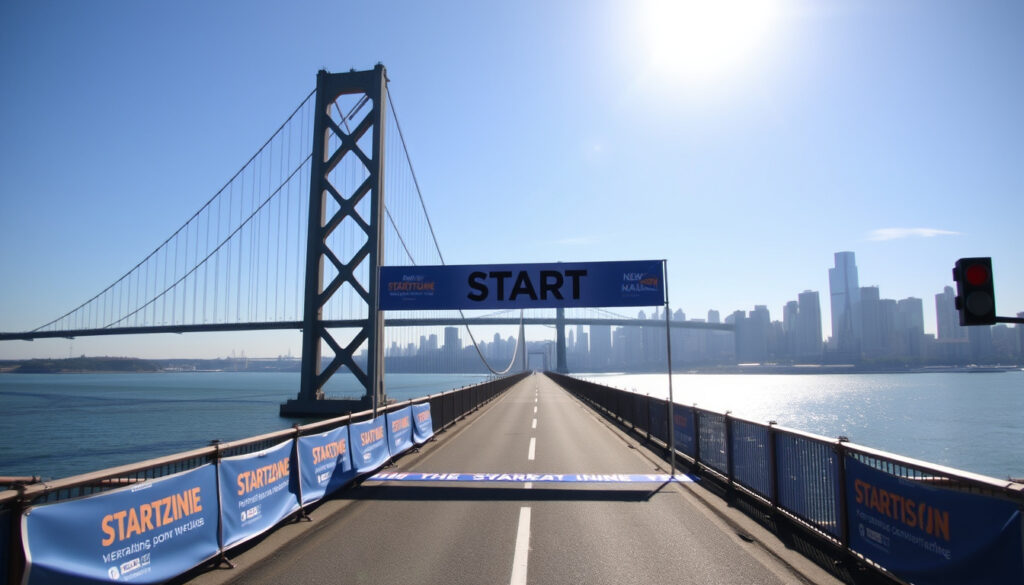
New York Marathon 2025: Date, Start Time, Qualifying, and Odds
Getting into the New York City Marathon has never been more competitive — or more possible. The 2025 race drew a record 59,226 finishers across a field that included lottery entrants, time qualifiers, and charity runners, reflecting how the event has grown beyond an elite competition into a mass-participation milestone.
Date: November 2, 2025 | Start Time: 8:00 AM | Finishers (2025): 59,226 | Final Finisher: 12:30 AM (November 3, 2025) | Distance: 26.2 miles
Race Day Essentials
- Date: November 2, 2025 — NYRR official race page
- Start Time: 8:00 AM — NYRR official race page
- Distance: 26.2 miles — Wikipedia
Record Participation
- 59,226 finishers in 2025 — NYRR official results
- Largest NYC Marathon ever — NYRR official statement
- Final finisher at 12:30 AM — NYRR results page
Entry Methods
- Lottery (10-15% acceptance) — NYRR drawing page
- Qualifying times by age/gender — NYRR time qualifiers
- Charity entries available — NYRR official site
Pacing Strategy
- 10-10-10 rule for even effort — Runner’s World guide
- Avoid hitting the wall — Runner’s World guide
- Adjust based on fitness — common marathon practice
The table below summarizes the key facts every runner needs for the 2025 race.
| Detail | Value | Source |
|---|---|---|
| Date | November 2, 2025 | NYRR official page |
| Start Time | 8:00 AM | NYRR official page |
| Finishers | 59,226 | NYRR official results |
| Final Finisher | 12:30 AM, November 3 | NYRR results page |
| Distance | 26.2 miles | Wikipedia |
| Lottery Acceptance | Approximately 10-15% | NYRR drawing page |
What time starts the New York Marathon 2025?
What is the NYC Marathon 2025 start time?
The 2025 TCS New York City Marathon starts at 8:00 AM on November 2, 2025. The first wave of runners, including elite athletes and wheelchair competitors, begins at Fort Wadsworth on Staten Island. Subsequent waves follow at staggered intervals based on projected finish times. NYRR official race page confirms the 8:00 AM start for the 2025 edition.
What time does the NYC Marathon officially end?
The official cutoff ends when the final finisher crosses the line in Central Park. For the 2025 race, the final official finisher, Juan Pablo, crossed at 12:30 AM on November 3, 2025, according to the NYRR results page. This means the marathon course remains open for approximately 16.5 hours from the 8:00 AM start. Runners who cannot maintain a minimum pace of roughly 15 minutes per mile may be asked to board sweep buses.
“Juan Pablo crossed the finish line at 12:30 AM on November 3, 2025, as the final official finisher of the 2025 NYC Marathon.” — @nycmarathon Instagram
The pattern: The 16.5-hour window accommodates walkers and slower runners, making the NYC Marathon one of the most inclusive major marathons in the world for finishers of all paces.
What date is the 2026 New York Marathon?
The 2026 New York City Marathon is scheduled for the first Sunday of November, which falls on November 1, 2026. While NYRR has not yet posted the official date on their website, the race has followed the first-Sunday tradition since 1976. NYRR official race page will confirm the 2026 date when registration opens.
When does registration open for the 2026 NYC Marathon?
Registration for the 2026 NYC Marathon will likely open in early 2026, following the pattern of previous years. For the 2025 race, the non-guaranteed general entry drawing ran from February 11 to February 25, 2025, as published on the NYRR drawing page. A similar timeline is expected for 2026, with an application window in February 2026.
What is the lottery schedule for 2026?
Based on the 2025 schedule, the lottery for the 2026 NYC Marathon will likely open in February 2026 and close later that month. The drawing took place after the application period ended, and results were announced in early March — in 2025, NYRR announced record demand on March 6. RRM reported that more than 200,000 applications were received for the 2025 drawing.
“We received more than 200,000 applications for the 2025 marathon drawing, reflecting unprecedented demand for participation in this iconic event.” — NYRR announcement, March 2025
What this means: Runners targeting the 2026 race should plan to apply in February 2026 and expect lottery results by early March, with odds likely similar to 2025 given the sustained surge in demand.
How fast do you have to run to qualify for the New York Marathon?
NYC Marathon qualifying times for 2025
NYRR maintains a marathon time qualifiers page that lists automatic qualifying standards. Runners who meet these times are not guaranteed entry — only the top 25 percent of non-NYRR qualifiers are accepted. According to a report from RRM, successful qualifiers typically need to beat the standard by at least 13 minutes and 20 seconds to secure a spot.
Age group qualifying standards
Qualifying times vary by age and gender. The standards below reflect NYRR published benchmarks for the 2025 cycle:
- Men 18-34: Marathon 2:51:00 or Half Marathon 1:19:00 — NYRR time qualifiers
- Men 35-39: Marathon 2:53:00 or Half Marathon 1:21:00 — NYRR time qualifiers
- Women and Nonbinary 18-34: Marathon 3:13:00 or Half Marathon 1:32:00 — Runner’s World guide
- Women and Nonbinary 35-39: Marathon 3:15:00 or Half Marathon 1:34:00 — Runner’s World guide
Older age groups have progressively slower standards. Full tables are available on the NYRR time qualifiers page.
Tip: Because only the top 25 percent of non-NYRR qualifiers are accepted, runners should aim to beat their age-group standard by at least 13 to 14 minutes. A time that barely meets the cutoff will likely not be sufficient.
How to submit a qualifying time
Runners who have run a certified marathon or half marathon within the qualifying window can submit their results through the NYRR time qualifier portal. Follow these steps:
- Run a certified marathon or half marathon at or below the NYRR standard for your age and gender group.
- Create or log in to your NYRR account on the NYRR time qualifiers page.
- Upload your official race results and verify that the race is USATF-certified or equivalent.
- Wait for NYRR to review and approve your qualifying time — this can take several weeks.
- If accepted, register during the designated qualifying entry period.
What are the odds of getting into the NYC Marathon?
How hard is it to get into the NYC Marathon?
Getting into the NYC Marathon is widely considered one of the toughest lottery processes among major marathons. For the 2025 race, RRM reported that NYRR received more than 200,000 applications for the drawing. With only 59,226 finishers in 2025, the acceptance rate for lottery applicants was approximately 10-15%, according to editorial analysis from The Independent.
Can a regular person run the NYC Marathon?
Yes. The NYC Marathon offers several pathways beyond the lottery. Charity runners, who raise funds for an official partner organization, receive guaranteed entry. In 2025, thousands of runners entered through charity teams. Time qualifiers who meet NYRR standards and are accepted also earn guaranteed spots. For a regular runner without a fast marathon time, the charity route is the most reliable option, though it requires a minimum fundraising commitment — typically between $2,500 and $5,000 depending on the organization. NYRR official site lists partner charities.
What are the chances of winning the lottery?
The lottery acceptance rate for the 2025 race was approximately 10-15%, based on the number of applicants and available spots. The drawing uses separate applicant pools for runners living in the New York City area, elsewhere in the United States, and outside the United States, as detailed by The Independent. This structure means that odds vary slightly by pool — local runners may have a marginally higher chance, though NYRR does not disclose exact pool-specific rates.
Warning: Be cautious of third-party services that claim to guarantee lottery entry. Only NYRR and its official charity partners can provide guaranteed entry. The lottery itself is free to enter; you pay only if selected.
What is the 10-10-10 rule for marathons?
How to pace a marathon using the 10-10-10 rule
The 10-10-10 rule is a pacing strategy designed to prevent early burnout and produce a strong finish. It splits the 26.2-mile race into three segments: run the first 10 miles at your goal pace, the next 10 miles 10 seconds slower per mile, and the final 10 kilometers at 10 seconds faster per mile. This approach helps conserve energy for the latter stages of the race, when fatigue typically sets in. Runner’s World guide describes the 10-10-10 rule as a practical framework for evenly distributed effort.
Why the 10-10-10 rule helps prevent hitting the wall
Hitting the wall — when glycogen stores run dry and the body shuts down — often results from starting too fast. The 10-10-10 rule forces a conservative early pace, allowing the body to burn fat more efficiently and delay glycogen depletion. By intentionally slowing during the middle segment, runners avoid the common trap of going out too fast in the first half. The final 10k acceleration then capitalizes on preserved energy. While the exact splits can be adjusted based on individual fitness and course conditions, the principle of negative splitting (running the second half faster than the first) is supported by multiple studies cited in endurance sports literature.
“The 10-10-10 rule is a pacing strategy designed to prevent early burnout and produce a strong finish.” — Runner’s World guide
The pattern: Runners who apply the 10-10-10 rule consistently report fewer late-race slowdowns and more even overall times compared to those who start at a pace they cannot sustain.
What We Know and What’s Still Unclear
The following lists summarize confirmed facts and areas where details remain uncertain for the 2025 and 2026 NYC Marathon.
Confirmed Facts
- The 2025 race date was November 2, 2025 — NYRR official page
- The start time was 8:00 AM — NYRR official page
- The finisher count was 59,226 — NYRR official results
- The final finisher crossed at 12:30 AM on November 3, 2025 — NYRR results page
What’s Still Unclear
- Exact official cutoff time for the marathon — the 16.5-hour window is derived from the final finisher time, not a posted policy
- 2026 race date (first Sunday in November is November 1, but not yet officially confirmed by NYRR)
- Lottery acceptance rate for 2026 — will likely be similar to 2025’s 10-15%, but no official projection exists
- Whether the qualifying standards will change for the 2026 cycle
- The exact number of charity entries available for 2026
- Whether the lottery pool structure will be adjusted for 2026
The pattern: Most of the unclear items center on the 2026 cycle, which NYRR will likely clarify when registration opens in early 2026.
Related reading: **Dublin Marathon 2025 Route**
run247.com, nyrr.org, marathons2025.com, reddit.com, nyrr.org, marathons2025.com, nyrr.org, worldmarathoner.com, ptairsupply.com
Frequently Asked Questions
How do I register for the NYC Marathon 2025?
Registration for the 2025 race is now closed. The non-guaranteed general entry drawing ran from February 11 to February 25, 2025. For future races, create an NYRR account and apply during the designated drawing window in early race year.
What is the charity entry process?
Charity runners commit to raising a minimum amount — typically $2,500 to $5,000 — for an official NYRR partner organization. In return, they receive guaranteed entry. Apply through the charity’s portal on the NYRR website.
What is the course elevation profile?
The NYC Marathon course features rolling hills, including the infamous Queensboro Bridge and the climb into Central Park. Total elevation gain is approximately 820 feet, with the steepest sections in the first half of the race.
Is there a time limit for finishing the NYC Marathon?
There is no published time limit, but runners must maintain a pace that allows them to finish before the course closes. The final official finisher in 2025 crossed at 12:30 AM, about 16.5 hours after the start. Runners falling behind the pace of the last official finisher may be directed to sweep buses.
Can I transfer my entry to another runner?
No. NYRR does not allow bib transfers or entry transfers. Each runner must register under their own name. Attempting to transfer or sell a bib may result in disqualification and a ban from future NYRR events.
What should I wear for the NYC Marathon?
Weather in early November in New York can range from 40°F to 60°F. Layering is recommended: a moisture-wicking base layer, running shorts or tights, and a lightweight jacket if rain is forecast. Most runners wear a singlet and shorts or capris.
Where does the marathon start and finish?
The race starts at Fort Wadsworth on Staten Island and finishes in Central Park near West 67th Street. The 26.2-mile course passes through all five boroughs: Staten Island, Brooklyn, Queens, the Bronx, and Manhattan.
More related posts
 Things to Do in Dublin This Weekend: Culture, Food & Outdoors
 Liverpool F.C. vs PSV Eindhoven Standings: Head-to-Head
 5 Feet to cm: 152.4 cm Exact Height Conversion Guide
 Task (Miniseries): Episodes, Cast, and Season 2 Status
 Treaty United vs Dundalk: Complete Match Analysis
 Taylor Sheridan Movies and TV Shows: Complete List
 What to See in Dublin: Top Attractions, Itineraries & Local Tips
 World Book Day Ireland 2026: Date, Tokens and Books