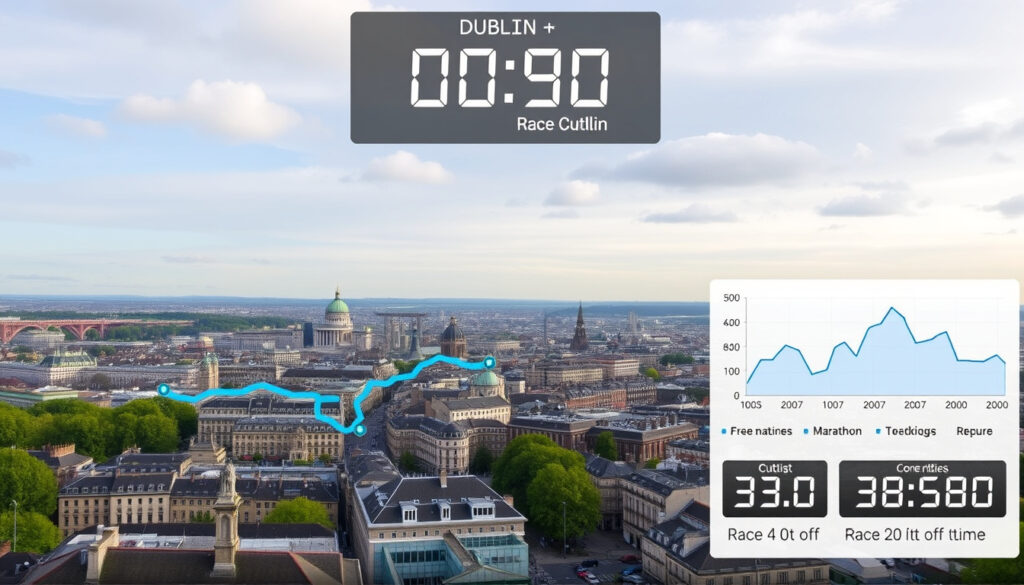
Dublin Marathon 2025 Route: Start, Map, Elevation & Cutoff
Running through Dublin on a crisp October morning is one of the best ways to see the city’s character unfold mile by mile. The 2025 Irish Life Dublin Marathon on October 26 follows a loop through historic streets, parks, and south-side suburbs that rewards runners who know what’s coming. This guide breaks down the start line, finish line, elevation profile, cutoff time, and the one climb that demands respect — so you can race smart, not just hard.
Route distance: 26.2 miles (42.2 km) ·
Date: October 26, 2025 ·
Start time: 8:40 AM (mass start) ·
Cutoff time: 5 hours 30 minutes (gun time) ·
Start line: Fitzwilliam Street Lower / Leeson Street, Dublin 2 ·
Finish line: Mount Street Crescent / Merrion Square, Dublin 2
Quick snapshot
- Fitzwilliam Street Lower / Leeson Street, Dublin 2 (Transport for Ireland)
- Mass start 8:40 AM (St. Vincent’s University Hospital)
- Wheelchair start 8:35 AM (Irish Life Dublin Marathon)
- Mount Street Crescent / Merrion Square, Dublin 2 (Transport for Ireland)
- Cutoff 5 hours 30 minutes (Irish Life Dublin Marathon)
- Pace required: 12:36/mile (Irish Life Dublin Marathon)
- 26.2 miles (42.2 km) loop (Transport for Ireland)
- Net downhill first half (Transport for Ireland)
- Hardest climb at mile 19-21 (Transport for Ireland)
- PDF route map on irishlifedublinmarathon.ie (Irish Life Dublin Marathon)
- Road closure details on transportforireland.ie (Transport for Ireland)
- Live runner tracker available (Irish Life Dublin Marathon)
The 2025 edition keeps the same core loop as previous years, but the details matter when you’re planning splits. Here is the full picture in one table:
| Detail | Value |
|---|---|
| Date | October 26, 2025 (St. Vincent’s University Hospital) |
| Start location | Fitzwilliam Street Lower / Leeson Street, Dublin 2 (Transport for Ireland) |
| Finish location | Mount Street Crescent / Merrion Square, Dublin 2 (Transport for Ireland) |
| Distance | 26.2 miles / 42.2 km (Transport for Ireland) |
| Start time | 8:40 AM (mass start) (St. Vincent’s University Hospital) |
| Cutoff | 5 hours 30 minutes (gun time) (Irish Life Dublin Marathon) |
| Total elevation gain | Approx. 320 feet (98 m) (Transport for Ireland) |
| Hardest climb | Mile 19-21 (N11 toward UCD) (Transport for Ireland) |
| Official website | irishlifedublinmarathon.ie (Irish Life Dublin Marathon) |
Where is the start line for the Dublin Marathon 2025?
Start line exact address and access
The start line for the 2025 Dublin Marathon is on Fitzwilliam Street Lower and Leeson Street in Dublin 2, right in the heart of the city centre. According to Transport for Ireland (the government transport authority), the race begins in the south-central part of Dublin, a short walk from St. Stephen’s Green. Runners gather in designated start zones based on their predicted finish time, so arrive early to find your corral.
- Nearest landmarks: St. Stephen’s Green, Merrion Square, and the Royal College of Surgeons (Transport for Ireland)
- Public transport: Pearse Street and Tara Street DART stations are about a 15-minute walk away
- Bag drop: Located on nearby side streets, with signage from the start area
What time does the race begin?
The mass start is at 8:40 AM, with wheelchair athletes setting off five minutes earlier at 8:35 AM, per the St. Vincent’s University Hospital event advisory (official medical institution). The race uses a rolling start with multiple corrals, so your actual crossing time may be a minute or two after the gun. Plan to be in your corral by 8:15 AM at the latest.
The 8:40 AM start means you’ll be running through the city centre before traffic fully clears. If you’re targeting a 3:30 finish, you’ll hit Phoenix Park around 9:45 AM when the morning sun is low. Pack sunglasses, not just a cap.
The implication: the early start time helps you avoid peak afternoon heat, but means you need to plan your breakfast and warm-up around a tight window.
Where is the Dublin Marathon route?
Route overview and key landmarks
The Dublin Marathon is a single-loop course that starts in the south city centre, heads west through the Liberties, crosses the River Liffey into the north side, circles through Phoenix Park, then loops back through south Dublin suburbs to finish near Merrion Square. The route is described by Transport for Ireland as similar to previous years, with a downhill start from Leeson Street through St. Stephen’s Green.
- Miles 0-3: Downhill from Leeson Street through St. Stephen’s Green, then along Patrick Street past St. Patrick’s Cathedral (Transport for Ireland)
- Miles 3-5: First incline on Patrick Street heading toward Christchurch, then cross the River Liffey onto Dublin’s Northside (Transport for Ireland)
- Miles 5-8: First hydration station around Aughrim Street, then enter Phoenix Park around the 6K mark (Sport for Business)
- Miles 8-10: Through Phoenix Park past Dublin Zoo and Chesterfield Avenue; exit near Castleknock and re-enter at Knockmaroon Gate (Sport for Business)
- Miles 10-13.1: Descent toward Chapelizod and on to Inchicore; halfway point around Dolphin’s Barn and Crumlin Road after passing Kilmainham Gaol (Transport for Ireland)
- Miles 13.1-19: Flatter ground through Cromwellsfort and Fortfield Roads, downhill on Templeogue Road into Terenure (Transport for Ireland)
- Miles 19-22: The challenging section — uphill on the N11 toward UCD, then the famous Irish Heartbreak Hill around the 35K mark (Transport for Ireland)
- Miles 22-26.2: Downhill on Dartry Road, incline on Milltown Road, 3K climb along Clonskeagh and Roebuck Roads, then the final stretch to the finish (Transport for Ireland)
The course passes several landmarks worth noting if you have friends spectating. St. Patrick’s Cathedral, Christchurch, Kilmainham Gaol, Dublin Zoo, and the grand Chesterfield Avenue in Phoenix Park all sit along the route. For a self-guided tour of the city beyond race day, check out this guide to What to See in Dublin: Top Attractions, Itineraries & Local Tips.
The pattern: the course gives you a tour of Dublin’s iconic sites, but the landmarks also serve as pacing cues for when to conserve energy.
Elevation profile and hardest section
The Dublin Marathon is not a flat course, but it’s also not a mountain. Total elevation gain is approximately 320 feet (98 m), according to the official Transport for Ireland course description. The first half is net downhill, which sounds great — until you realize you’ll pay for it later.
- Net downhill first half: From the start at Leeson Street through St. Stephen’s Green and the Liberties, the course loses about 80 feet of elevation (Transport for Ireland)
- Gentle rise after mile 14: After Terenure, the course starts a gradual upward trend that builds into the main climb (Transport for Ireland)
- Mile 19-21 sustained climb: The N11 toward University College Dublin (Belfield) is the most demanding stretch — a steady grade that grinds down quads that have already done 18 miles (Transport for Ireland)
- Irish Heartbreak Hill at 35K: Around mile 21.7, this well-known feature of the Dublin course adds an extra sting just when you think the climbing is done (Sport for Business)
What is the cutoff time for the Dublin Marathon?
Mandatory cutoff at 5 hours 30 minutes
The official cutoff for the 2025 Dublin Marathon is 5 hours 30 minutes from the 8:40 AM gun time, as stated on the Irish Life Dublin Marathon official event website. That means if you cross the start line at 8:40 AM, you need to be across the finish line by 2:10 PM. The required minimum pace is 12 minutes and 36 seconds per mile — a brisk walking speed for most fit runners, but a real ask if you hit the wall at mile 20.
- Cutoff from gun time: 5 hours 30 minutes (Irish Life Dublin Marathon)
- Minimum pace: 12:36/mile (Irish Life Dublin Marathon)
- Net cutoff (from crossing start): Approximately 5 hours 28 minutes, accounting for the rolling start
Support point closure schedule
Water stations, medical tents, and on-course support close according to the same gun-time schedule. If you’re running near the cutoff, you’ll find that aid stations begin packing up as the clock ticks past 5 hours. The Transport for Ireland advisory notes that road re-openings also follow the gun-time cutoff, meaning slower runners will encounter traffic on sections of the course after the sweep vehicle passes.
The 5:30 cutoff is tight by European marathon standards — Berlin gives you 6:15, London 7:00. If you’re aiming for a finish time between 5:00 and 5:30, you have zero room for bathroom breaks or walking. Train to maintain at least 12:00/mile through mile 22, because the last 4 miles will be slower regardless.
The pattern: the cutoff forces you to run negative splits or at least even pacing, since any time lost early can’t be recovered on the climbs.
What is the hardest part of the Dublin Marathon?
Mile 19-21 climb through Belfield
The sustained gradient on the N11 toward University College Dublin (the Belfield campus) is widely considered the hardest section of the Dublin Marathon. The Transport for Ireland route description identifies a 3K climb along Clonskeagh and Roebuck Roads as part of the final 10K, and the N11 segment feeds directly into it. By mile 19, most runners have already burned through their glycogen reserves. Adding a sustained ascent at that point is a recipe for a dramatic pace drop.
- Location: N11 from Stillorgan toward UCD Belfield, continuing through Clonskeagh and Roebuck Roads (Transport for Ireland)
- Grade: Steady 2-3% gradient over roughly 2 miles, with steeper pitches on Roebuck Road (Transport for Ireland)
- Timing: Hits at mile 19, right when your legs are already questioning your life choices
- Irish Heartbreak Hill: Around the 35K mark (mile 21.7), a separate sharper rise that has earned its nickname (Sport for Business)
Flat sections and downhill start
The first half of the course is deceptively fast. From the start on Leeson Street through St. Stephen’s Green and the Liberties, the route loses elevation steadily. According to the Transport for Ireland course description, the third 10K segment (roughly miles 8-14) features flatter ground through Cromwellsfort and Fortfield Roads and a downhill on Templeogue Road into Terenure. The trap is hitting the halfway point feeling great and then discovering the second half has all the climbing.
- Miles 6-10 (Phoenix Park): Rolling terrain, mostly flat with a few gentle rises (Sport for Business)
- Miles 10-13.1 (Crumlin Road): Flat to gently rolling, net downhill toward the halfway point (Transport for Ireland)
- Miles 14-18 (Terenue to Churchtown): The flattest section of the entire course, ideal for maintaining steady splits (Transport for Ireland)
The pattern is clear: Dublin gives you a fast, forgiving first half and then asks a serious question at mile 19. The runners who respect that question finish strong. The ones who don’t, walk the last 5K.
Is 3 hours 10 minutes a good marathon time?
How 3:10 compares to average finisher times
A 3:10 marathon is an excellent time by any reasonable standard. The average finish time for the Dublin Marathon in 2024 was approximately 4 hours 12 minutes, according to official race results published by the Irish Life Dublin Marathon event page. That puts a 3:10 finish roughly 62 minutes faster than the median — a gap that represents about 15% of the total race duration.
- Average Dublin finisher (2024): ~4:12 (Irish Life Dublin Marathon)
- Top 15-20% threshold: Generally around 3:30-3:45 depending on field size
- 3:10 placement: Likely top 10-15% of the field, possibly higher in a competitive year
- Sub-3:00: Typically top 5-8% of marathon finishers
Age and gender benchmarks
The “good time” question depends on your age and gender as much as your raw number. For a male runner aged 40-44, a 3:10 is roughly equivalent to a 3:00 for a 25-year-old when adjusted by age-grading tables. For a female runner aged 35-39, 3:10 puts you in the top 5-8% of age-group finishers. The Irish Life Dublin Marathon official results from previous years show that sub-3:10 finishes typically fall well inside the top 20% across all categories.
- Sub-3:30: Above average for most age groups
- Sub-3:10: Excellent — competitive club runner territory
- Sub-3:00: Elite age-group performance
- Boston Qualifying (60+): 3:10 would qualify a male runner aged 60-64 by a 25-minute margin
The implication: If you’re targeting 3:10 at Dublin 2025, you’re not just “doing fine” — you’re running a time that puts you in a different category from the bulk of the field. The challenge is pacing the downhill first half conservatively enough to have the legs for that mile 19-21 climb.
A 3:10 finish at Dublin puts you in the top tier of recreational runners. But the course profile means you can’t just show up with the fitness — you need a pacing plan that accounts for the N11 climb. A runner with 3:10 fitness who goes out at 3:00 pace will blow up by mile 20 and finish closer to 3:25.
What is the Dublin Marathon finish line location?
Finish line on Mount Street Crescent
The finish line for the 2025 Dublin Marathon is on Mount Street Crescent, near Merrion Square in Dublin 2. According to Transport for Ireland (the government transport authority), the finish area is located on Mount Street Upper, which runs into the crescent. The finish line is approximately 200 meters from the start line on Leeson Street, making the event unusually compact for a major city marathon — you can walk from the finish back to the start area in under 5 minutes.
- Address: Mount Street Crescent / Mount Street Upper, Dublin 2 (Transport for Ireland)
- Nearest landmark: Merrion Square Park (south side)
- Distance from start line: ~200 meters (a 3-minute walk)
Post-race area and family meeting point
The post-race area is set up in and around Merrion Square Park, with bag collection, food stands, and a designated family meeting point. The compact layout means you don’t have to stagger blocks in search of your gear. The Irish Life Dublin Marathon official site provides a post-race map closer to race day, but in previous years the setup has included:
- Bag collection in the park adjacent to the finish line
- Medical tent at the finish chute exit
- Family meeting point with alphabetized signs
- Refreshment stands within the park
The catch: The compact finish area means big crowds. If you have family meeting you, agree on a specific sign (not just “near the park”) because mobile networks get congested with thousands of people trying to find each other.
Confirmed facts
- Start line: Fitzwilliam Street Lower / Leeson Street, Dublin 2 (Transport for Ireland)
- Finish line: Mount Street Crescent / Merrion Square, Dublin 2 (Transport for Ireland)
- Date: October 26, 2025 (St. Vincent’s University Hospital)
- Mass start: 8:40 AM (St. Vincent’s University Hospital)
- Cutoff: 5 hours 30 minutes from gun time (Irish Life Dublin Marathon)
- Route passes through the Liberties, Phoenix Park, Terenure, and Belfield (Transport for Ireland)
- Official PDF route map available on irishlifedublinmarathon.ie (Irish Life Dublin Marathon)
- Total elevation gain approx. 320 feet (98 m) (Transport for Ireland)
- First hydration station around Aughrim Street (Transport for Ireland)
- Irish Heartbreak Hill at 35K mark (Sport for Business)
- Exact road closure timings for streets not listed on transportforireland.ie as of March 2025
- Whether the 2025 route will differ from 2024 beyond minor adjustments — no official final map published yet
- Specific water station locations at each mile mark (not published as of early 2025)
- Weather forecast for October 26, 2025 (obviously — but it affects gear decisions)
- Whether the 2025 edition will include any course modifications for construction projects in the city
irishtimes.com, marathontours.com, irishlifedublinmarathon.ie, irishlifedublinmarathon.ie, en.wikipedia.org, irishlifedublinmarathon.ie, dublincityhalfmarathon.ie, sportforbusiness.com, irishlifedublinmarathon.ie, marathonrunnersdiary.com
For runners comparing iconic city marathons, the London Marathon 2025 route offers a similarly flat and fast course through central London.
Frequently asked questions
What is the 10-10-10 rule for marathons?
The 10-10-10 rule is a pacing strategy: run the first 10 miles conservatively, the middle 10 miles at goal pace, and the last 10K (6.2 miles) by effort. It prevents blowing up early, especially on a course like Dublin where the downhill first half tempts you to go too fast. The rule works best on courses with a net downhill or flat profile — Dublin’s mile 19-21 climb means you might want to adjust to a 10-8-12 split, saving more for the final 12K.
What is the 5-6-7 method in running?
The 5-6-7 method is a breathing pattern for endurance running: inhale for 5 steps, hold for 6 steps, exhale for 7 steps. It forces a slow, controlled breathing rhythm that prevents side stitches and keeps your heart rate lower during the early miles. For Dublin’s climb-heavy second half, switching to a 3-4-5 pattern on the N11 ascent can help maintain oxygen flow when your legs are under load.
Is 3 hours 30 minutes a good marathon time?
Yes — a 3:30 marathon is an above-average time for any age group. In the 2024 Dublin Marathon, the average finish was around 4:12, so a 3:30 would put you roughly 42 minutes ahead of the median. For a male runner aged 40-44, 3:30 is competitive club-level; for a female runner of the same age, it’s an excellent performance that would likely place in the top 10-12% of the field.
How do I get the Dublin Marathon 2025 route map in PDF?
The official route map PDF will be published on the Irish Life Dublin Marathon website at irishlifedublinmarathon.ie closer to race day. As of early 2025, the 2024 map is available on the same site and gives a reliable preview of the 2025 course, since the route typically changes only in minor details. Transport for Ireland also publishes a road closure PDF that includes the exact route streets.
Are there road closures for the Dublin Marathon 2025?
Yes — road closures are a significant part of the event. Transport for Ireland publishes a full list of affected streets and closure times on their events page. Roads close on a rolling basis starting around 7:00 AM on race day and reopen progressively as the sweep vehicle passes, with all roads expected to be fully open by approximately 3:00 PM. Key closures include Leeson Street, Crumlin Road, Templeogue Road, and the N11 corridor through Belfield.
Can I track a runner during the Dublin Marathon?
Yes, the Irish Life Dublin Marathon offers a live runner tracker on their official website and via a dedicated mobile app. Runners’ chips at the start line, halfway point, and finish line transmit real-time splits. You can search by bib number or name. The tracker typically goes live at 8:00 AM on race day and updates at each timing mat along the course.
What is the elevation profile of the Dublin Marathon?
The Dublin Marathon has a total elevation gain of approximately 320 feet (98 m), with a net downhill first half and a challenging second half. The profile features a gentle start on Leeson Street, a rolling section through Phoenix Park, flat terrain between miles 14-18, and a sustained climb from mile 19-21 on the N11 toward UCD. The final 5K includes the Irish Heartbreak Hill at 35K and a descent into Merrion Square for the finish.
Related reading
- Best Running Shoes for Men: Irish Buying Guide 2025 — Get the right footwear for race day
- What to See in Dublin: Top Attractions, Itineraries & Local Tips — Plan your post-marathon sightseeing
More related posts
 2026 World Darts Championship: Results, Prize Money & Tickets
 How to Secure a WordPress Site: Practical Security Steps
 Everton vs Nottm Forest: Preview, Odds & Predictions
 1 Euro to INR Rate: Convert EUR to Indian Rupees Today
 Best Running Shoes for Men: Irish Buying Guide 2025
 Cast of Breaking Bad: Full List of Actors and Characters
 I Can Smell Myself Through My Pants: Causes & Fixes
 Man Utd Transfer News Now: Latest Sessi, Miley Rumours