Trinity College Dublin Book of Kells: Tickets & Visitor Guide
If you’ve ever seen an image of the Long Room at Trinity College Dublin and wondered whether it really was the Hogwarts library, you’re not alone. That grand hall—with its barrel-vaulted ceiling, marble busts, and 200,000 early printed books—is the gateway to Ireland’s most precious manuscript, the Book of Kells.
Created: c. 800 AD · Origin: Iona, Scotland / Kells, Ireland · Material: Vellum (calfskin) · Folios: 340 · Annual visitors: Over 1 million · Location: Trinity College Library, Dublin
Quick snapshot
- 9th-century illuminated gospel manuscript on vellum (Trinity College Dublin Official Library)
- Tickets required for all visitors (Trinity College Dublin Official Booking Site)
- No Harry Potter scenes filmed inside Trinity College (Trinity College Library (Harry Potter myth page))
- Which specific monks created the manuscript — likely Iona monastery but not certain (Wikipedia (encyclopedic overview))
- Exact date of later repairs and rebinding not fully documented (Trinity College Dublin Official Library)
- Created c. 800 AD — one of the oldest surviving illuminated manuscripts in Europe (Trinity College Dublin Official Library)
- Moved from Iona to Kells in the 9th century due to Viking raids (Wikipedia (encyclopedic overview))
- Demand for advance tickets continues to rise — book 2-4 weeks ahead in peak season (Trinity College Dublin Official Booking Site)
- New immersive exhibition (Book of Kells Experience) launched 2023, lasting 90 minutes (Trinity College Dublin Official Booking Site)
What is the Book of Kells in Trinity College Dublin?
A 9th-century gospel manuscript
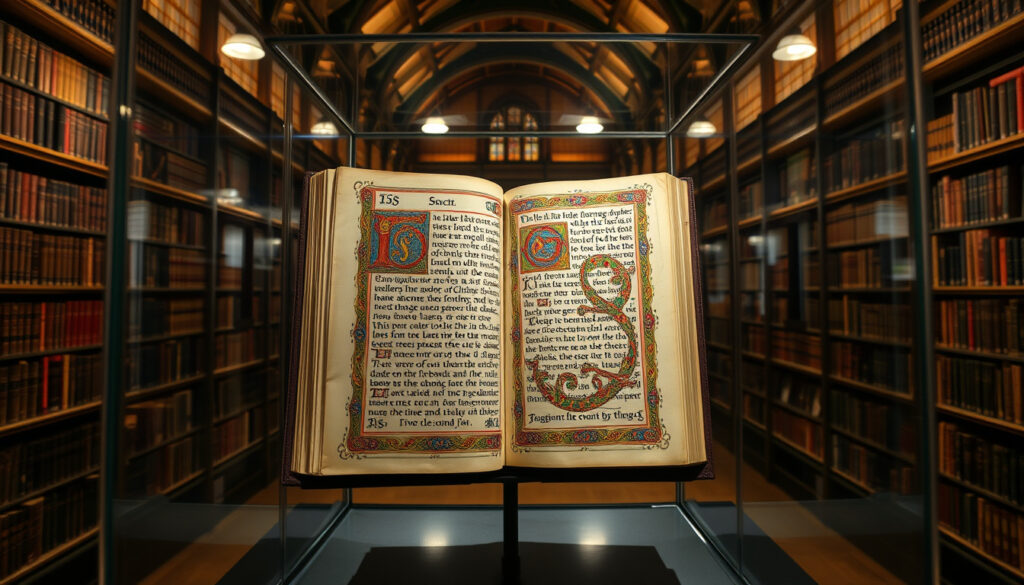
The Book of Kells is an illuminated manuscript of the four Gospels of the New Testament in Latin, created around 800 AD. It was produced by Celtic monks—likely at the monastery of Iona in Scotland—and later moved to Kells in County Meath for safety during Viking raids (Trinity College Dublin Official Library). The manuscript is written on vellum (calfskin) and contains 340 folios (Wikipedia (encyclopedic overview)).
- Four Gospels: Matthew, Mark, Luke, John
- Latin text with lavish decoration
- Used for ceremonial purposes—not daily reading
The trade-off: the same fragility that makes it precious also means you see only two pages at a time, on rotation.
Contents and artistry
The manuscript is famous for its intricate illumination: interlaced patterns, animal forms, human figures, and elaborate initials. The Chi Rho page—depicting the first two letters of Christ’s name in Greek—is widely considered one of the finest examples of medieval European art (Visit Dublin Official Tourism).
- Every page is decorated—no two are the same
- Includes full-page illustrations of the Evangelists and their symbols
- Color pigments: ultramarine (lapis lazuli), vermilion, gold leaf
Why this matters: this is not a dry religious text but a masterpiece of design that influenced later Celtic and Insular art across Europe.
Why is the Book of Kells so famous?
Masterpiece of illumination
The Book of Kells is widely regarded as one of the most richly decorated manuscripts to survive from the early medieval period. Its ornamentation includes intricate interlacing, zoomorphic forms, and detailed initials—all executed with precision that modern calligraphers still study (Wikipedia (encyclopedic overview)).
The manuscript’s reputation as a pinnacle of Insular art is not hype: fewer than 50 fully illuminated gospel manuscripts survive from this period, and the Book of Kells is the most ornate of them all.
Historical significance
The manuscript is considered Ireland’s national treasure, attracting more than one million visitors each year (Trinity College Dublin Official Booking Site). Its survival across 1,200 years—through Viking raids, theft attempts, and the dissolution of monasteries—makes it an object of remarkable resilience.
- First recorded at Kells Abbey in 1541
- Presented to Trinity College Dublin in 1661 by Henry Jones
- First exhibited publicly in the 1800s
The implication: the Book of Kells is simultaneously a work of art, a historical document, and a symbol of Irish cultural identity—a rare triple role that few artifacts anywhere can claim.
Do you need tickets to see the Book of Kells at Trinity College?
Ticket types and pricing
Yes, tickets are required for all visitors. Two main options exist (Trinity College Dublin Official Booking Site).
The price gap reflects a real difference in experience depth.
| Ticket type | Price (from) | Duration | What’s included |
|---|---|---|---|
| Book of Kells & Old Library | €19 | 45 minutes | Manuscript display + Long Room access |
| Book of Kells Experience | €25.50 | 90 minutes | Immersive digital exhibition + manuscript + Old Library |
| Student/Senior concession | ~€17–€23 | Same as above | Valid ID required |
The pattern: the Experience version costs about a third more but triples your time—worth it if you want context, less so if you’re in a hurry.
Where to buy tickets
Online booking is strongly recommended and often required during peak months (May–September). Official tickets are sold through visittrinity.ie. Common reseller markups can add 30–50% to the price, so stick to the official site (Trinity College Dublin Official Booking Site).
- Walk-up sales: limited same-day tickets available, but often sold out by 11 am
- Wheelchair users: accessible via College Street entrance
- No photography allowed in the manuscript display room
Opening hours and best time to visit
Hours vary by season (Trinity College Dublin Official Booking Site, LaidBack Trip Travel Guide (tier2 guide)).
The seasonal shift reveals a clear strategy: longer hours when crowds are heaviest.
| Season | Monday–Saturday | Sunday | Last entry |
|---|---|---|---|
| April–September | 8:30 am – 6:30 pm | 9:30 am – 5:00 pm | 30 min before close |
| October–March | 9:30 am – 5:00 pm | 12:00 pm – 4:30 pm | 30 min before close |
| Christmas holiday | Closed Dec 24–27, Jan 1 | Limited hours | Check website |
The catch: peak season crowds mean 30–45 minute queues for the manuscript room. Go at 8:30 am or after 4:00 pm for the shortest wait.
Ticket resellers often show “sold out” to push marked-up third-party options. As of June 2025, official tickets remain available for advance dates on the Trinity site—check there first before paying a premium.
Was Harry Potter filmed in the Trinity Library?
Myth vs. reality of Harry Potter filming at Trinity
No scenes from the Harry Potter films were shot inside Trinity College Library. This is one of the most persistent myths in Dublin tourism, likely fueled by the visual resemblance between the Long Room and the Hogwarts library set (Trinity College Library (Harry Potter myth page)).
- No film crew from any Harry Potter production visited Trinity College
- The Hogwarts library scenes were built at Leavesden Studios, England
- The Long Room was used as a reference for concept artists, not as a set
The Long Room as inspiration
While not a filming location, the Long Room’s design did influence the Hogwarts library concept. The room itself holds 200,000 early printed books and is one of the most photographed library interiors in the world (Trinity College Dublin Official Library).
The irony: the actual filming location myth hurts the Long Room’s own credibility. It doesn’t need Potter associations—it remains one of the finest surviving 18th-century library interiors in Europe.
Is the Book of Kells worth it?
Visitor reviews and experience
Online reviews on platforms like TripAdvisor and Google Maps consistently rate the visit 4.0–4.5 stars, with the Old Library (Long Room) often cited as the highlight—more so than the manuscript itself (Trinity College Dublin Official Booking Site).
Many visitors rank the 5-minute manuscript viewing as “underwhelming” but the Long Room as “breathtaking”—making the combined ticket a split experience where one half justifies the other.
What you get with your ticket
The standard ticket includes:
- The Book of Kells Experience exhibition (digital multimedia show)
- The manuscript itself (two pages on display, rotated regularly)
- The Long Room with its 200,000 books, marble busts, and the original 1916 Proclamation of the Irish Republic
The Experience add-on includes a 9th-century virtual reality tour and a projection gallery—engaging for first-time visitors but skippable for repeat guests.
Alternatives if time is limited
- For history lovers: the standard ticket is essential—the manuscript is irreplaceable
- For casual tourists: 45 minutes is enough to see both manuscript and Long Room
- For cost-conscious visitors: skip the Experience add-on; the standard ticket gives you the core experience
- For Harry Potter fans: the Long Room alone is worth the visit—even without the films
Upsides
- Unparalleled access to a 1,200-year-old illuminated manuscript
- Long Room is genuinely stunning on its own merits
- Convenient central Dublin location
- Ticket includes optional multimedia exhibition for context
- Well-organized queue system with timed entry slots
Downsides
- High cost for the brevity of the manuscript viewing
- Peak season queues can exceed 45 minutes
- No photography allowed in manuscript room
- Experience add-on feels thin for the price delta
- Reseller confusion online—tourists overpay frequently
Timeline: 1,200 years of the Book of Kells
- c. 800 AD — Created by Celtic monks on Iona, Scotland (Trinity College Dublin Official Library)
- 9th century — Moved to Kells, Ireland, for safety from Viking raids (Wikipedia (encyclopedic overview))
- 1541 — First recorded mention at Kells Abbey
- 1661 — Presented to Trinity College Dublin by Bishop Henry Jones
- 1800s — First public exhibition at Trinity College Library after restoration
- 1953 — Facsimile editions published for broader access
- 2023 — Book of Kells Experience immersive exhibition launches
The pattern: this manuscript has survived Viking pillaging, English reformation, theft attempts, and 1,200 years of humidity—each move and display change has risked its destruction, and yet it remains.
“The Book of Kells is the most precious object of the Western world. In the world of illuminated manuscripts, it’s the Mona Lisa.”
— Trinity College Dublin Library (official manuscript description)
“The Long Room is one of the most beautiful libraries in the world. It’s not just a tourist attraction—it’s a working research library that houses 200,000 early printed books.”
— Visit Trinity (official visitor site)
For a visitor who cares about both history and value, the choice is clear: book the standard ticket in advance, arrive by 9 am on a weekday, and spend 30 minutes in the Long Room absorbing the quiet grandeur. The Book of Kells will be there—it has been for 1,200 years—but seeing it in a calm hour is worth the extra planning.
Related reading: What to See in Dublin
Frequently asked questions
What is the best time to visit the Book of Kells to avoid crowds?
Weekday mornings at 8:30 am (April–September) or 9:30 am (October–March) are the quietest slots. Avoid weekends and school holidays. The last two hours before closing also see reduced footfall (Trinity College Dublin Official Booking Site).
Can I take photos of the Book of Kells?
No. Photography is strictly prohibited in the manuscript display room to protect the vellum from light exposure. Flash photography is never allowed. You may take photos in the Long Room without flash (Trinity College Dublin Official Booking Site).
How long does the Book of Kells Experience last?
The Experience lasts 90 minutes total: 30 minutes for the multimedia exhibition, 10–15 minutes viewing the manuscript, and remainder exploring the Long Room (Trinity College Dublin Official Booking Site).
Is the Book of Kells accessible for wheelchair users?
Yes. The main entrance via College Street is accessible. The Old Library and manuscript room are at ground level. There is a lift available for the Experience exhibition (Trinity College Dublin Official Booking Site).
Are there discounts for students or seniors for Book of Kells tickets?
Yes. Student and senior concession tickets cost approximately €17–€23 depending on the ticket type. Valid photo ID is required at entry (Trinity College Dublin Official Booking Site).
Can I see the Book of Kells without a tour?
Yes. All tickets are self-guided. No guided tour is required or included. Audio guides and multimedia displays provide context (Trinity College Dublin Official Booking Site).
What else is in the Long Room besides the books?
Marble busts of great thinkers, the 1916 Proclamation of the Irish Republic, a 15th-century harp (the model for Ireland’s national symbol), and the original Book of Durrow (Trinity College Dublin Official Library).
More related posts
 Assistant Attorney General Rhode Island: Devon Flanagan
 Pirates of the Caribbean 2: Dead Man’s Chest – Full Guide & Facts
 Happy Gilmore 2 Release Date: July 25, 2025 on Netflix
 Ryanair Digital Boarding Passes – Complete Guide 2025
 Liverpool Airport to City Centre: Bus, Taxi & Train Options
 Marks and Spencers Dublin: Grafton and Mary Street Guide
 Is Heel Pain a Sign of Cancer? Red Flags & When to Act
 How to Create a New Gmail Account: Step-by-Step Guide