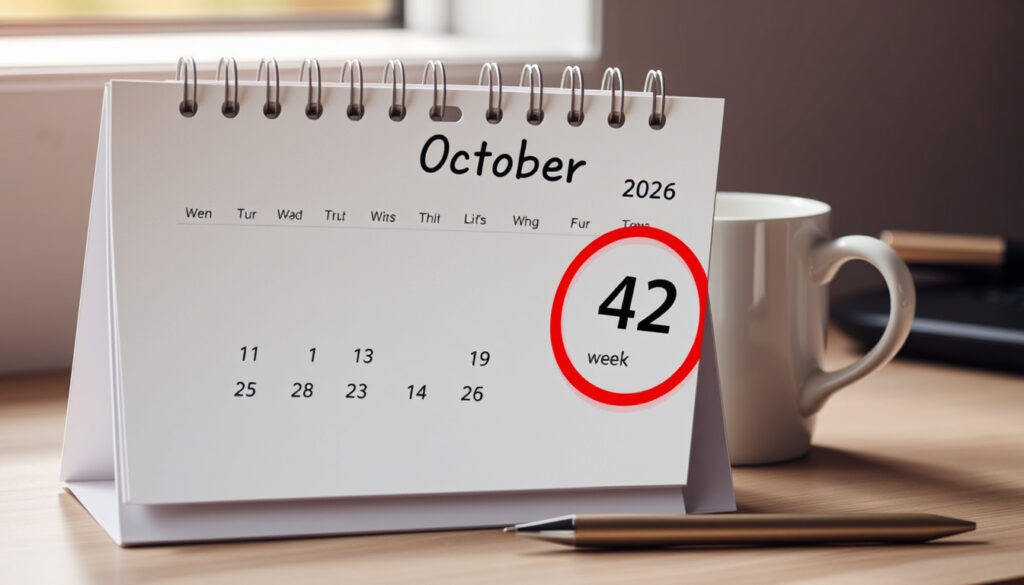
What week number is it? Current week 42 in 2026 (ISO & US)
Anyone who’s booked a flight, filed a timesheet, or checked a pregnancy app has hit the same puzzle: what week of the year is it? As of Saturday, October 17, 2026, ISO calendars say week 42 — a tidy number that hides real complications: 2026 runs to 53 weeks, US and international systems don’t always agree, and pregnancy weeks tick on a different clock entirely.
Current week number (ISO, 2026): 42 ·
Number of weeks in 2026: 53 ·
First day of week (ISO standard): Monday ·
First day of week (US standard): Sunday
Quick snapshot
- ISO week 42 of 2026 runs Monday, October 12, through Sunday, October 18 (Make a Calendar, printable calendar utility)
- 2026 has 53 numbered ISO weeks (Epoch Converter, developer date tool)
- Saturday, October 17, is day 6 of week 42, written 2026-W42-6 (WebCal.Guru, calendar conversion tool)
- Which convention your region or app follows — ISO or US — has to be checked per locale (WorldTimeData, time-and-date reference)
- A pregnancy week can differ if a calculator uses ultrasound dating instead of the last menstrual period (WorldTimeData, time-and-date reference)
- Whether the 2026 ISO year starts in December 2025 is a common point of confusion (WorldTimeData, time-and-date reference)
- Whether Google Calendar displays the same week number as a printed Irish calendar depends on the user’s locale settings (WorldTimeData, time-and-date reference)
- ISO week 1 of 2026 began Monday, December 29, 2025 (Scribd, document platform)
- Week 42 closes at the end of Sunday, October 18; week 43 opens the next day (WebCal.Guru, calendar conversion tool)
- ISO week 43 of 2026 opens Monday, October 19 (Epoch Converter, developer date tool)
- The final ISO week of 2026, week 53, ends Sunday, January 3, 2027 (Scribd, document platform)
- The US week containing October 17 closes Saturday, October 17 (Calendar-365, online calendar reference)
Six numbers, one pattern: the split between the two conventions is where the surprises hide.
| Detail | Value |
|---|---|
| Current ISO week number (2026) | 42 (WebCal.Guru) |
| Number of weeks in 2026 (ISO) | 53 (Epoch Converter) |
| First day of week (ISO) | Monday (WebCal.Guru) |
| First day of week (US) | Sunday (WorldTimeData, time-and-date reference) |
| First day of 2026 (ISO) | Thursday — week 1 opens Monday, December 29, 2025 (Scribd, document platform) |
| Week 42 date range (ISO, 2026) | October 12–18 (Make a Calendar) |
Week numbers change at the week boundary: Sunday for the US convention, Monday for ISO. The dates above are pinned to the week of October 12–18, 2026.
What week number is it now?
The short answer for the week of October 12–18, 2026: both systems agree on 42. The longer answer is that they get there by different rules, and the gap shows up at every Sunday boundary.
On Sunday, October 18, the two calendars finally split: US calendars open week 43 while ISO is still counting week 42. Anyone syncing a US schedule with a European one gets a small preview of that friction this weekend.
How to find the current week number
- ISO week 42: Monday, October 12 – Sunday, October 18
- US week 42: Sunday, October 11 – Saturday, October 17
- ISO date format for October 17: 2026-W42-6
Both answers are correct within their own definitions. The ISO convention runs weeks Monday to Sunday; the US convention runs them Sunday to Saturday, usually ties week 1 to the week holding January 1, and for most of 2026 stays aligned with ISO from Monday through Saturday — then runs one week ahead on Sundays (WorldTimeData, time-and-date reference).
Using online week-number tools
- Epoch Converter, WebCal.Guru, Make a Calendar, and Calendar-365 each display week numbers in one form or another
- Some show ISO and US numbers side by side; others default to one system
- The safest move is to check which week-start day the tool uses before relying on its number
The fastest way to settle the question is to open one of these tools and read the number. Just check whether the tool is showing Monday-start or Sunday-start weeks before you write it into a timesheet.
Manual calculation with the ISO formula
- Find the week containing the year’s first Thursday — that is ISO week 1; the same rule is often stated as “the week containing January 4”
- Count forward: the week containing the first Thursday is week 1, the next week is week 2, and so on
- For a date in October 2026, the count lands on week 42
That “first Thursday” anchor keeps every ISO week inside a single year, which is why 2026’s numbering runs 1 to 53 rather than stopping at 52 (Make a Calendar, printable calendar utility).
Why does 2026 have 53 weeks?
Most years have 52 numbered weeks. 2026 has 53, and the reason lives in a single rule about how the first week of the year is defined.
A 53-week year sounds like a bonus week, but nobody gets extra time off. The ISO year stretches across two calendar years — week 1 starts in December 2025 and week 53 ends in January 2027 — so the extra count is about labeling days, not adding them.
What causes a 53-week year?
- ISO week 1 is the week containing the year’s first Thursday
- A 53-week year occurs when January 1 falls on a Thursday
- It also occurs when December 31 falls on a Thursday in a leap year
Because week 1 must contain the first Thursday, a year that begins on Thursday has no choice but to carry 53 numbered weeks (Wikipedia, ISO week date reference). 2026 is exactly that case: its week 1 opens in December 2025, which pushes January 1 into the first ISO week and stretches the count to 53.
Checking the 2026 calendar
- ISO week 1 of 2026: opens Monday, December 29, 2025
- ISO week 42 of 2026: October 12–18 (current week)
- ISO week 53 of 2026: closes Sunday, January 3, 2027
Those three reference points map the whole year. The ISO year effectively starts before New Year’s Day and finishes after it, which is why a 53-week year doesn’t mean the calendar year got longer. The extra week is just the ISO system assigning days to the right year.
Frequency of 53-week years
- Roughly every five or six years
- Next 53-week year after 2026: 2032
Under the ISO system, that rhythm is stable: a 53-week year appears whenever the first-Thursday rule and the leap-year cycle line up that way (Wikipedia, ISO week date reference). For practical purposes, it’s normal calendar plumbing, not an anomaly.
Is it 52 or 56 weeks in a year?
The number 52 is real. The number 56 comes from a spreadsheet error, a typo, or a myth — never from the calendar itself.
Why the confusion between 52 and 56 weeks?
56 is never the right answer. A year has 365 or 366 days, and neither divides into 56 seven-day weeks. If a source says 56 weeks in a year, treat it as a typo or a misread.
The math is straightforward: 365 divided by 7 is 52.14, and 366 divided by 7 is 52.29. That leftover fraction is why most years present 52 numbered weeks, with the extra day or two absorbed at the edges of January.
Standard year length: 52 weeks plus one day
Common year: 365 days · Week count: 52 weeks + 1 day · Weekday shift: one day forward
A common year is 52 weeks plus one day (Calendar-365, online calendar reference). That single extra day is why the same date shifts to the next weekday in the following year, and why week numbers can roll over at the edges.
Leap year: 52 weeks plus two days
- 366 days = 52 weeks + 2 days
- Leap day: February 29
- Leap years shift weekdays one step further than common years
A leap year moves the whole calendar one day further on, which is why a date’s week number can differ between one year and the next even when the date itself doesn’t move.
The pattern: 52 weeks plus a civil day or two is the real ceiling. Any number larger than 53 is someone’s arithmetic gone wrong.
Which week am I in my pregnancy?
Pregnancy weeks are the exception to everything above. They have nothing to do with ISO 8601, and a calendar week-number site will not answer this question.
A pregnancy calculator and a payroll calendar answer two different questions. If you type a due date into a generic week-number site, you’ll get a number that means nothing for your pregnancy.
How pregnancy weeks are counted
- Counting starts on the first day of the last menstrual period (LMP)
- Full-term is generally treated as 40 weeks
- Week numbers run continuously from that date, not from January 1
Standard obstetric practice counts from LMP rather than from conception, which is why a pregnancy “week” can begin before the baby is even conceived. It’s a 40-week clock, not a 52-week one.
Gestational age vs. fetal age
- Gestational age: counted from LMP; this is the number in most apps and in clinic notes
- Fetal age: counted from conception; runs a couple of weeks behind gestational age
- Due dates and week-by-week pregnancy guides use gestational age
The offset between those clocks explains why an ultrasound can suggest a slightly different pregnancy week than a calendar calculation does. Neither is wrong; they’re measuring from different start lines.
Using a due date calculator
- Find the first day of your last menstrual period
- Add 280 days (40 weeks) to estimate the due date
- Or enter the due date and let the tool calculate the current pregnancy week
Because the pregnancy clock is anchored to LMP, a due date calculator and a week-number site will rarely agree on a number for the same day.
The trade-off: one unified 40-week clock is simpler than the calendar’s two competing systems — but only if you remember it’s an entirely different clock.
What week number is it in Ireland?
Ireland sits firmly in the ISO camp. For anyone searching “week number Ireland,” that means the answer matches the European standard — and matches the UK too.
Ireland’s week numbering system
- Standard: ISO 8601, weeks start Monday
- Week 1: tied to the year’s first Thursday
- Current number: week 42, same as the rest of Europe
Ireland follows ISO 8601 week numbering, the same standard used across the EU and the UK (Wikipedia, ISO week date reference). That’s why the number on an Irish calendar agrees with a German, French, or British one.
Comparing Irish and UK week numbers
- Both countries use ISO week dates
- Week numbers match between Ireland and the UK
- US Sunday-start calendars disagree on Sundays
If you’re comparing an Irish calendar with a British one, the numbers line up. Compare either with a US calendar and Sunday becomes the fault line, because the US convention rolls into the next week a day earlier.
Weeknumber.ie as a reliable source
- Shows the current ISO week number for Ireland
- Follows the Monday-start convention
- Handy for a quick check without opening a spreadsheet
Weeknumber.ie is one of the quick-checks people land on for an Irish week number, and it reports the ISO figure that matches the European standard. No lookup tool replaces knowing which convention your organization uses, but for Ireland the ISO answer is the one to trust.
Why this matters: in Ireland, “what week is it” has a single correct answer — the ISO one. A US calendar on the desk quietly tells a different story every Sunday.
How to check your week number in four steps
- Decide which system you need. European payroll, school calendars, and Irish or UK scheduling use ISO; many US payroll and consumer calendars use the Sunday-start convention.
- Check the week’s starting day. ISO weeks begin Monday; US weeks begin Sunday. That single detail explains most confusing results online.
- Use the formula or a tool. For ISO, find the week containing the first Thursday (week 1) and count forward — or let Epoch Converter, WebCal.Guru, or Make a Calendar do the counting.
- For pregnancy, switch clocks. Enter your due date or last-period date into a pregnancy calculator and ignore calendar week numbers entirely.
The catch: the first step does most of the work. People rarely get the wrong week number because they can’t count; they get it because they used the wrong system.
What’s confirmed and what’s unclear
Confirmed facts
- ISO week 42 of 2026 runs October 12–18 (Make a Calendar, printable calendar utility)
- 2026 has 53 ISO weeks (Epoch Converter, developer date tool)
- ISO 8601 weeks begin on Monday (WebCal.Guru, calendar conversion tool)
- Under the US convention, week 42 wraps up Saturday, October 17 (Calendar-365, online calendar reference)
What’s unclear
- Which convention your region or app follows has to be checked per locale
- Whether a pregnancy calculator uses LMP or ultrasound dating
- Whether a week number found in search results is ISO or US
- How to read a week number that starts in December, like 2026-W01
The pattern: the dates themselves are solid, but which system applies to you depends on where you live and which app you open. Check the convention before you trust the number.
What the sources say
Four different references, one shared mechanism: the week belongs to the year through a defined anchor, not through January 1 alone.
The ISO week date system ensures that every week belongs to a single year, based on the week containing the first Thursday of the year.
Wikipedia, ISO week date reference
ISO week 1 is the week containing January 4, equivalently the week containing the year’s first Thursday.
Make a Calendar, printable calendar utility
The common US convention begins weeks on Sunday and commonly assigns week 1 to the week containing January 1.
WorldTimeData, time-and-date reference
The 2026 ISO calendar contains 53 numbered weeks.
Epoch Converter, developer date tool
What ties these together: the week number is never a random count. It’s the output of a defined rule, and the rule differs by region.
The takeaway
For anyone trying to answer “what week is it,” the real question is whose calendar they’re using. European and Irish readers get the ISO number — week 42, running through Sunday, October 18 — because that’s the standard behind their payroll calendars and delivery schedules. US readers get a Sunday-start week that jumps to 43 a day earlier. Pregnancy calculators ignore both systems entirely, counting from a due date or a last period instead. For anyone filling in a form this week, the choice is clear: match the week number to the calendar the organization uses, or file the wrong week and spend Monday explaining it.
Related reading
Frequently asked questions
What is the current week number in 2026?
As of October 17, 2026, it’s ISO week 42, running Monday, October 12, through Sunday, October 18. Under the US convention, the same date also falls in week 42, spanning Sunday, October 11, through Saturday, October 17.
How many weeks are in a typical year?
A common year has 365 days, which is 52 weeks plus one day. A leap year has 366 days, or 52 weeks plus two days. Most years therefore have 52 numbered weeks; 53-week years like 2026 are the exception.
How do I calculate the week number from a date?
For ISO, find the week that contains the year’s first Thursday — that is week 1 — then count forward. Online tools such as Epoch Converter, WebCal.Guru, and Make a Calendar handle both ISO and US systems automatically.
What is the difference between ISO and US week numbering?
ISO weeks start on Monday and define week 1 as the week containing the first Thursday. The US convention starts weeks on Sunday and usually ties week 1 to the week containing January 1.
How many weeks in a pregnancy?
A full-term pregnancy is counted as about 40 weeks, starting from the first day of the last menstrual period. Counting from conception, the number is roughly two weeks lower.
Why does 2026 have 53 weeks but 2025 only 52?
2026 begins on a Thursday, and a Thursday start triggers a 53-week ISO year under the first-Thursday rule. Years that start on other weekdays generally stay at 52 numbered weeks.
Which week number system does Google use?
Google Calendar follows your device’s regional settings. In Ireland, the UK, and most of Europe, users see Monday-based ISO week numbers; in the US, the calendar shows Sunday-start weeks.
More related posts
 Surron Type E-Bike Classification: E-Bike or Motorbike?
 Metro Hotel Dublin Airport: Parking, Shuttle & Reviews
 Waterford News & Star: Local News, Courts, Crime & Obituaries
 SAS Rogue Heroes Cast: Season 1, Season 2, and Paddy Mayne
 Ireland v France Rugby: History, Players, and Match Facts
 West Ham United F.C.: Latest Transfers & 2026/27 Season News
 How to Cancel Netflix: Step-by-Step Guide (No Fee)
 The Strand Hotel Limerick: Rooms, Parking, Dining & More