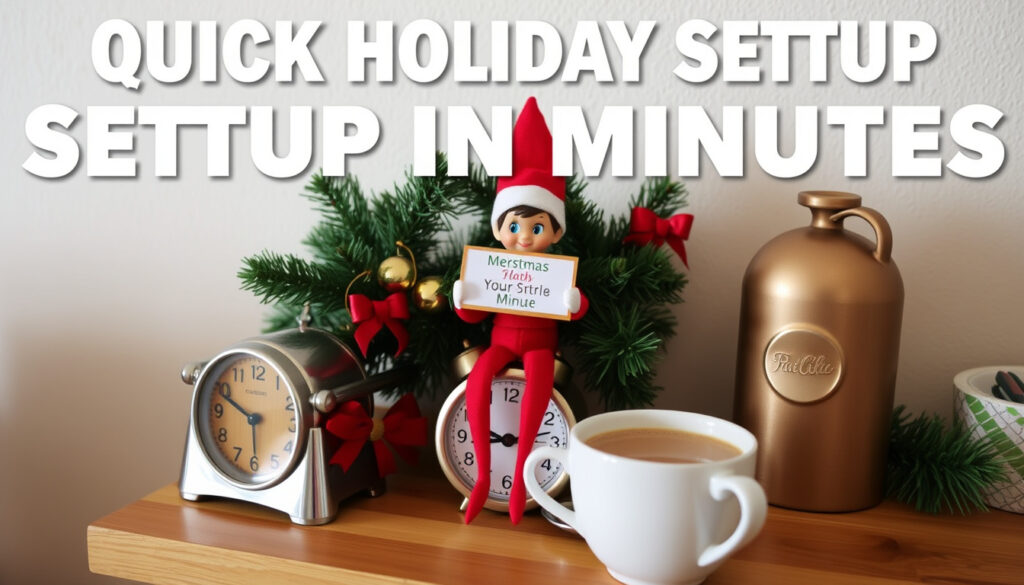
Quick Elf on the Shelf Ideas That Take Minutes to Set Up
Anyone who has shuffled into the kitchen at 10 p.m. and remembered the elf still hasn’t moved knows the feeling. The good news: a scene that takes under five minutes works as well as an elaborate diorama.
Original book published: 2005 (CNBC’s coverage) ·
Creators: Carol Aebersold and Chanda Bell ·
Official rule: Never touch the Scout Elf (official Elf on the Shelf site) ·
Common arrival window: Thanksgiving to Christmas Eve
Quick snapshot
- The book and doll were self-published in 2005 (CNBC’s coverage) (Aperplexity’s roundup)
- The official rule is never to touch the Scout Elf (CNBC’s coverage) (Aperplexity’s roundup)
- The commonly cited three rules are no touching, no moving, no talking (Aperplexity’s roundup)
- No official age cutoff appears in the brand’s materials (brand safety materials)
- No official “rarest Elf” list appears in brand safety materials
- Touch rules for 10-year-olds aren’t addressed in official policy (brand safety materials)
- 2005: book and doll self-published (CNBC)
- Each night: elf reports to Santa, parents move it before morning (the official Elf on the Shelf site)
- December 24: elf leaves for the North Pole until next year (the official Elf on the Shelf site)
- Household-item scenes keep the tradition going in under five minutes (Aperplexity’s guide)
- Official safety guidance means supervising food and string props (official safety warnings)
- The official no-touch rule applies to every scene, even the quickest ones (the official Elf on the Shelf site)
Seven facts anchor most family debates about the elf, and one pattern runs through them: the official story is simpler than the version families pass around.
| Fact | Detail | Source |
|---|---|---|
| First published | 2005 | CNBC’s business coverage |
| Creators | Carol Aebersold and Chanda Bell | CNBC’s business coverage |
| Original family tradition | Dates to the 1970s | CNBC’s reporting on the creators |
| Official rule | Never touch the Scout Elf | the official Elf on the Shelf site |
| Common arrival window | Thanksgiving to Christmas Eve | the official Elf on the Shelf site |
| Common three-rule version | No touching, no moving, no talking | Aperplexity’s idea roundup |
| Official safety stance | Adult supervision recommended for elf activities | official safety warnings |
What’s an easy Elf on the Shelf idea?
The easiest ideas skip the craft bin completely. They rely on one move and one ordinary object, which is why they survive a school night.
What are quick Elf on the Shelf ideas for kids?
- Move the elf to a mug, shoe, shelf, or cereal-box flap for a zero-mess reset (Aperplexity’s quick-idea guide)
- Tuck the elf into a clean slipper or boot with a washcloth as a blanket — under five minutes, no loose materials (Aperplexity’s quick-idea guide)
- Seat the elf beside an open children’s book with a bookmark or paper glasses for a book-nook scene (Aperplexity’s quick-idea guide)
These are one-location setups: nothing new enters the room, nothing needs cleanup, and the elf becomes the punchline instead of the project.
The elf is supposed to be magical, but the magic depends on a parent’s 10 p.m. energy. A five-minute reset lowers the cost of the surprise, so the magic survives school nights.
What are lazy easy Elf on the Shelf ideas?
- Turn a clean sock into a miniature sleeping bag for the elf and its doll friends (Aperplexity’s roundup)
- Swap toilet-water fishing for an empty bowl with a candy cane or paper hook (Aperplexity’s roundup) — the same gag, without the hygiene downside
- Photobomb a framed family photo with a removable paper speech bubble — no markers on the frame or picture (Aperplexity’s roundup)
- Lean a small paper label against a banana for a message that never touches the food (Aperplexity’s roundup)
The lazy test is simple: can you do it in pajamas? If the setup needs scissors, tape, and a reread of a craft tutorial, it’s not a lazy idea. Lazy setups also tend to be the safest, because they skip loose parts, food mess, and unstable towers. The pattern: speed comes from restraint. One new location or one small prop beats an elaborate scene, especially on school nights.
The pattern: speed comes from restraint, which is why the fastest ideas in this guide rely on a single prop and a 60-second thought.
What to do with Elf on the Shelf day 1?
Day 1 does two jobs: it introduces the elf as a named character, and it explains the one rule that keeps the magic working.
How should the elf arrive on day 1?
- Keep the first scene simple: elf sitting in a tree, on a shelf, or in a stocking
- Give the elf a name on the first morning so kids have a character to talk to
- Explain that the elf reports to Santa each night and returns by morning in a new spot (the official Elf on the Shelf site)
A calm arrival beats a dramatic one. The first morning should feel like a discovery, not a production, because it sets the bar for the next three weeks. The easiest first-day prop is a paper speech bubble: write “I’m here!” and lean it next to the elf (Aperplexity’s guide). No cleanup, no explanation needed.
What should kids know when the elf appears?
- The official rule: never touch the Scout Elf (CNBC’s coverage of the tradition)
- The elf’s job: report to Santa each night and come back by morning (the official Elf on the Shelf site)
- The commonly repeated three rules — no touching, no moving, no talking — are the expanded family version, not the book’s wording (Aperplexity’s roundup)
The distinction matters because the book keeps the rule at one line, while the three-rule version spreads through social media and group chats. The implication: a calm day 1 sets the ceiling for the whole season. Start simple, and every later idea builds on a habit, not a spectacle.
What are some creative ideas for an Elf on the Shelf?
Creative doesn’t mean complicated. Most good scenes are one visual gag that reads instantly — an elf caught doing something human.
What are some Elf on the Shelf hiding ideas?
- Hiding spots behind ornaments, inside mugs, or between books create quick discovery moments
- Behind the open flap of a cereal box, with the elf kept away from direct food contact (Aperplexity’s quick-idea guide)
- In a clean slipper or boot, with a washcloth as a blanket (Aperplexity’s quick-idea guide)
Hiding spots work when they’re at kid-eye level and in a room the family actually uses. A hidden elf nobody finds is just a lost toy.
Most top-ranked idea lists run 70 to 90 ideas; this guide keeps the count focused on scenes that take five minutes or less, because parents don’t browse 90 ideas at 10 p.m.
How do you make an Elf on the Shelf scene with everyday objects?
- Paper chef hat, mixing bowl, and wooden spoon make a kitchen scene — keep knives, hot surfaces, and appliances out of the frame (Aperplexity’s guide)
- A short, stable tower of large building blocks creates a rescue scene with low fall risk (Aperplexity’s guide)
- A mini reading club with three books, the elf, and two toys needs no craft supplies (Aperplexity’s guide)
- A breakfast-inspection scene uses a simple sign and normal breakfast food, served as usual (Aperplexity’s guide)
- A cotton-ball snowball scene reads as instant winter, but keep it away from kids who mouth small objects (Aperplexity’s safety note)
The official safety guidance is the constraint that makes these scenes work: supervise children when they help with elf activities, follow the manufacturer’s instructions for any craft supplies, and check ingredient lists on food props because they can trigger allergic reactions (official safety warnings). The catch: creativity doesn’t need crafts, but it does need a safety check. Low, stable, and supervised beats clever. For a movie-night pairing, the building-block scene fits our Home Alone LEGO house article.
What are some funny Elf on the Shelf ideas?
The funniest elf moments treat the elf as a tiny troublemaker with the same impulses as the family, which is why kids laugh and parents groan.
What are funny Elf on the Shelf ideas for adults?
- Elf caught taking a selfie with a paper phone
- Elf stuck in a bag or tangled in a scarf
- Elf wrapping a room in toilet paper — the mess is the punchline, so keep it to one room
- Pop-culture gags that land for adults but stay family-friendly
Adult humor works best when it’s visual and wordless. The elf doesn’t need a caption; the posture and the prop do the work. The kids won’t get every joke, and that’s fine — the scene still reads as mischief, which is the part they understand.
How do you make an Elf on the Shelf prank?
- Turn ordinary objects into punchlines: tape, mini props, or the elf caught mid-mischief
- Use the elf’s fixed pose to imply a sequence — one pose, one story
- Keep pranks safe: string-like materials need adult supervision around children, per the official warnings (official safety warning)
The prank formula is simple: take a normal morning object, add the elf, and let the implied story do the work. The fewer props, the faster the laugh.
The pattern: a single prop and an implied story replace forty items and a craft table.
What are the three rules of elf on a shelf?
Every December, the same question shows up in parenting groups: what are the actual rules? The answer depends on whether you ask the book or the group chat.
What happens if you touch the Elf?
- The official book states one rule: never touch the elf (CNBC’s coverage of the tradition)
- The commonly repeated three-rule version adds “no moving” and “no talking” (Aperplexity’s roundup)
- Neither version includes a published exception for older children
The book’s wording stops at one rule; the three-rule version is the expanded story families pass around. The distinction changes the pressure level: one rule is easy for a 4-year-old to remember, three rules feel like a contract.
When does the Elf return to the North Pole?
- Each night, the elf reports to Santa (the official Elf on the Shelf site)
- It returns by morning in a new spot, which is why parents move it after bedtime
- On December 24, the elf leaves for the North Pole until next season
The nightly report is the practical engine of the tradition: it explains both the morning move and the Christmas Eve goodbye. The trade-off: the official rule protects the magic with one line, while the three-rule version adds clarity for older kids and more pressure for parents.
The five-minute reset: a step-by-step routine
If you only change one thing about your elf habit, make it this routine. It turns the nightly elf move into a 60-second habit.
- Pick a spot at kid-eye level. A shelf, table, or counter the child sees every morning. The official guidance says adults should supervise children when they help with elf activities (official safety warnings).
- Grab one prop already in the house. Mug, sock, book, paper, candy cane, or cereal box — no new purchases required (Aperplexity’s quick-idea guide).
- Place the elf and set the scene. One location change, one prop, done. The slipper and book-nook setups take under five minutes (Aperplexity’s quick-idea guide).
- Run the 10-second safety check. No knives, hot surfaces, appliances, unstable towers, or small loose parts near young kids. String-like materials need adult supervision (official safety warning).
- Walk away. The scene is finished. A five-minute elf beats a perfect elf you skip on Wednesday.
The official safety guidance is clear that supervision matters, especially with food and string props. Skip anything that needs a knife, a hot surface, or a ceiling fan, no matter how funny it looks.
What this means: the reset routine turns a nightly chore into a 60-second habit — the same surprise, at a fraction of the cost.
The Elf on the Shelf timeline
The elf runs on a short, repeatable calendar. Once you see the pattern, every scene is just a variation on the same two moves.
- 2005: The Elf on the Shelf book and doll are self-published by Carol Aebersold and Chanda Bell (CNBC’s coverage)
- 1970s: The family tradition behind the product dates to the creators’ own family history (CNBC’s reporting on the creators)
- Thanksgiving (traditional start): The elf arrives, gets a name, and appears in a morning spot (the official Elf on the Shelf site)
- Each night: The elf reports to Santa; parents move it before the kids wake up (the official Elf on the Shelf site)
- December 24: The elf leaves for the North Pole until next year (the official Elf on the Shelf site)
The whole calendar fits on a sticky note, which is why the tradition survives busy Decembers. The pattern: the season runs on two moving pieces — the elf’s nightly report and the parents’ morning move. Everything else is decoration.
What’s confirmed and what’s still unclear
Separating brand facts from family folklore clears up most elf arguments in under a minute. Here’s the confirmed list and the still-open questions.
What’s confirmed
- The book and doll were self-published in 2005 by Carol Aebersold and Chanda Bell (CNBC’s coverage)
- The official book tells families never to touch the elf (the official Elf on the Shelf site)
- The commonly repeated three rules are no touching, no moving, no talking (Aperplexity’s roundup)
What’s still unclear
- There’s no official age when a family must stop using the elf — the brand’s materials publish no cutoff
- There’s no official “rarest Elf” list — rarity rankings come from community speculation, not the brand
- Whether a 10-year-old can touch the elf depends on family rules, not published brand policy
Read the two lists side by side and the pattern is obvious: the brand publishes a rule and a safety guide, and almost everything else comes from the group chat. The pattern: most family arguments about the elf come from version drift — the book says one rule, the group chat says three.
What the brand and the business coverage say
Two voices anchor the elf conversation: the brand’s own guidance and the business coverage that tracked its rise. The parent guides add the practical layer.
Children should be supervised when interacting with or assisting with Scout Elf activities. Follow manufacturer instructions and warnings for craft supplies and products.
The Elf on the Shelf — official safety guidance
The modern Elf on the Shelf concept was commercialized through a 2005 company launch and became a major holiday product.
CNBC — reporting on the Elf’s national success
The easiest zero-mess setup is simply moving the elf to a new visible or mildly hidden location, such as a mug, shoe, shelf, or cereal-box flap.
Aperplexity — parenting idea guide
The takeaway: the brand’s guidance, the business coverage, and the parent guides pull in the same direction — keep it simple, keep it supervised, and let the location do the work.
Here’s the part that doesn’t show up in idea listicles: the elf only works when it fits your family’s energy. A five-minute reset keeps the surprise alive without turning December into a nightly chore. The book’s rule is a single line — don’t touch — and the fastest ideas in this guide prove that one small prop beats an elaborate scene every time. For busy parents, the choice is clear: run the five-minute reset on school nights, or skip the elf entirely and let an advent calendar carry the countdown.
The takeaway: the elf tradition survives not because of elaborate scenes, but because it adapts to the energy available on a given night.
Frequently asked questions
What are some creative ideas for an Elf on the Shelf arrival?
Keep the first scene small: the elf in a tree, on a shelf, or in a stocking, with a name and a short explanation of the nightly Santa report. A paper speech bubble reading “I’m here!” gives the scene a prop without any cleanup (Aperplexity’s guide).
What are some cute gift ideas for an elf?
Gifts for the elf work best as tiny versions of real things: a sock sleeping bag, a mini book, or a paper bow. Gifts from the elf can be a removable note, a candy cane, or a small treat — all built from household items in Aperplexity’s quick-idea roundup.
What can I do besides Elf on the Shelf?
Families often swap in a Kindness Elf, a Christmas Pickle, or an advent calendar countdown. These keep the morning discovery and the countdown to Christmas without the nightly move or the no-touch rule. If your family likes calendar-based holidays, our Easter 2026 date guide covers the same planning logic for spring.
At what age do you stop doing Elf on the Shelf?
The brand publishes no official cutoff, so families decide based on whether the kids still believe and whether the parents still have energy. The official materials cover supervision and craft safety, not age limits (official safety guidance).
Can 10 year olds touch an Elf on the Shelf?
The book’s rule includes no age exception — it’s simply never touch. Whether a 10-year-old follows it is a family decision, not a brand policy.
What is the rarest Elf on the Shelf?
There’s no official rarity list from the brand. “Rarest elf” talk is community speculation, usually about discontinued outfits and older editions, so treat any ranking as collector buzz rather than catalog fact.
More related posts
 Man City vs AFC Bournemouth Stats: H2H Record & Analysis
 Best Arroz Primavera Near Me: What It Is & How to Make It
 Ireland v France Rugby: History, Players, and Match Facts
 How to Bake a Cheesecake: Complete Guide
 Wisconsin Supreme Court Election – Crawford Victory, Key Impacts
 SEO Blueprint Strategy: PAA-Driven Content Optimization
 Silo Season 3 Release Date: July 3, 2026 Episodes & Trailer
 Taylor Sheridan Movies and TV Shows: Complete List