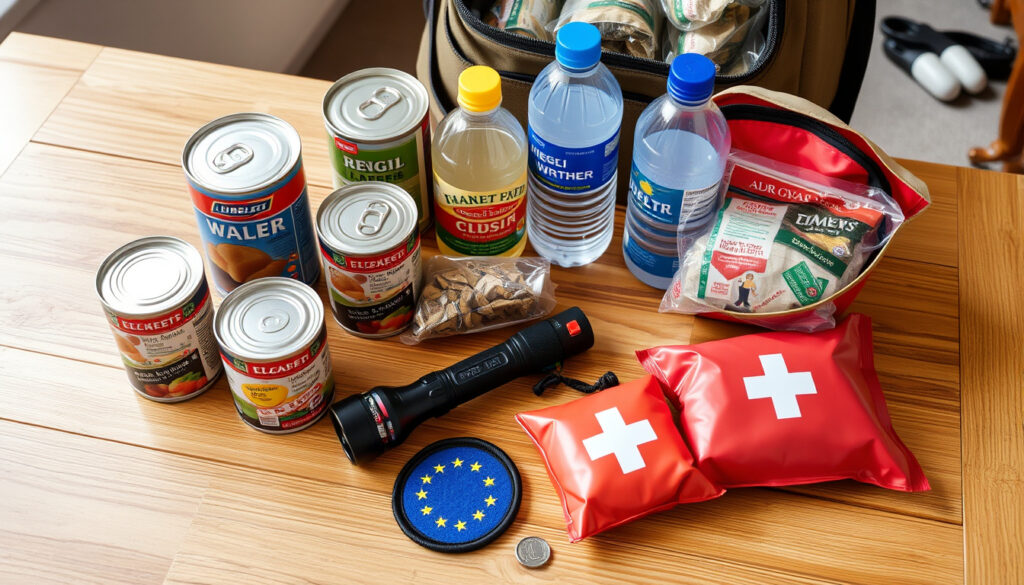
EU Stockpile Food: 72-Hour Emergency Guide for Citizens
If you live in the European Union, you’ve likely heard the advice to keep enough food and water at home for at least three days — but the official push behind it marks a real shift in how Europe thinks about everyday readiness. This article walks through the EU’s stockpile guidance, what to actually put in your kit, and why this matters right now.
Recommended stockpile duration: 72 hours · EU citizens advised: 450 million · Strategy announced: March 26, 2025 · Key motivation: Natural disasters, pandemics, military threats
Quick snapshot
- EU issued 72-hour stockpile guidance for all citizens (European Commission (official policy page))
- Strategy includes 30 key actions (European Commission Press Corner)
- Non-binding, not a legal requirement (European Commission (official policy page))
- Whether member states will enforce adherence
- How quickly households are responding
- Preparedness Union Strategy published March 25, 2025 (European Commission Press Corner)
- Public stockpile advice amplified in late March 2025 (European Commission Press Corner)
- EU stockpiling strategy to be formalised by September 2025 (Reuters)
- Guidelines for member states and public awareness campaigns (Associated Press)
Four key figures define the EU’s new readiness push:
| Category | Detail |
|---|---|
| Strategy Launch Date | March 26, 2025 |
| Stockpile Duration Target | 72 hours |
| Affected Population | 450 million EU citizens |
| Primary Threats Addressed | Natural disasters, pandemics, military attacks |
Is the EU telling people to stockpile?
What did the European Commission announce?
- The European Commission published the Preparedness Union Strategy on March 25, 2025 (European Commission Press Corner).
- The strategy contains 30 key actions and a detailed action plan.
- It urges citizens to maintain enough essential supplies for at least 72 hours in an emergency (European Commission official policy page).
Why now?
- The Commission says the strategy aims to enhance civilian and military preparedness for future crises (European Commission).
- Reuters reported the threats include natural disasters, cyberattacks and geopolitical tensions.
- Associated Press added warfare, climate change and disease to the list.
“The Commission is building a culture of citizen-level preparedness — the guidance is formal but still advisory.”
— European Commission, Preparedness Union Strategy
The strategy depends on citizens actually following through. Without mandated compliance, the success of the 72‑hour goal rests on awareness campaigns and voluntary action — a gamble when real threats don’t wait.
What is the EU guidance on stockpile?
What items are recommended in a 72‑hour kit?
- Food, water, medicines, identification documents (Associated Press).
- Flashlight, power bank, radio, cash (Reuters).
- Shortwave radios and medications (Associated Press).
How to store emergency supplies
- Keep in a cool, dry, dark place.
- Rotate stock every six months using FIFO (first in, first out).
- Label and date every item.
The European Parliament recorded a written question noting the Commission’s recommendation for citizens to stockpile essentials for 72 hours (European Parliament (official record)).
The implication: the guidance is formal but still advisory. Households that treat it as optional risk being unprepared when a crisis hits.
What are the top 10 foods to stockpile?
Non‑perishable staples
- Rice, pasta, oats — calorie‑dense and long shelf life.
- Dried fruit, nuts, peanut butter — protein and energy.
Canned goods and proteins
- Canned vegetables, beans, fish — ready to eat with minimal prep.
Grains and legumes
- Lentils, chickpeas, whole grains — versatile and nutrient‑rich.
The EU has not published an official food list, but the combination of shelf‑stable staples and protein will cover most households for 72 hours. CNN noted that the advice applies to all 450 million EU citizens.
Label and date every item. Rotate stock every six months using FIFO. Keep everything in a cool, dry, dark place.
What Should Your Emergency Pantry Look Like?
Pantry location and organization
- Choose a cool, dry, dark area like a basement or closet.
- Group similar items together — canned goods, grains, water.
- Keep heavy items on lower shelves for safety.
Rotation system for freshness
- Check expiration dates regularly.
- Use FIFO: place new purchases behind older stock.
- Consume and replace items before they expire.
- Rotate every six months.
Why are people being told to stock up on food?
Geopolitical tensions and preparedness
The EU strategy aims to boost resilience against cascading crises — natural disasters, pandemics, and military threats. Recent conflicts and climate events drove the policy.
Lessons from COVID-19 pandemic
The strategy is not about an immediate threat but proactive readiness. The Commission wants households to be self-sufficient for at least 72 hours, reducing strain on emergency services.
“We need a culture of preparedness where every citizen can manage for at least 72 hours.”
— Hadja Lahbib, EU Commissioner for Crisis Management (via Reuters)
The pattern is clear: the EU is moving from institutional stockpiles to citizen‑level responsibility.
Related reading: HSE Cross Border Directive · New Primary School Curriculum Ireland 2026
cnn.com, reddit.com, linkedin.com, prepared-project.eu, epr.eu, youtube.com, bertelsmann-stiftung.de
For practical steps on assembling your supplies, see this comprehensive emergency kit guide from Ireland Voice that expands on what the EU recommends.
Frequently Asked Questions
How long does canned food last in storage?
Canned goods typically last 2–5 years if stored in a cool, dry place. Always check for dents or rust before use.
Can I use frozen food in an emergency?
Yes, but only if power is available. Frozen food can last 1–2 days in a closed freezer during a blackout. Rotate it regularly.
Is tap water safe to store for emergencies?
Store tap water in clean, sealed containers. Replace every 6 months. In the EU, tap water quality is generally good for short-term storage.
What should I do if I have dietary restrictions?
Focus on shelf‑stable foods that meet your needs: gluten‑free grains, canned legumes, nut butters, and special medical foods if required.
Do I need to stockpile pet food?
Yes. Include at least 72 hours’ worth of pet food and any medications your pet requires.
Where can I find official EU stockpile checklists?
The European Commission’s preparedness page (EU Preparedness page) offers general guidance. Specific checklists are expected from member states later in 2025.
More related posts
 Brighton & Hove Albion F.C. history, stadium & tickets
 Leap Card Top Up Guide: Online, App and Machine Methods Explained
 T. Kenny Car Sales Enniscorthy: What Buyers Should Know
 Low White Blood Cell Count: Causes, Dangers, and How to Improve
 St Brigid’ Primary School Kildare: Addre , Roll Number, Calendar
 Ear Drops for Wax: Best Options, How to Use, and Safety Tips
 FIFA Club World Cup Table 2025: Standings & Groups
 Q-Park Grand Parade Cork: Parking Rates, Hours & Rules