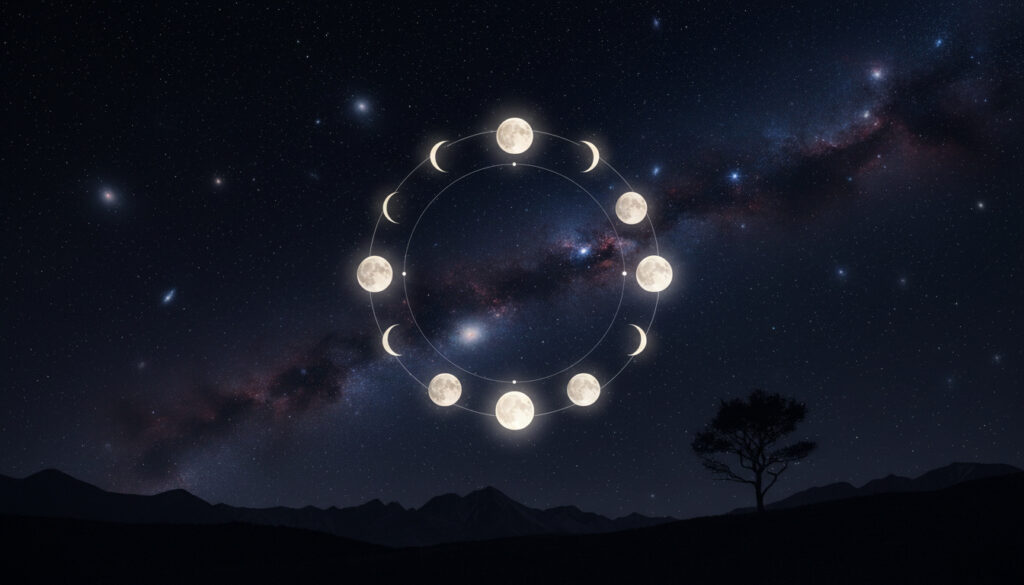
Phases of the Moon – 8 Stages and Cycle Timeline
The Moon transforms nightly through a predictable sequence of illumination changes visible from Earth. These phases of the moon represent the lunar surface’s changing sunlit portion as our natural satellite completes its monthly orbit around our planet.
Understanding the Lunar phase cycle requires tracking the relative positions of the Sun, Earth, and Moon. Each phase marks a specific geometric alignment, producing the familiar crescents, quarters, and full disks that have guided calendars and navigation for millennia.
What Are the Phases of the Moon?
Distinct illumination stages from new moon through waxing and waning periods to full moon
Synodic month duration from new moon to new moon
Creates lunar eclipses, not the regular monthly phases
Visible from any location on Earth with clear skies
Key insights:
- Phases result from orbital geometry rather than Earth’s shadow blocking sunlight
- The cycle spans 29.5 days, longer than the Moon’s orbital period due to Earth’s motion
- Sunlight always illuminates exactly half the lunar surface at any given moment
- The terminator line shifts daily, revealing changing portions of the lit hemisphere
- Primary phases mark precise 90-degree intervals in the Moon’s orbit
- Intermediate phases occupy approximately 7.4 days each on average
| Phase Name | Illumination % | Description | Visibility |
|---|---|---|---|
| New Moon | 0% | Moon positioned between Earth and Sun | Invisible or faint silhouette |
| Waxing Crescent | 1–25% | Thin crescent on right side growing | Visible after sunset |
| First Quarter | 50% | Right half illuminated at 90° from Sun | Visible afternoon to midnight |
| Waxing Gibbous | 51–99% | More than half lit, bulging toward full | Visible most of night |
| Full Moon | 100% | Fully illuminated hemisphere facing Earth | Rises at sunset, visible all night |
| Waning Gibbous | 99–51% | Illumination decreasing from left side | Visible after sunset until morning |
| Last Quarter | 50% | Left half illuminated opposite first quarter | Visible midnight to morning |
| Waning Crescent | 25–1% | Thin crescent on left side fading | Visible before sunrise |
What Causes the Phases of the Moon?
The Moon generates no light of its own. Every phase results from sunlight reflecting off the lunar surface as the Moon orbits Earth every 27.3 days. NASA explains that the Sun illuminates exactly half the Moon at all times, but Earth’s vantage point reveals varying portions of this lit hemisphere.
The Geometry of Sunlight
As the Moon moves counterclockwise around Earth when viewed from above the North Pole, the angle between the Sun, Moon, and Earth shifts continuously. This changing perspective creates the terminator line—the boundary between lunar day and night—that sweeps across the visible disk.
Common Misconceptions
Contrary to popular belief, Earth’s shadow does not create the regular monthly phases. That phenomenon produces lunar eclipses, which occur only during specific alignments. The phases occur because we observe the Moon from different angles as it orbits, according to NASA Space Place.
Earth’s shadow causes lunar eclipses, not the regular phases. Phases occur monthly; eclipses only happen when the full or new moon aligns precisely with the orbital nodes.
What Is the Order of the Moon Phases?
The sequence progresses counterclockwise through eight distinct stages. The U.S. Naval Observatory tracks these transitions with precision, noting that the cycle repeats every 29.53 days—a period called the synodic month.
The Sequential Progression
Beginning with the new moon, illumination increases through waxing crescent, first quarter, and waxing gibbous to reach full moon. The sequence then reverses through waning gibbous, last quarter, and waning crescent before returning to darkness.
Waxing vs. Waning
Waxing phases show increasing illumination from the right side in the Northern Hemisphere, growing toward fullness. Waning phases display shrinking illumination from the left side. EarthSky notes that this orientation reverses for observers in the Southern Hemisphere.
Descriptions of Key Moon Phases
New Moon
The Moon sits between Earth and the Sun, with its unilluminated side facing our planet. The synodic month begins at this conjunction, marking the start of the lunar cycle.
Full Moon
When the Moon reaches the opposite side of Earth from the Sun, its fully illuminated hemisphere faces us. This opposition creates the bright, complete disk visible throughout the night, rising at sunset and setting at sunrise.
Quarter Moons
First and last quarter phases occur when the Moon forms a 90-degree angle with the Sun-Earth line. Exactly half the visible surface appears illuminated—right side for first quarter, left side for last quarter.
Observers in the Southern Hemisphere see the illuminated portion on the left side during waxing phases and the right side during waning phases, opposite to Northern Hemisphere views.
Crescent and Gibbous Stages
Intermediate phases display less than half (crescent) or more than half (gibbous) illumination. These periods last approximately 7.4 days each, bridging the quarters and the primary phases.
The Moon’s elliptical orbit causes phase durations to vary by approximately 11% from the average, making exact timing predictions challenging without precise astronomical calculations.
How Long Does the Lunar Cycle Take?
The complete sequence spans 29.53 days, though the Moon orbits Earth in only 27.3 days. This discrepancy arises because Earth simultaneously moves around the Sun, requiring the Moon to travel slightly farther to realign with the same Sun-Earth angle.
- Day 0: New Moon—conjunction with Sun, 0% illumination
- Day 3.5: Waxing Crescent—thin right-side crescent visible
- Day 7.4: First Quarter—50% illuminated, 90° elongation
- Day 11: Waxing Gibbous—more than half lit, approaching full
- Day 14.8: Full Moon—100% illuminated, opposition to Sun
- Day 18: Waning Gibbous—dimming from left side
- Day 22.1: Last Quarter—50% left-side illumination
- Day 26: Waning Crescent—thin left-side crescent fading
- Day 29.5: Return to New Moon—cycle completes
What Is Scientifically Certain About Lunar Phases?
| Established Mechanisms | Variable or Uncertain Elements |
|---|---|
| Sunlight illuminates exactly half the lunar surface constantly | Exact minute of phase transition varies monthly due to orbital speed |
| Synodic month averages 29.53 days | Calendar dates shift approximately one day earlier each month |
| Phases result from orbital geometry, not Earth’s shadow | Cultural interpretations and names vary across civilizations |
| Eight distinct phase categories recognized astronomically | Visual appearance affected by atmospheric conditions and observer location |
Why Do Moon Phases Matter to Observers?
Lunar phases have governed agricultural planting schedules, religious calendars, and maritime navigation for thousands of years. The predictable cycle provided ancient civilizations with a reliable timekeeping system independent of solar seasons.
Modern observers use phase knowledge for astronomical planning. Dark skies during new moons offer optimal conditions for viewing deep-space objects, while full moons illuminate nighttime landscapes but wash out faint stars. Time and Date resources provide real-time tracking for photographers and astronomers.
Expert Sources and Scientific Verification
Phases result from the changing angle of sunlight as the Moon orbits Earth. The terminator line shifts daily, revealing more or less of the sunlit hemisphere.
NASA Space Place
Multiple observatories confirm these mechanics. USA Today summarizes the consensus that no significant scientific uncertainty exists regarding phase mechanics, though minor terminology differences persist between “third quarter” and “last quarter” nomenclature.
Summary: Understanding the Lunar Cycle
The eight phases of the moon represent a celestial geometry lesson visible to the naked eye. From the invisible new moon through waxing illumination to the brilliant full disk and back to darkness, the 29.5-day cycle demonstrates the predictable mechanics of orbital motion. Understanding these Moon Phases provides both practical calendar utility and connection to the rhythms that have guided humanity since ancient times.
How can I check tonight’s moon phase?
Astronomical websites and mobile apps calculate current illumination based on your location and UTC time. The U.S. Naval Observatory publishes daily phase data showing exact illumination percentage and moon age.
Do moon phases create ocean tides?
Phases correlate with but do not cause tides. Lunar gravity produces tides; phases indicate the Moon’s position relative to Sun and Earth. Spring tides occur during full and new moons when solar and lunar gravity align.
Why does the crescent moon face different directions?
The illuminated side points toward the Sun. In the Northern Hemisphere, waxing crescents face right (sunset direction); in the Southern Hemisphere, they face left. Near the equator, the crescent appears horizontal.
When is the next full moon?
Full moons occur every 29.5 days. Consult astronomical calendars for exact dates, as the cycle shifts approximately one day earlier each month relative to calendar months.
Why don’t we see the far side of the moon?
Tidal locking keeps the same lunar hemisphere facing Earth. The far side remains hidden from ground observers, visible only to spacecraft and satellites orbiting the Moon.
More related posts
 Surron Type E-Bike Classification: Light Bee X vs Ultra Bee
 Surron Type E-Bike Classification: E-Bike or Motorbike?
 HSE Self Service App: Login, Payslips & Pension Help
 The Mayson Hotel Dublin Guide: Rebranded to Dean Docklands
 Kai Tak Sports Park: Capacity, Events & Visitor Guide
 T. Kenny Car Sales Enniscorthy: What Buyers Should Know
 Full Body Massage Dublin – Top Spas and Prices
 Dublin Marathon 2025 Route: Start, Map, Elevation & Cutoff