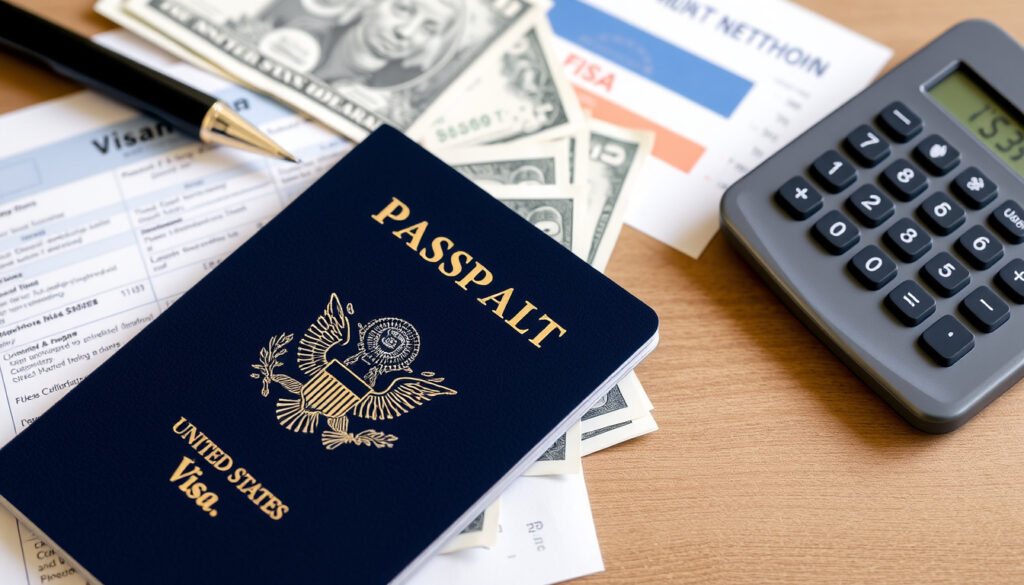
US Visa Integrity Fee: $250 Charge, Refund Rules, and Increases
You probably know about the $185 visa application fee by now. Then came word of a new $250 “visa integrity fee” that the One Big Beautiful Bill Act layered on top of existing charges for every nonimmigrant visa issued (CNN’s travel coverage) — and the refund promise, tied to staying in full compliance with your visa terms, is where the fine print gets interesting.
New integrity fee: $250 per nonimmigrant visa issuance ·
Standard MRV fee: $185 for most nonimmigrant visas ·
Petition-based visa fee increase: From $190 to $205 (H, L, O, P, Q, R) ·
Refund policy: Refundable only with full compliance ·
Effective date: Announced July 2025, implementation pending
Quick snapshot
- The integrity fee is at least $250 per nonimmigrant visa issued and is paid at visa issuance, not at application (CNBC’s explainer).
- It is separate from the standard $185 MRV application fee, not a replacement for it (CNN). (CNBC’s explainer)
- It applies to nonimmigrant visas, not to Visa Waiver Program travel (The Gazette). (CNBC’s explainer)
- Reimbursement is permitted but not guaranteed: the statute’s discretionary language leaves the refund to DHS rulemaking (TIME’s analysis).
- The exact enforcement date has not been announced (CNBC). (TIME’s analysis)
- Whether pending applications will be charged retroactively is not specified (TIME). (TIME’s analysis)
- July 2025: the fee becomes law; by late July, The Gazette reports it will affect millions of foreign visitors (The Gazette’s breakdown).
- Reimbursement, if it comes, is contemplated after the visa expires — a long wait, not a border refund (CNBC). (The Gazette’s breakdown)
- Inflation adjustments mean the $250 figure is a floor, not a ceiling (TIME). (The Gazette’s breakdown)
- DHS must build the refund process before any reimbursement can be claimed (CNN’s travel coverage).
- Watch for rulemaking on the enforcement date and the final refund conditions (TIME).
- Budget for the fee at visa issuance in the meantime (CNBC).
Ten line items, one pattern: every visa pathway now carries an added issuance charge with a compliance-based refund, and the starting arithmetic has shifted for everyone.
| Label | Value |
|---|---|
| New integrity fee | $250 per nonimmigrant visa issuance |
| Standard MRV fee | $185 for most nonimmigrant visas (excluding E) |
| Petition-based fee increase | $190 → $205 (H, L, O, P, Q, R) |
| Fee timing | Paid at visa issuance, not at application |
| Refund condition | Full compliance with visa terms and conditions |
| Refund mechanism | No automatic process; DHS must establish rules |
| Unreimbursed fees | Directed to the U.S. Treasury general fund |
| Combined base cost | $185 (MRV) + $250 (integrity) = $435 |
| Reciprocity fee | Varies by nationality, set by the State Department |
| Status | Announced July 2025; implementation pending |
What are the US visa requirements?
What documents are required for a US visa?
- A valid passport with enough validity for your intended stay.
- A recent photo that meets U.S. visa specifications.
- The Form DS-160 confirmation page with its barcode.
- Category-specific evidence: financial documents for a tourist visa, an approved petition for an H-1B, and similar proof for other categories.
Completing Form DS-160 online, paying the nonimmigrant visa application fee, gathering those documents, and attending an interview at a U.S. embassy or consulate are the core steps for most applicants, as the State Department’s own fee schedule and application guidance lay out (U.S. State Department fee schedule).
What is the standard application process?
- Complete Form DS-160 and save the confirmation barcode.
- Pay the MRV application fee — $185 for most categories, $205 for petition-based visas.
- Schedule an interview at a U.S. embassy or consulate.
- Attend the interview with your passport, photo, and supporting evidence.
Processing time is set by interview availability at each consular post, so wait times change by season and location.
The $250 fee arrives after approval, not before it. Your budget needs to hold $250 in reserve through the interview — the money is due only when the visa is issued.
The implication: the requirements themselves have not changed. What changed is the bill that lands after approval.
Do I have to pay $250 to enter the USA?
When does the $250 fee apply?
- It applies to nonimmigrant visas, not to Visa Waiver Program travel.
- It is charged when the visa is issued, not when the application is submitted.
- It is separate from the MRV fee and any reciprocity fee.
CNBC’s explainer is explicit on the timing: the fee is payable when the nonimmigrant visa is issued, not merely when an application is submitted, and applicants whose visa applications are denied are not charged under the reported statutory structure (CNBC’s explainer).
Is the integrity fee refundable?
- Only visa holders who stay in full compliance with their visa terms may qualify.
- Reported conditions include not accepting unauthorized employment.
- Reimbursement is contemplated after the visa expires, not immediately upon departure.
TIME’s analysis adds two practical cautions: a qualifying visa holder must generally depart no later than five days after the last day of the authorized period (unless an extension or adjustment exception applies), and the statute’s discretionary language means reimbursement should not be treated as guaranteed until DHS writes the rules (TIME’s analysis).
The statutory floor is $250, but the Secretary of Homeland Security can raise it by rule, and inflation adjustments are built into the statute. The number on next year’s fee schedule may be higher.
The pattern: the refund exists only for flawless stays, and even then the final decision rests with DHS, not with the traveler.
How much does a tourist visa cost for US?
What is the MRV fee for tourist visas?
- The B1/B2 tourist visa application fee is $185.
- The $250 integrity fee is added when the tourist visa is issued.
- The base total is $435 before any reciprocity or other charges.
The State Department’s fee schedule sets the MRV fee at $185 for most non-petition-based categories, with the E category as the exception, and also lists country-specific reciprocity fees — so two applicants with identical tourist plans can face different totals (U.S. State Department fee schedule). Add the $250 integrity fee and the starting cost for a first-time tourist visa is $435.
Are there additional reciprocity fees?
- Some nationalities pay a reciprocity fee (visa issuance fee) on top of the MRV fee.
- The amount depends on the applicant’s nationality, not just the visa category.
- ESTA travelers bypass these visa fees entirely for short tourism.
If you are already mapping a U.S. trip around a big event, our New York Marathon 2025 Guide covers the travel-planning side of getting there. The trade-off: the advertised $185 tourist visa was always an incomplete number. The realistic baseline is now $435, with reciprocity ready to add more.
Is there an increase in the H-1B visa fee?
What other petition-based visa fees increased?
- Application fees for H, L, O, P, Q, and R petition-based visas increased from $190 to $205.
- The integrity fee then adds $250 at issuance, putting the applicant’s base total at $455.
- Employers sponsoring workers may face separate fraud prevention and training fees.
The State Department’s fee schedule lists $205 for petition-based nonimmigrant visas in the H, L, O, P, Q, and R categories, up from the previous $190 baseline (U.S. State Department fee schedule).
How does the integrity fee affect H-1B applicants?
- The $250 integrity fee applies when the H-1B visa is issued.
- The applicant’s share is now $205 (MRV) plus $250 (integrity) = $455.
- Employer-paid fraud prevention and training fees sit on top of that.
What this means: the H-1B route is no longer a $190 paperwork exercise — the applicant-side cost is $455, and employer-paid fees are extra.
What happens if I enter the US without an ESTA?
Which countries are part of the Visa Waiver Program?
- The Visa Waiver Program covers a defined list of countries, including the UK, Ireland, Japan, Australia, and most EU member states.
- Travelers must obtain an approved ESTA before boarding a flight to the U.S.
- ESTA is a travel authorization, not a visa.
The integrity fee does not apply to Visa Waiver Program travel, but ESTA-related charges have also drawn attention under the same legislation; the Gazette’s breakdown notes the fee targets nonimmigrant visa applicants rather than VWP travelers (The Gazette’s breakdown).
What is the difference between ESTA and a US visa?
- ESTA authorizes visa-free travel for tourism or short business visits.
- A U.S. visa is required for longer stays, work, study, or any activity outside ESTA rules.
- Entering without an approved ESTA can mean denial of boarding or entry.
In practical terms, UK citizens do not need a visa for tourism but must hold a valid ESTA before departure, and the same logic applies to every other VWP country.
For travelers comparing a U.S. trip against a European one, our Top Tourist Attractions in Italy guide is a lighter read than the ESTA fine print. The implication: for short tourism, the integrity fee is a non-issue — ESTA stays the cheaper, faster path. The moment travel shifts to work, study, or a longer stay, the $250 fee is waiting.
How to apply for a US visa: step by step
- Confirm your visa category. B1/B2 for tourism, H-1B for specialty work, F-1 for study, and similar options for other purposes.
- Complete Form DS-160 online and save the confirmation barcode.
- Pay the MRV application fee — $185 for most non-petition-based visas, $205 for petition-based categories.
- Schedule an interview at the U.S. embassy or consulate for your region.
- Attend the interview with your passport, photo, and category-specific evidence.
- Budget for the $250 integrity fee at visa issuance, once implementation begins.
- Track your stay so a future refund claim — if DHS finalizes one — starts from a position of full compliance.
Applicants applying from Ireland follow the same sequence; the main difference is where the interview gets scheduled. The fee logic is identical everywhere: the MRV fee is paid to apply, and the integrity fee appears only if the visa is issued.
For an H-1B applicant, the base cost is now $205 for the application plus $250 at issuance — $455 before courier, photo, travel, or employer-paid fees. That is more than double the old $190 application fee alone.
The catch: by the time you reach the interview, the $185 application fee is already spent. The $250 fee arrives only at approval, so a denial costs you the MRV fee but not the integrity fee.
Timeline: what’s happened and what’s pending
- — The One Big Beautiful Bill Act introduces the $250 visa integrity fee for nonimmigrant visas. CNBC (July 18) and CNN (July 21) publish the first wave of explainers.
- — The Gazette reports the combined base cost of $185 plus $250 and describes the fee as affecting millions of foreign visitors (The Gazette’s breakdown).
- — The enforcement date and the DHS refund process have not been finalized; the statute directs unreimbursed fees to the Treasury general fund (CNN).
- — Inflation adjustments and a possible higher amount set by DHS rule could raise the fee above $250 (TIME).
What this means: the fee is law, but the practical machinery — the date, the payment portal, the refund claim path — is still being built.
Confirmed facts vs. what’s still unclear
Confirmed facts
- The integrity fee is at least $250 per nonimmigrant visa issued (CNBC).
- It is paid at visa issuance, not at application (CNBC).
- It is separate from the $185 MRV application fee (CNN).
- It is subject to inflation adjustments under the statute (TIME’s analysis).
What’s unclear
- The exact enforcement date has not been announced (TIME).
- The refund process is not automatic; DHS must create it before anyone can claim money back (CNN).
- What proof of “full compliance” will be required beyond the reported conditions — no unauthorized employment and departure within five days after the authorized period — is not defined (TIME).
- Whether pending applications will be retroactively charged has not been specified (CNBC).
- Whether DHS will set a higher amount than $250 by rule remains open (TIME).
The read: treat the $250 as the likely starting price and the refund as a possible bonus, not an entitlement.
What the coverage says
The integrity fee is collected at visa issuance, not at application. An applicant denied a visa is not charged, and any reimbursement is contemplated only after the visa expires, and only for a holder who stayed in compliance.
— CNBC’s explainer
The fee is additional to existing nonimmigrant visa fees, not a replacement, and the statute does not create an automatic refund mechanism — DHS has to establish the practical process before anyone can claim money back.
— CNN’s travel coverage
The pattern across both reports: plan for the fee, read the compliance language carefully, and do not treat the refund as a certainty.
The takeaway
The $250 integrity fee is not a rumor and not a loophole; it is a statutory charge that lands at visa issuance and refunds only through full compliance, at DHS’s discretion. For a tourist, the realistic cost of a U.S. visa just went from $185 to $435. For a first-time H-1B applicant, the applicant-side cost is $455 before employer-paid fees. For anyone planning a U.S. visit from Ireland or anywhere else, the decision is clear: budget $250 on top of the application fee now, or let the visa-issuance counter deliver the surprise.
Frequently asked questions
When do I need to pay the $250 visa integrity fee?
At visa issuance, not at application. If your visa is approved and issued, the integrity fee is collected at that point, on top of the MRV application fee.
Can I get a refund if my visa application is denied?
Under the reported statutory structure, denied applicants are not charged the integrity fee, because the fee is tied to issuance. The MRV application fee, however, is generally non-refundable.
Does the integrity fee apply to ESTA travelers?
No. The integrity fee applies to nonimmigrant visas. Visa Waiver Program travelers use ESTA for tourism, and ESTA-related charges are a separate matter.
Do UK citizens need to pay the $250 fee for a visa?
For tourism, UK citizens travel under the Visa Waiver Program with an approved ESTA, so the integrity fee does not apply to those visits. If a UK citizen applies for a nonimmigrant visa — for work or study, for example — the fee applies at issuance.
How is the integrity fee different from the MRV fee?
The MRV fee is the application fee you pay to apply: $185 for most non-petition-based visas. The $250 integrity fee is an additional issuance fee, charged when the visa is approved and issued, and it can be reimbursed only with full compliance.
Will the fee affect my existing visa or future renewals?
Published coverage focuses on new issuances. A renewal that results in a new nonimmigrant visa issuance appears to fall within the fee’s scope, but retroactive application to pending applications has not been specified.
What happens if I cannot pay the integrity fee at visa issuance?
This is not yet defined. The practical payment process and regulations are pending, which is exactly why the enforcement date matters.
More related posts
 Everton vs Nottm Forest: Preview, Odds & Predictions
 Work From Home Jobs Ireland: Guide to Remote Opportunities
 Full Body Massage Dublin – Top Spas and Prices
 When is Cheltenham 2025? Festival Dates and Schedule
 1 Euro in Rupees Today: Live EUR/INR Rate ₹111.22 (Xe)
 T. Kenny Car Sales Enniscorthy: What Buyers Should Know
 Nottingham Forest vs Man City Stats: H2H, Form & Results
 What to Do in Killarney: Complete Guide to Attractions