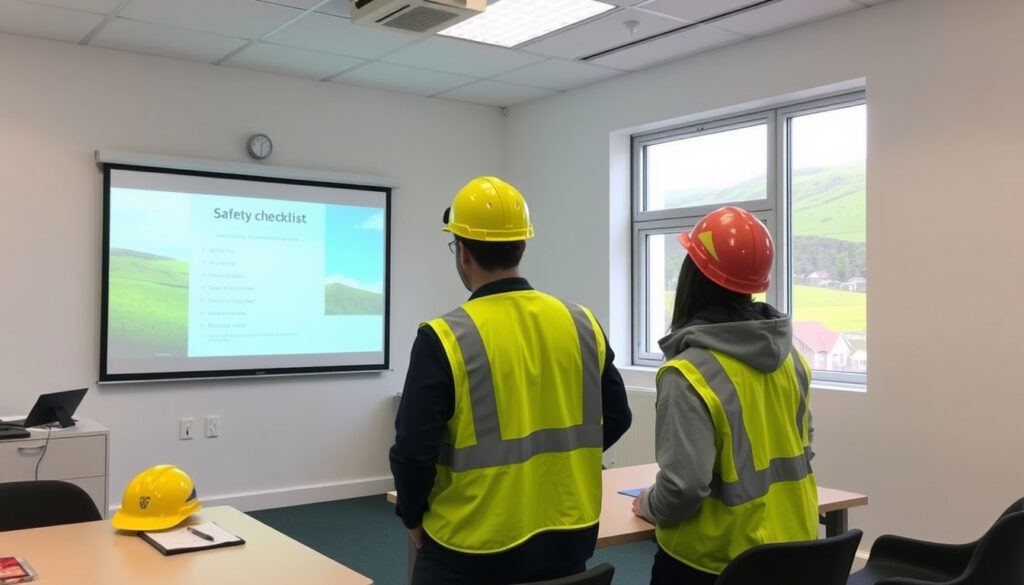
Health and Safety Courses in Ireland: Complete Guide
Safe Pass is mandatory for construction workers, but it’s only the first step in a career in health and safety. From free online awareness modules to university-level diplomas, this guide lays out the full pipeline, what each qualification actually gets you, and where the real value lies for different career paths.
Duration of typical online health and safety course: 12 weeks ·
Qualification level range: Level 6 to Level 7 ·
Number of questions in Safe Pass exam: 20
Quick snapshot
- Duration: 4 hours (SOLAS Safe Pass)
- Cost: €50-100 depending on provider (SOLAS Safe Pass)
- Assessment: 20 multiple-choice questions (SOLAS Safe Pass)
- Valid for 5 years (SOLAS Safe Pass)
- Available from ATU, CMI, and others
- Flexible scheduling (ATU)
- Recognized nationwide (ATU)
- Ideal for working professionals (ATU)
- Subsidized for eligible learners (Springboard+)
- Level 7 options available (Springboard+)
- Apply through Springboard+ website (Springboard+)
- Funded by the Irish government (Springboard+)
Key facts about health and safety courses in Ireland — a quick reference table:
| Fact | Value |
|---|---|
| Average duration of health and safety certificate | 12 weeks |
| Highest qualification available (entry-level) | Level 7 (e.g., UCD Certificate) |
| Safe Pass validity | 5 years |
| Number of Safe Pass questions | 20 |
| Typical Safe Pass duration | 4 hours |
| Safe Pass cost range | €50–€100 |
| ATU online Higher Certificate duration | 2 years part-time |
| HSA student course duration | 45 minutes |
How to become a health and safety officer in Ireland?
Becoming a health and safety officer in Ireland isn’t a single-step process — it’s a progression through qualifications and experience. The typical route involves three clear stages.
- Step 1: Get a foundational qualification. Start with a certificate or diploma in occupational health and safety. The Atlantic Technological University (ATU) Higher Certificate in Science in Occupational Safety and Health is a widely recognized Level 6 qualification delivered online over two years part-time.
- Step 2: Gain practical experience. Most employers expect at least 1–2 years in a safety-related role before considering you for an officer position. Many start as safety representatives or site supervisors.
- Step 3: Pursue professional registration. Joining a body like IOSH (Institution of Occupational Safety and Health) or IAPA can strengthen your credentials. Some roles require Chartered status.
The catch: there’s no single “health and safety officer” licence in Ireland. Employers set their own requirements, which is why a Level 6 or Level 7 qualification from a recognized provider gives you the strongest starting position.
What is the best health and safety qualification?
“Best” depends on where you’re starting and where you want to go. Here’s how the main options compare for different goals.
Three prominent qualifications, one key difference: Level 6 diplomas are about operational competence; Level 7 certificates introduce management-level thinking.
| Qualification | Provider | Level | Duration | Best for |
|---|---|---|---|---|
| Higher Certificate in Occupational Safety and Health | ATU | Level 6 | 2 years part-time online | Career starters seeking a formal qualification |
| Certificate in Safety and Health at Work | UCD | Level 7 | 12 weeks online | Working professionals needing a quick, recognized credential |
| OTHM Level 6 Diploma in Occupational Health & Safety | CMI Ireland | Level 6 | 12 months part-time online | Those aiming for IOSH technical membership |
ATU’s two-year programme gives depth but demands time. UCD’s 12-week certificate gets you into the market fast. For someone looking to become a safety officer within 18 months, the UCD route is the practical choice — but you’ll need to supplement it with experience.
The implication: if you’re paying out of pocket, the UCD certificate offers the fastest return on investment. If you’re eligible for Springboard+ funding (which covers up to 90% of fees for many part-time courses), a Level 7 diploma becomes the clear value winner.
How many years is a health and safety course?
Health and safety courses in Ireland range from 45 minutes to two years. Here’s the breakdown by course type.
- Short awareness courses (free): The HSA’s student course ‘Get Safe – Work Safe’ takes just 45 minutes of self-directed learning, accessible 24/7 via hsalearning.ie. The HSA (Ireland’s workplace health authority) describes these as short awareness-raising modules, not qualifications.
- Safe Pass: A single 4-hour classroom-based session, valid for 5 years. SOLAS directs applicants to find registered tutors via constructioncourses.ie.
- Certificate courses: The ATU online certificate runs for 12 weeks. CMI’s Level 6 diploma spans 12 months part-time.
- Diploma and degree programmes: ATU’s Higher Certificate takes two years. Level 7 programmes through Findacourse or Springboard+ can extend to 18–24 months.
What this means: if you need a qualification fast for a job application, the UCD 12-week certificate is your best bet. If you’re building a career as a safety professional, budget for 1–2 years of part-time study.
How much does a safe pass course cost in Ireland?
The Safe Pass course typically costs between €50 and €100. That fee includes the half-day classroom session, the assessment, and the card that’s valid for five years. Some private providers quote higher, but the range is fairly tight.
Can I do my safe pass course online?
Yes — but only through approved providers. The SOLAS Safe Pass programme requires that any online offering comes from an accredited tutor listed on the Safe Pass Accredited Tutors register. Several third-party platforms, like SafetyCoursesOnline.ie, advertise fully online Safe Pass courses with self-paced learning and same-day certificate download for around €39. But those are third-party providers, not SOLAS directly — so verify the tutor’s accreditation status before enrolling.
For the Safe Pass specifically, the online option is real but comes with a catch: the provider must be SOLAS-approved. A €39 course from an unverified site may not get you a valid card. Always cross-check against the official SOLAS tutor register.
How many hours does a safe pass course take?
Four hours. That’s the standard duration for the classroom-based component. Some online providers, like SafetyCoursesOnline.ie, advertise a 3-hour self-paced version. GTSS also offers online safety training that learners can complete at their own pace on mobile, tablet, or desktop. But the official SOLAS-approved Safe Pass course runs 4 hours.
Can you fail a safe pass course?
Yes. The assessment is 20 multiple-choice questions, and you need to pass to get your card. If you fail, you’ll have to retake the course. The pass mark isn’t published by SOLAS, but the test is designed to verify understanding of core safety concepts — not to trick you.
How many questions are in the safe pass course?
20 multiple-choice questions. That’s the standard across all approved providers.
What do I need to bring to a safe pass course?
Photo ID and, if you have it, your CSP registration number. Some providers ask you to bring your PPS number. No specific safety gear is required — comfortable clothing is sufficient.
Who is exempt from a Safe Pass in Ireland?
Workers who hold an equivalent qualification from another jurisdiction, such as a valid CSCS card from the UK, may be exempt. SOLAS assesses equivalence on a case-by-case basis. The exemption isn’t automatic — you need to apply.
What to wear to a Safe Pass course?
Standard comfortable clothing. No hard hat, hi-vis, or steel-toe boots are required unless you’re on an active construction site as part of a combined programme. The course is classroom-based.
The pattern: Safe Pass is straightforward, low-stakes, and cheap — but the bureaucracy around approved tutors and exemptions can trip you up if you don’t check the details in advance.
Will social Welfare pay for a Safe Pass?
Possibly, but it’s not automatic. The Department of Social Protection (Deasp) may fund Safe Pass training for jobseekers through specific programmes administered by local Intreo offices. You’ll need to contact your local Intreo centre and ask about eligibility. Funding depends on individual circumstances — it’s not a blanket entitlement.
Jobseekers who assume Social Welfare covers Safe Pass automatically risk paying out of pocket when they show up to a course expecting a funded place. Always get confirmation in writing from Intreo before you book.
What this means: jobseekers should not assume funding is automatic.
Confirmed facts
Confirmed facts
- Safe Pass is mandatory for construction workers in Ireland (SOLAS, Ireland’s further education and training authority).
- The HSA provides free online health and safety courses through hsalearning.ie (HSA Learning portal, Ireland’s workplace health regulator).
- ATU offers a full suite of online occupational safety and health courses at Levels 6, 7, 8, and 9 (ATU course listing).
What’s unclear
- Exact Safe Pass cost varies by provider — ranges from €39 to €100.
- Social Welfare coverage depends on individual circumstances — no standard published rate.
- Pass mark for Safe Pass is not publicly confirmed by SOLAS.
- Several universities offer health and safety courses, including ATU and UCD — but UCD’s course page is not directly sourced.
The implication: the lack of published pass mark and variable costs make it essential to verify details directly with providers.
Expert perspectives
“This Health and Safety Diploma course is the only online course in Ireland, designed to meet the highest standards of working as a health and safety officer.”
CMI Ireland (professional health and safety training provider)
“This 12 week online course has been designed to facilitate the working person gain health and safety certification with minimum disruption to their work.”
Atlantic Technological University (public university, Ireland)
The pattern: both providers emphasize flexibility and recognition, but the choice depends on career goals.
What this means for you
Health and safety training landscape in Ireland is a two-tier system. On one side, you have mandatory regulatory certifications like Safe Pass — cheap, fast, and necessary for construction workers. On the other, you have diploma-level qualifications from universities and professional bodies that open the door to full-time safety officer roles. The gap between the two is where most people get stuck: they complete Safe Pass and assume that’s enough for a career. It isn’t. For the jobseeker in Ireland looking to move from site worker to safety officer, the decision is clear: invest in a Level 6 or Level 7 diploma through a recognized provider like ATU or UCD, or remain in the entry-level certification lane. Work From Home Jobs and EU Stockpile Guide are also relevant resources for career planning.
findacourse.ie, qualifax.ie, nightcourses.com, ehsinternational.com, safetycoursesonline.ie
Frequently asked questions
What is a Safe Pass card?
A Safe Pass card is a mandatory health and safety awareness card for construction workers in Ireland. It’s valid for five years and proves you’ve completed the SOLAS-approved Safe Pass programme.
Is an online health and safety course recognized in Ireland?
Yes — if it’s from an approved provider. ATU, UCD, and CMI all offer online courses that are fully recognized. Always check that the provider is QQI-accredited or SOLAS-approved for the specific course.
How do I renew my Safe Pass?
You retake the Safe Pass course before your current card expires. There’s no renewal test — you simply attend the 4-hour session again and pass the 20-question assessment.
Can I use my UK health and safety qualification in Ireland?
Possibly. SOLAS assesses UK qualifications like the CSCS card for equivalence on a case-by-case basis. It’s not automatic — you must apply for a determination.
What is the difference between Level 6 and Level 7?
Level 6 is a higher certificate (two years part-time). Level 7 is an ordinary bachelor’s degree — one step higher on the NFQ framework. Level 7 qualifications are more widely recognized by employers for safety officer roles.
Are there free health and safety courses in Ireland?
Yes. The HSA offers free short awareness courses through hsalearning.ie. Springboard+ also subsidizes many Level 7 and Level 8 courses for eligible learners — meaning you pay just 10% of the fee.
More related posts
 The Last of Us Season 2 Episode 2 – Full Recap and Ending Explained
 Low White Blood Cell Count: Causes, Dangers, and How to Improve
 Leicester City vs Ipswich Town: H2H, Results, Live & Prediction
 Words Starting with X: Short, Common & Scrabble Words
 Golf Grand Slam Winners: Who Has Won All Four Majors
 Cast of The Office UK: Complete Guide to Actors and Characters
 How to Opt Out of Organ Donation in Ireland | HSE Opt-Out Regi ter
 Arthur and the Invisibles: Flop, Sequels, Minimoys Explained