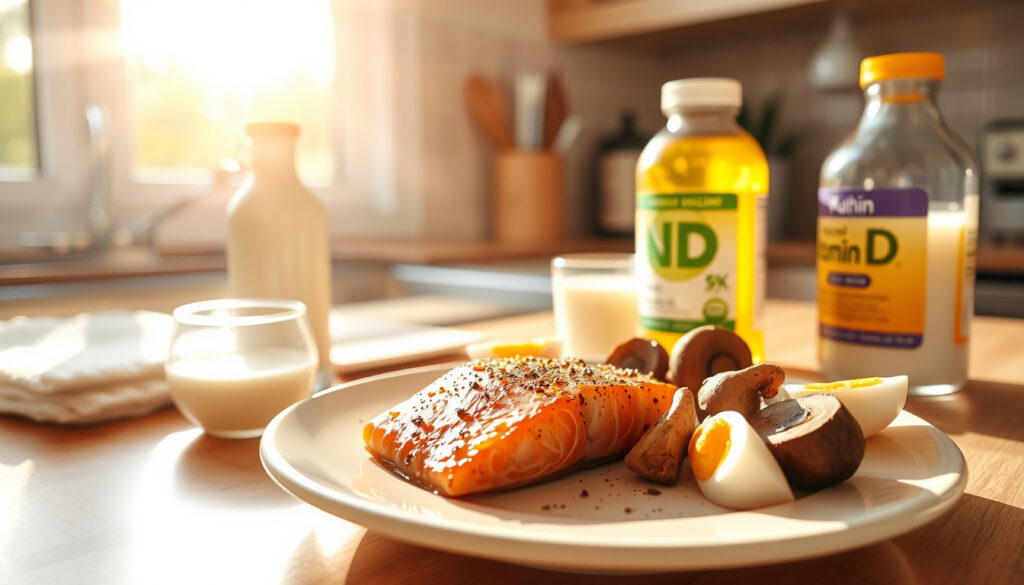
Sources of Vitamin D: Top Foods, Sunlight, and Supplements
If you’ve ever felt inexplicably tired or noticed your bones aching more than usual, there’s a chance your vitamin D levels might be running low. Around 1 billion people worldwide have insufficient vitamin D, according to the NIH Office of Dietary Supplements (U.S. federal health agency).
Recommended daily intake (adults): 600–800 IU ·
Top natural food source: Oily fish (salmon, mackerel, sardines) ·
Percentage of vitamin D from sun exposure: 80–90% ·
Vitamin D deficiency prevalence (worldwide): ~1 billion people ·
Time to raise levels with supplementation: 3–4 months
Quick snapshot
- Oily fish are the most concentrated natural food source (NIH Office of Dietary Supplements)
- Sun exposure is the most efficient source for most people (NHS (UK national health authority))
- Vitamin D deficiency impairs bone health and immune function (MedlinePlus (U.S. National Library of Medicine))
- Optimal blood levels for non-skeletal benefits remain debated (NIH Office of Dietary Supplements) (Yale Medicine (academic medical center))
- Role of vitamin D in sleep regulation is not fully understood (Yale Medicine (academic medical center))
- Exact contribution of dietary sources vs sun varies widely by individual (NHS (UK national health authority)) (Yale Medicine (academic medical center))
- With supplementation (1,000–4,000 IU/day), levels can rise in 3–4 months (NIH Office of Dietary Supplements)
- Sun exposure: 10–30 minutes midday on arms and legs can boost levels within days (NHS (UK national health authority))
- Combining sun, food, and supplements yields fastest results (Patient.info (UK clinical reference))
- Public health policies increasingly recommend year-round supplementation for at-risk groups (NHS (UK national health authority)) (Patient.info (UK clinical reference))
Five key facts, one pattern: most people fall short of the recommended intake from food alone, making sunlight and fortified products essential bridges.
| Label | Value |
|---|---|
| Recommended Dietary Allowance (adults 19–70) | 600 IU (15 mcg) per day |
| Tolerable Upper Intake Level | 4,000 IU (100 mcg) per day |
| Vitamin D in 100g salmon | 526–614 IU |
| Vitamin D in one egg yolk | ~40 IU |
| Sun exposure for fair skin (noon, arms+legs) | 10–15 minutes |
What foods are the highest in vitamin D?
Oily fish
- Salmon, mackerel, and sardines are the richest natural sources. A 100g serving of wild salmon provides 526–614 IU, nearly the full daily recommendation for adults (NIH Office of Dietary Supplements (U.S. federal health agency)).
- Herring and canned tuna also contribute meaningful amounts, though levels vary by species and preparation (NHS (UK national health authority)).
Red meat and liver
- Beef liver contains moderate vitamin D: about 40 IU per 100g. It’s also rich in vitamin A, so limit intake to avoid excess (Cleveland Clinic (leading U.S. hospital)).
Egg yolks
- One egg yolk provides roughly 40 IU of vitamin D. Two eggs give about 80 IU — only 10–13% of the daily RDI (NIH Office of Dietary Supplements).
Fortified foods
- Many countries mandate fortification of milk, breakfast cereals, and plant-based milks. In the U.S., the FDA requires fortified milk to contain vitamin D under food fortification standards (eCFR / FDA regulation (U.S. food safety authority)).
- Fortified orange juice and yogurts are other common carriers, typically providing 100 IU per serving (NHS (UK national health authority)).
Mushrooms exposed to UV
- UV-treated mushrooms are the only plant source that naturally contains vitamin D2. Some commercially grown mushrooms are exposed to UV light to boost levels to 400–600 IU per 100g (NIH Office of Dietary Supplements).
If you rely on diet alone, hitting 600 IU daily means eating salmon twice a week plus fortified foods — or accepting that eggs and red meat alone won’t get you there.
The implication: achieving the daily target from food alone requires deliberate pairing of the richest sources.
How can I raise my vitamin D quickly?
Safe sun exposure
- Exposing arms and legs to midday sunlight for 10–30 minutes (without sunscreen) triggers vitamin D synthesis in the skin. People with darker skin may need longer exposure (NIH Office of Dietary Supplements).
High-dose supplements
- Vitamin D3 (cholecalciferol) supplements at 1,000–4,000 IU/day are effective for raising levels. The NHS advises all UK adults to consider a daily 10 mcg (400 IU) supplement during autumn and winter (NHS (UK national health authority)).
Concentrated food sources
- Oily fish several times per week can raise levels significantly. Cod liver oil is extremely concentrated: 450 IU per teaspoon, but watch for vitamin A toxicity (NIH Office of Dietary Supplements).
Combination strategy
- Pairing moderate sun exposure with vitamin D-rich foods and a daily supplement is the fastest route to bring levels from deficient to sufficient (Patient.info (UK clinical reference)).
For someone in the UK or northern latitudes, sunny months are short, making a combined approach the only reliable way to avoid deficiency during winter.
The pattern: multiple weak sources together produce stronger results than any single approach.
Is 2 eggs a day enough vitamin D?
Vitamin D content in eggs
- One egg yolk provides about 40 IU of vitamin D. Two eggs give roughly 80 IU (NIH Office of Dietary Supplements).
Daily requirement comparison
- For adults aged 19–70, the RDA is 600 IU. Two eggs deliver only 10–13% of that target (NHS (UK national health authority)).
Eggs as part of a broader strategy
- Eggs are a helpful addition but cannot be the sole source. Combine with oily fish, fortified foods, or supplements to meet daily needs (Cleveland Clinic (leading U.S. hospital)).
The implication: eggs are a side dish, not the main course for vitamin D.
What drink is high in vitamin D?
Fortified dairy and plant milks
- Fortified cow’s milk typically contains 100 IU per cup. Many soy, almond, and oat milks are fortified to the same level (NHS (UK national health authority)).
Fortified orange juice
- Some brands of orange juice are fortified with 100 IU per serving. Check the label, as not all juices are fortified (NIH Office of Dietary Supplements).
Fish liver oils
- Cod liver oil is extremely high: 450 IU per teaspoon. However, it also contains high levels of vitamin A, so limit intake (NIH Office of Dietary Supplements).
Vitamin D fortified water
- Some bottled waters are fortified with vitamin D, but levels are typically low (50–100 IU per liter) and not a primary source (NHS (UK national health authority)).
The trade-off: drinks are a convenient way to add vitamin D, but they rarely deliver more than 100 IU per serving, so they work best as a complement to food and sun exposure.
What are 5 signs of vitamin D deficiency to not ignore?
Fatigue and bone pain
- Persistent fatigue and bone pain are among the most consistently reported deficiency signs (Yale Medicine (academic medical center)).
Muscle weakness
- Muscle weakness, especially in older adults, may indicate deficiency. In severe cases, it can cause a waddling gait (Patient.info (UK clinical reference)).
Mood changes
- Low vitamin D is linked to depression and anxiety in several clinical summaries (Cleveland Clinic (leading U.S. hospital)).
Hair loss
- Severe hair loss (alopecia) can be a symptom of deficiency, though it’s less common than fatigue or bone pain (WebMD (health information resource)).
Impaired wound healing
- Slow healing of cuts or fractures may signal deficiency, as vitamin D plays a role in tissue repair (MedlinePlus (U.S. National Library of Medicine)).
If you have two or more of these symptoms, a simple blood test can confirm whether your levels are low. Don’t guess — treat with a validated supplement dose.
The catch: symptoms are nonspecific, so testing is the only way to confirm deficiency.
Steps to raise your vitamin D levels
- Get safe sun exposure. Aim for 10–30 minutes of midday sun on arms and legs without sunscreen, several times a week. Adjust for skin type and latitude.
- Eat vitamin D-rich foods. Include oily fish twice a week, fortified dairy or plant milks, and UV-exposed mushrooms. For a broader nutrition boost, check out easy ways to eat vegetables every day.
- Consider supplementation. Take 400–2,000 IU of vitamin D3 daily, especially from October to March in northern climates. The NHS recommends 10 mcg (400 IU) for adults in the UK.
- Combine strategies. Sun + food + supplements gives the fastest, most reliable results. Track your intake with a food diary app.
- Test after 3–4 months. A blood test can confirm whether your levels are in the optimal range (30–50 ng/mL). Adjust supplement dose if needed.
Raising vitamin D quickly is possible, but consistency matters more than a one-time high dose. A steady routine of 1,000–2,000 IU daily plus sun exposure is safer than megadoses.
The implication: a slow, consistent approach prevents toxicity and sustains levels.
What’s certain and what’s still debated
Confirmed facts
- Oily fish are the most concentrated natural food source (NIH Office of Dietary Supplements).
- Sun exposure is the most efficient source for most people (NHS (UK national health authority)).
- Vitamin D deficiency impairs bone health and immune function (MedlinePlus (U.S. National Library of Medicine)).
What’s unclear
- Optimal blood levels for non-skeletal benefits remain debated (NIH Office of Dietary Supplements).
- Role of vitamin D in sleep regulation is not fully understood (Yale Medicine (academic medical center)).
- Exact contribution of dietary sources vs sun varies widely by individual (NHS (UK national health authority)).
The pattern: strong consensus on bone health, but open questions on broader effects remain.
“Sunlight exposure is a major natural route for vitamin D production because the skin synthesizes vitamin D when exposed to UVB radiation.”
— NIH Office of Dietary Supplements (U.S. federal health agency)
“The NHS advises all adults and children over 4 years to consider taking a daily vitamin D supplement during autumn and winter in the UK.”
Vitamin D is one of the few nutrients where a single source — the sun — can cover your needs, but only if you live in the right latitude and have the right skin type. For anyone in the UK or similar northern latitudes, the choice is clear: incorporate fortified foods, get moderate sun when possible, and consider a daily supplement of 10 micrograms during autumn and winter, or risk the long-term bone and immune consequences of deficiency. For more on how fortified orange juice supports immune health, read this related article.
medicinenet.com, nebraskamed.com, patient.info, verywellhealth.com, completehealthcare.com, healthline.com, msdmanuals.com, azgyn.com
Frequently asked questions
Can you get too much vitamin D from the sun?
No, the body naturally limits vitamin D synthesis from sun exposure. Overdose is only possible from excessive supplement intake, not from sunlight (NIH Office of Dietary Supplements).
What is the best time to take vitamin D supplements?
Taking vitamin D with a meal that contains fat improves absorption. Many people take it in the morning, but evening is fine too (NHS (UK national health authority)).
Do I need vitamin D if I live in a sunny climate?
Even in sunny climates, many people spend time indoors or use sunscreen, which reduces synthesis. Deficiency is still possible, so it’s wise to get tested (Cleveland Clinic (leading U.S. hospital)).
Are there any risks of taking vitamin D with other medications?
Vitamin D can interact with certain medications, including steroids, weight-loss drugs, and some seizure medications. Consult your doctor before starting high-dose supplements (MedlinePlus (U.S. National Library of Medicine)).
How is vitamin D deficiency diagnosed?
A simple blood test measures 25-hydroxyvitamin D levels. Levels below 20 ng/mL (50 nmol/L) are generally considered deficient (NIH Office of Dietary Supplements).
Can vegetarians get enough vitamin D from food?
Yes, but it requires planning. UV-exposed mushrooms, fortified plant milks, and fortified breakfast cereals are good options. Supplementation is often recommended (NHS (UK national health authority)).
Does vitamin D help with weight loss?
Some studies suggest a link between low vitamin D and higher body fat, but evidence is not strong enough to recommend vitamin D for weight loss. It’s important for overall health, though (Yale Medicine (academic medical center)).
More related posts
 1 Euro in Rupees Today: Live EUR/INR Rate ₹111.22 (Xe)
 St Brigid’ Primary School Kildare: Addre , Roll Number, Calendar
 Our Lady of Clonfert: 700-year-old statue, shrine, mass times
 How Many Bones Are in Human Body? Adult, Baby & Gender
 Wrexham vs Sheffield United: Recap, Ownership, and Fan Stories
 Long Sleeve Midi Dress: How to Style for Every Occasion
 Liverpool F.C. vs PSV Eindhoven Standings: Head-to-Head
 Meghan Markle Latest News 2025: UK Visit, Matcha, WHO