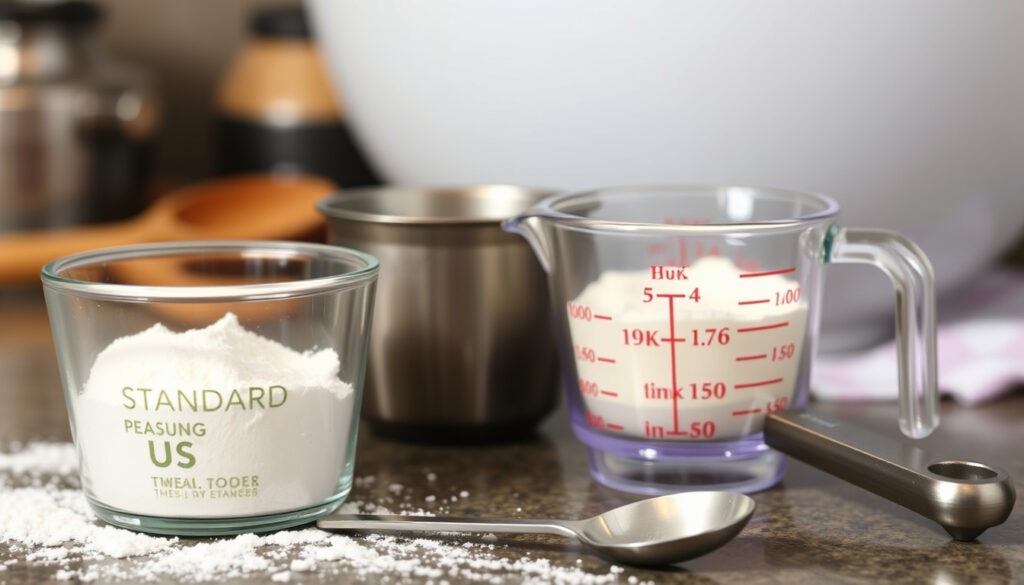
How Many Tablespoons in a Cup? Easy Conversion Guide – US & UK
If you’ve ever stood in the middle of a recipe feeling a little lost, you’re not alone. Figuring out exactly how many tablespoons are in a cup is one of the most common kitchen questions — and getting it right can mean the difference between a perfect cake and a flop.
Tablespoons in 1 cup (US standard): 16 tablespoons ·
Tablespoons in 1/2 cup: 8 tablespoons ·
Tablespoons in 1/3 cup: 5 tablespoons + 1 teaspoon ·
Tablespoons in 1/4 cup: 4 tablespoons ·
Tablespoons in 3/4 cup: 12 tablespoons
Quick snapshot
- Precise tablespoon measurement for packed brown sugar or sifted flour may vary by method
- Some non-US countries (Australia, Canada) use 20 ml tablespoons, making conversions different
- 1 UK cup = 10 UK tablespoons — but some UK recipe charts treat 1 cup as 16 UK tablespoons
- 1/4 cup = 4 tablespoons in US system, but measuring method (scoop vs spoon) can affect actual volume of dry ingredients
- US customary system has been standard since the early 19th century
- UK imperial cup size (10 UK fl oz) diverges from US system
- Check recipe origin (US vs UK) before converting
- Use weight measurements for most consistent results with dry ingredients like flour
The numbers tell a clear story — here are the core conversions you need, backed by official sources.
| Measurement | US Customary | UK Imperial |
|---|---|---|
| 1 cup to tablespoons | 16 tbsp (USDA ARS) | 10 UK tbsp (UnitConverters.net) |
| 1/2 cup to tablespoons | 8 tbsp (USDA ARS) | 5 UK tbsp |
| 1/3 cup to tablespoons | 5 tbsp + 1 tsp (USDA ARS) | 3.33 UK tbsp |
| 1/4 cup to tablespoons | 4 tbsp (Clemson HGIC) | 2.5 UK tbsp |
| 3/4 cup to tablespoons | 12 tbsp (USDA ARS) | 7.5 UK tbsp |
| 1/8 cup to tablespoons | 2 tbsp (USDA ARS) | 1.25 UK tbsp |
| Cup to fluid ounces | 8 fl oz (Kansas State University Extension) | 10 UK fl oz |
| Tablespoon to teaspoons | 3 tsp (USDA ARS) | 3 UK tsp |
How many tablespoons are in a cup?
In the US customary system, which is the standard for nearly all American cookbooks and recipes, one cup equals exactly 16 tablespoons. This is confirmed by the USDA’s measurement conversion table, as well as educational resources like Kansas State University Extension and Clemson HGIC.
A US home baker measuring sugar faces a simple truth: 16 tablespoons per cup is the law of the land — but that rule changes the moment you pick up a UK cookbook.
US vs UK cup differences
- The US customary cup measures 8 fluid ounces, which is equal to 236.59 mL (The Calculator Site)
- The UK imperial cup measures 10 UK fluid ounces, or about 284 mL
- Because the UK tablespoon is also larger (17.76 mL vs 14.79 mL for US), 1 UK cup equals 10 UK tablespoons — not 16 (The Calculator Site)
- If you use US tablespoons in a UK cup, you get 16 US tablespoons — but the volume is still different
Tablespoons in a cup of dry ingredients vs liquid
- By volume, a cup of dry flour and a cup of water both equal 16 tablespoons (USDA ARS)
- However, flour can be packed differently (sifted vs scooped vs spooned), changing its mass while the volume stays the same
- Weight is more reliable for dry ingredients: 1 cup of all-purpose flour weighs about 4.5 ounces (128 g) (King Arthur Baking Company)
The pattern: volume is volume — 16 tablespoons is always 1 US cup. But weight varies. For consistent baking results with flour, weighing is better than counting tablespoons.
Is 1 cup 8 tablespoons?
No. One cup equals 16 tablespoons, not 8. This is a common mistake, often because 8 fluid ounces equals 1 cup, and people confuse fluid ounces with tablespoons. In fact, 8 tablespoons equals exactly 1/2 cup (USDA ARS).
Mixing up 8 vs 16 tablespoons doubles or halves your ingredient — a mistake that turns a cake recipe into soup or a dry lump. The difference between 1/2 cup and 1 cup is the difference between success and a baking fail.
Common measurement mistakes
- Assuming “1 cup = 8 tablespoons” — it’s 1 cup = 8 fluid ounces, but 1 cup = 16 tablespoons
- Using a liquid measuring cup for dry ingredients (or vice versa) — they measure volume the same, but technique differs
- Forgetting to level off dry measuring cups and spoons — a heaping tablespoon can add 25-50% more ingredient
The catch: these three mistakes account for most measurement errors in home kitchens. Memorizing the 16-tablespoon baseline prevents the most common one.
How many tablespoons in a 1/4 cup?
There are 4 tablespoons in 1/4 cup in the US system (Clemson HGIC). This is one of the most frequently searched conversions because 1/4 cup appears in countless recipes for butter, sugar, oil, and liquids.
How many tablespoons in a 1/2 cup?
One half cup equals 8 tablespoons in US customary measurement (USDA ARS). This is a handy midpoint: memorize that 8 tablespoons = 1/2 cup, and you can double or halve from there.
How many tablespoons in a 3/4 cup?
Three quarters of a cup equals 12 tablespoons (USDA ARS). To visualize: 1/2 cup (8 tbsp) plus 1/4 cup (4 tbsp) = 12 tablespoons.
The implication: fraction-to-tablespoon conversions follow a simple doubling pattern — 1/4 (4), 1/2 (8), 3/4 (12), whole (16) — no calculator needed.
How many tablespoons in a cup of flour?
A cup of flour, measured by volume, contains 16 tablespoons — exactly the same as any other ingredient (USDA ARS). The catch is that flour’s density varies dramatically based on how you fill the cup.
How many tablespoons in a cup of water?
- 1 cup of water = 16 tablespoons by volume (The Calculator Site)
- 1 cup of water weighs about 8.3 ounces (236 g)
- Unlike flour, water does not compress, so volume and weight are consistent
How many tablespoons in a cup of sugar?
- 1 cup of granulated sugar = 16 tablespoons by volume (USDA ARS)
- Weight varies: 1 cup granulated sugar ≈ 7 oz (200 g); 1 cup brown sugar (packed) ≈ 7.5 oz (213 g)
- Powdered sugar is lighter — 1 cup ≈ 4 oz (113 g)
How many tablespoons in a cup of butter?
Butter is the easiest ingredient to convert. One cup of butter equals 2 sticks, and each stick equals 8 tablespoons. So 1 cup of butter = 16 tablespoons (King Arthur Baking Company). Most butter wrappers are marked in tablespoons for easy cutting.
How many tablespoons in a cup of milk?
- 1 cup of milk = 16 tablespoons by volume (USDA ARS)
- Weight: 1 cup of whole milk ≈ 8.6 oz (244 g)
- Milk, like water, is consistent — no packing or sifting needed
What is 1 cup in UK tablespoons?
In the UK imperial system, 1 cup equals 10 UK tablespoons (UnitConverters.net). This is because the UK cup is larger (10 UK fl oz, about 284 mL) and the UK tablespoon is larger (17.76 mL vs 14.79 mL for US).
A cook using a UK recipe with US measuring spoons will inadvertently add 60% more volume per tablespoon. The opposite is also true — a US recipe made with UK spoons will be short on ingredient. Always confirm which system your recipe uses.
How many tablespoons are in 1/4 cup of the UK?
- 1/4 UK cup = 2.5 UK tablespoons
- 1/4 UK cup = about 4 US tablespoons (since US tablespoons are smaller)
- Always check whether “tablespoon” means US or UK when reading international recipes
The pattern: UK conversions require their own set of multipliers. The 10-tablespoon-per-cup rule for UK is as foundational as the 16-tablespoon rule for US.
How do I convert tablespoons to cups?
The conversion between tablespoons and cups is straightforward because it’s a simple division. To convert tablespoons to cups, divide the number of tablespoons by 16. The formula is: cups = tablespoons / 16. To go the other way: tablespoons = cups × 16.
Conversion formula for tablespoons to cups
- 2 tbsp ÷ 16 = 1/8 cup
- 4 tbsp ÷ 16 = 1/4 cup
- 5.33 tbsp ÷ 16 = 1/3 cup
- 8 tbsp ÷ 16 = 1/2 cup
- 12 tbsp ÷ 16 = 3/4 cup
- 16 tbsp ÷ 16 = 1 cup
- 32 tbsp ÷ 16 = 2 cups (1 pint)
The implication: this formula is your best friend in the kitchen. Memorize the 16-tablespoons-per-cup base, and every other conversion is just multiplication or division.
Step-by-step guide: Measuring ingredients correctly
- Choose the right cup: Use a dry measuring cup for dry ingredients (flour, sugar, oats) and a liquid measuring cup for liquids (water, milk, oil).
- For dry ingredients like flour: Spoon the flour into your measuring cup until it overflows, then level it off with a straight edge (like a knife). Do not scoop directly with the cup — that packs the flour and adds up to 20% more by weight.
- For brown sugar: Pack it firmly into the cup so it holds the shape when turned out. Level the top.
- For butter: Use the markings on the wrapper to cut the needed tablespoons. One stick = 8 tbsp = 1/2 cup.
- For liquids: Pour into a liquid measuring cup set on a flat surface. Bend down to read the measurement at eye level.
- For sticky ingredients (honey, molasses): Lightly spray the measuring cup or spoon with nonstick spray before measuring — the ingredient will slide out cleanly.
The catch: proper measuring technique matters as much as knowing the conversion. A “cup of flour” can vary by 1-2 ounces depending on your method, which is enough to change a recipe’s texture.
Summary
Knowing that one US cup equals 16 tablespoons is the single most important kitchen conversion you can learn — it unlocks every fraction and every ingredient. For a home cook in the US, the choice is clear: memorize the base, use proper measuring tools, and when precision matters most (baking), switch to a kitchen scale. The 16-tablespoon rule is your safety net, but weight is your upgrade.
unitconverters.net, unitconverters.net, inchcalculator.com, arahr.com, cookingcalcs.com, infoplease.com, recipeland.com, hgic.clemson.edu, mathda.com
Frequently asked questions
How many tablespoons in 1 cup of dry ingredients?
For all dry ingredients measured by volume, 1 US cup equals 16 tablespoons. However, weight varies: 1 cup all-purpose flour ≈ 128 g, while 1 cup granulated sugar ≈ 200 g. For best precision, use a scale (King Arthur Baking Company).
How many tablespoons in 1 cup of liquid?
1 US cup of any liquid = 16 tablespoons by volume. This includes water, milk, oil, and broth. Liquid measuring cups are recommended for accuracy (The Calculator Site).
Does 8 tablespoons equal 1 cup?
No. 8 tablespoons equals 1/2 cup, not 1 cup. One full cup requires 16 tablespoons (USDA ARS).
How many tablespoons in a cup of butter?
1 cup of butter = 2 sticks = 16 tablespoons. Each stick is marked with tablespoon increments for easy cutting (King Arthur Baking Company).
How many tablespoons in a cup of flour?
1 cup of all-purpose flour = 16 tablespoons by volume. However, the weight can vary from 4 to 5 ounces depending on measuring method. Spooning and leveling gives the most consistent volume measurement (King Arthur Baking Company).
How many tablespoons in a cup of sugar?
1 cup of granulated sugar = 16 tablespoons by volume, weighing about 200 g. Brown sugar (packed) is similar in volume but slightly heavier (King Arthur Baking Company).
Is there a difference between a US cup and a UK cup?
Yes. The US cup is 8 US fluid ounces (236.59 mL) and equals 16 US tablespoons. The UK cup is 10 UK fluid ounces (about 284 mL) and equals 10 UK tablespoons. A UK tablespoon is also larger (17.76 mL vs 14.79 mL) (The Calculator Site).
How many tablespoons in a cup of milk?
1 cup of milk = 16 tablespoons by volume, weighing about 244 g. Like other liquids, milk is measured consistently by volume (USDA ARS).
More related posts
 Beauty in Black Cast: Who’s Who in Tyler Perry’s Netflix Series
 What Is an ROI? Definition, Formula & Examples
 Trim County Meath Weather Forecast & Current Conditions | Met Éireann
 Where is the Black Sand Beach in Iceland? Reynisfjara Location
 Where Can I Find My Child’s PPS Number Online – Recovery Guide for Ireland
 How to Fix Slow Boot Mac: Step-by-Step Guide (2025)
 Dunnes Stores Ravioli Gluten Recall: Refund Details
 Credit Union New Ross Guide: Services, Rates, and Benefits