How Many Hours in a Year – 8,760 Common, 8,784 Leap
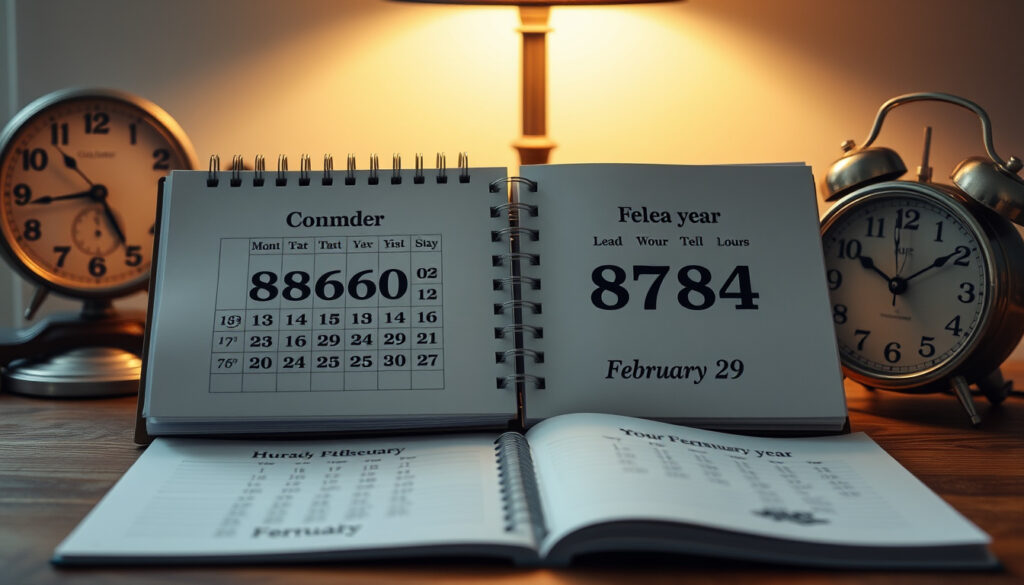
The question of how many hours exist in a year appears straightforward, yet the answer varies depending on calendar conventions. A standard common year contains exactly 8,760 hours, while a leap year adds an extra day to reach 8,784 hours. These calculations stem from fundamental arithmetic: 365 or 366 days multiplied by 24 hours per day. Understanding these distinctions matters for scheduling, billing cycles, and scientific measurements.
This breakdown examines the precise calculations behind yearly hour counts, explores how leap year rules affect the totals, and provides context for why calendars incorporate these adjustments. The information draws from established timekeeping standards and calendar mathematics used across scientific and civil applications.
How Many Hours Are in a Standard Year?
A standard (non-leap) Gregorian calendar year comprises 365 days. Multiplying this by the 24 hours each day contains yields exactly 8,760 hours annually. This figure forms the baseline for most time-related calculations in business, education, and everyday life.
The formula remains consistent: Days × 24 = Total Hours. For 365 days, the calculation produces 8,760 hours with no exceptions under the Gregorian system.
8,760 hours
8,784 hours
~8,766 hours
Days × 24
Key Calculations and Insights
- Exact arithmetic yields 365 × 24 = 8,760 hours for any common year
- Leap years occur every four years, adding 24 additional hours
- The Julian calendar used 365.25 days, averaging to 8,766 hours
- Civil timekeeping relies on mean solar days of exactly 24 hours
- Different calendar systems may produce varying hour totals
- Business calculations often use 2,080 working hours annually (52 weeks × 40 hours)
- A century contains approximately 876,576 hours based on average year lengths
Hours in Common vs. Leap Years
| Year Type | Days | Hours | Minutes |
|---|---|---|---|
| Common (Non-Leap) | 365 | 8,760 | 525,600 |
| Leap Year | 366 | 8,784 | 527,040 |
| Average (365.25 days) | 365.25 | 8,766 | 525,960 |
| Gregorian Mean | 365.2425 | 8,765.82 | 525,949.2 |
How Many Hours in a Leap Year?
Leap years contain 366 days, producing 8,784 hours annually. This additional day compensates for the fact that Earth actually orbits the Sun in approximately 365.2425 days, not the neat 365 days our calendars assume. Without these corrections, seasons would gradually drift across calendar dates over centuries.
Leap Year Rules Explained
The Gregorian calendar employs specific rules to determine which years qualify as leap years. A year must be divisible by 4 to be a leap year, but century years (those ending in 00) require an additional condition: they must also be divisible by 400. This produces the precise average of 365.2425 days across a 400-year cycle.
The year 2000 qualified as a leap year because it is divisible by 400. However, 1900 was not a leap year despite being divisible by 4, since it fails the century rule. Future century years such as 2100, 2200, and 2300 will similarly be common years, while 2400 will leap again.
Over a 400-year cycle, the Gregorian calendar includes 97 leap years and 303 common years. This distribution yields the mean length of 365.2425 days, closely approximating the tropical year of approximately 365.2422 days. According to calculations from NASA’s educational resources, this pattern maintains calendar alignment with Earth’s orbital position around the Sun.
Understanding Year Length Variations
Different contexts require different average year calculations. The simplest approximation uses 365.25 days (the Julian calendar method), resulting in 8,766 hours. The more precise Gregorian average of 365.2425 days produces 8,765.82 hours. These distinctions matter primarily for scientific applications and long-term calendar planning.
Why Leap Years Exist
Earth requires roughly 365.2425 days to complete one orbit around the Sun. If calendars simply used 365 days, the accumulated error would shift seasons by approximately 24 days after 100 years. This misalignment would eventually place winter months in summer positions and disrupt agricultural cycles, religious festivals, and astronomical observations tied to specific dates.
The insertion of leap days keeps civil calendars synchronized with Earth’s position in its orbit. This system, refined during the Gregorian reform of 1582, replaced the earlier Julian calendar that had accumulated significant drift over previous centuries. The adjustment eliminated 10 days in October 1582 to realign the calendar with astronomical events. Historical records from the Library of Congress document this significant reform in timekeeping history.
Minutes and Seconds in a Year
Beyond hours, many find it useful to understand yearly time in smaller units. A common year contains 525,600 minutes (8,760 × 60) and 31,536,000 seconds (525,600 × 60). During leap years, these figures increase to 527,040 minutes and 31,622,400 seconds respectively.
To convert annual hours to minutes, multiply by 60. For seconds, multiply the minute total by 60 again. These conversions follow consistent ratios: 1 hour = 60 minutes = 3,600 seconds.
These expanded calculations prove useful for billing software, payroll systems, and scientific experiments requiring precise time intervals. Many productivity applications and project management tools calculate work hours into minutes for billing purposes, with 2,080 annual work hours (52 weeks × 40 hours) serving as a standard business baseline.
The Gregorian Calendar and Time Standards
The Gregorian calendar’s structure reflects centuries of astronomical observation and mathematical refinement. Its leap year system represents a balance between simplicity and accuracy, ensuring that seasonal markers remain relatively stable across generations. According to resources maintained by time.gov and various educational institutions, this calendar serves as the foundation for civil timekeeping worldwide.
- 1582: Pope Gregory XIII introduces Gregorian calendar reform, removing 10 days to correct accumulated Julian calendar drift
- 1700: First major century year under new rules—common year despite being divisible by 4
- 1800: Another century common year; calendar drift from seasonal markers becomes noticeable
- 1900: Third century common year; Gregorian rules fully applied and understood globally
- 2000: First Gregorian century leap year; 400-year cycle completes with special celebration
Time measurement standards continue to evolve, with organizations like the National Institute of Standards and Technology maintaining the precision necessary for modern technological and scientific applications. These standards ensure consistency across global timekeeping systems.
Key Facts About Hours in a Year
The mathematics behind yearly hour calculations remains certain and universally applicable. The distinction between 8,760 and 8,784 hours depends entirely on whether the year contains 365 or 366 days. The factors determining this classification follow clear divisibility rules with no ambiguity.
| Established Information | Context-Dependent Details |
|---|---|
| Common year = 365 days = 8,760 hours | Business year varies by accounting method |
| Leap year = 366 days = 8,784 hours | Working hours depend on employment contracts |
| Formula: Days × 24 = Hours | Julian calendar uses different average |
| Leap year rules: divisible by 4 (century exception) | Some cultures use lunar calendars with different lengths |
Uncertainty primarily arises when considering non-Gregorian calendar systems or specialized applications. Lunar calendars, fiscal years that differ from calendar years, and varying work hour definitions can produce different totals. However, the core astronomical and mathematical facts regarding the Gregorian calendar remain fixed and calculable.
Sources and Time Standards
The hour calculations presented here derive from established timekeeping standards and widely-used reference materials. Sources including RapidTables, NASA educational resources, and various academic repositories confirm these figures through consistent mathematical methods.
The Gregorian calendar approximates the tropical year with an average of 365.2425 days, yielding 8,765.82 hours through the formula (365 + 1/4 – 1/100 + 1/400) × 24.
— Calculation standards referencing NASA and astronomical institutions
These standards align with civil timekeeping maintained by national metrology institutes. While these organizations primarily focus on atomic time and leap second adjustments (27 leap seconds have been added since 1961), the underlying day length of exactly 24 hours remains the foundation for calendar hour calculations.
For those interested in related calendar phenomena, the Phases of the Moon – 8 Stages and Cycle Timeline explores lunar cycles that many cultures integrate with calendar systems. Similarly, understanding how yearly calculations affect event scheduling proves relevant for annual fixtures like Listowel Races 2025 Dates – Schedule, Fixtures and Ticket Guide.
Summary
The answer to how many hours exist in a year depends on whether you measure a common or leap year. A standard year contains 8,760 hours (365 × 24), while a leap year adds 24 hours to reach 8,784. The average across the Gregorian calendar’s 400-year cycle works out to approximately 8,766 hours when using the Julian approximation, or more precisely 8,765.82 hours under full Gregorian rules. These figures derive from straightforward multiplication and reflect centuries of astronomical refinement in calendar design.
Frequently Asked Questions
How many minutes are in a year?
A common year contains 525,600 minutes (8,760 × 60). A leap year contains 527,040 minutes (8,784 × 60).
How many seconds are in a year?
A common year has 31,536,000 seconds, while a leap year has 31,622,400 seconds. These are calculated by multiplying minutes by 60.
Does a year always have 365 days?
No. While common years have 365 days, leap years have 366 days. The pattern follows specific divisibility rules established by the Gregorian calendar.
What is the average number of hours in a year?
The Gregorian calendar averages 365.2425 days per year, yielding approximately 8,765.82 hours over a 400-year cycle. A simpler Julian approximation uses 365.25 days and 8,766 hours.
How do you calculate hours in a year?
Multiply the number of days by 24 hours. For a 365-day year: 365 × 24 = 8,760. For a 366-day year: 366 × 24 = 8,784.
Is 8784 hours a year?
Yes, 8,784 hours occur during leap years, which contain 366 days. This is 24 hours more than a standard common year.
Why do some years have 366 days?
Leap years exist to keep calendars aligned with Earth’s orbit around the Sun. Earth takes approximately 365.2425 days to complete one orbit, so an extra day is added every four years to prevent seasonal drift.
What years are leap years?
Years divisible by 4 are leap years, except century years (ending in 00) which must also be divisible by 400. This means 2000 was a leap year, but 1900 and 2100 are not.
More related posts
 The Grey Cat in Reykjavík, Iceland: Not a Bar, But a Breakfast Café
 The Dubliners Grace Lyrics: Meaning, Story & History
 6 Week Plan Ozempic Weight Loss Results: What to Expect
 Best Running Shoes for Men: Irish Buying Guide 2025
 Robert F. Kennedy: Biography, Assassination, and Legacy
 Wrexham vs Ipswich Town: FA Cup Result, H2H & TV Guide
 Simple Brown Bread Recipe: Authentic Irish Loaf
 SEO Content Blueprints: Structured Frameworks for Modern Publishing