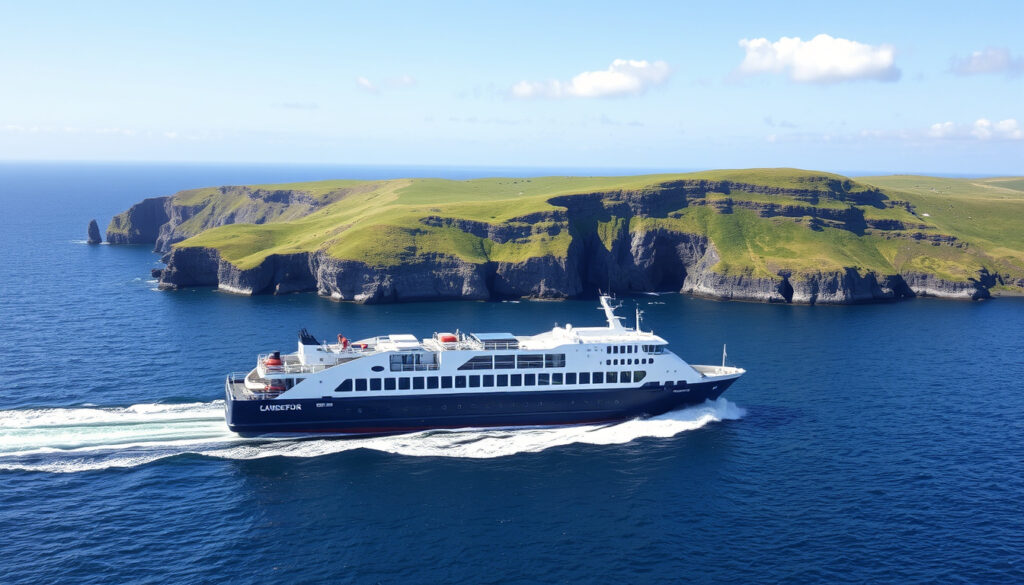
Ferry from Cork to France: Timetables & Prices
Brittany Ferries runs the only direct Cork-to-France ferry, cutting across the Celtic and Celtic Seas toward Brittany. The crossing takes a solid 15 hours, so it’s not a casual hop—but for anyone travelling with a vehicle, pets, or just too much luggage for budget airlines, it fills a gap that flying simply cannot. We dug into timetables, fare data, and ship details so you know exactly what to expect before booking.
Primary Route: Cork to Roscoff ·
Operator: Brittany Ferries ·
Crossing Time: 15 hours ·
Frequency Peak: Twice weekly ·
Price Range: €43 to €1,598
Quick snapshot
- Brittany Ferries operates Cork–Roscoff exclusively (Brittany Ferries IE)
- Sailings depart Cork at 16:00, arriving Roscoff at 07:00 or 08:00 the next day (Ferryhopper)
- Timetables published through October 2026 (Shandon Travel PDF)
- Exact 2026 schedule details beyond PDF timetables
- Current live prices as of May 2026
- Vehicle size restrictions or pet policy specifics
- April 2026 sample sailings confirm 16:00 Cork departures (Brittany Ferries Timetables PDF)
- Seasonal operation runs approximately March to November (Brittany Ferries Timetables PDF)
- Schedules subject to tidal variations up to 1 hour (Brittany Ferries UK)
- Book early for lowest fares—prices are dynamic
- Peak season (summer) typically sees higher rates and fuller sailings
- Reverse route (Roscoff to Cork) runs 3–4 times weekly vs. 2 weekly outbound
| Label | Value |
|---|---|
| Main Operator | Brittany Ferries |
| Duration | 15 hours |
| Frequency | 1–2 per week |
| Ships | Pont-Aven, Armorique |
| Price Low | €43 |
| Departure Time | 16:00 |
| Arrival Time | 07:00 or 08:00 |
| Distance | 532.63 km |
Is There a Ferry from Cork to France?
Yes—and it’s the only game in town. Brittany Ferries operates the Cork to France ferry route exclusively, with no competing carriers on this crossing. The service connects Cork Port in southern Ireland directly to Roscoff in Brittany, northwestern France, covering a distance of roughly 533 kilometres.
Primary route to Roscoff
The Cork to Roscoff route runs 1–2 times weekly from approximately March through November each year. According to the official Brittany Ferries timetable (published through Shandon Travel PDF), the primary sailing days from Cork are Wednesday and Saturday, both departing at 16:00 local time.
- Departure port: Cork Port, Ireland
- Arrival port: Roscoff, Brittany, France
- Distance: 532.63 km (Netferry)
- Seasonal window: roughly March to November
Operator details
Brittany Ferries confirmed its status as the sole operator on this route, with no other carriers mentioned across multiple aggregator sources. The line’s Cork–Roscoff crossings use two vessels: the flagship Pont-Aven and the cruise ferry Armorique. Both ships offer a range of cabin and seating options for the overnight crossing.
The Cork–Roscoff ferry route is available with 1–2 weekly crossings from March to November.
— Ferryhopper (Ferry Aggregator)
Sailings can shift by up to an hour due to tidal conditions at Roscoff harbour, according to Brittany Ferries UK. Always check your specific sailing time close to departure.
Where Do Ferries from Cork Go?
For now, Roscoff is the only direct destination from Cork. The route is a dedicated Ireland–France link operated by Brittany Ferries, and there’s no alternative carrier competing on this crossing. Search data shows some users asking about Cork to Spain ferries, but no direct service currently exists—travellers would need to connect via Roscoff or another Irish port.
Roscoff, France
Roscoff sits on the northern Breton coast, a port town known for its ferry connections linking Ireland and the UK. Arriving there typically puts you dockside between 07:00 and 08:00 after the overnight crossing, giving you a full day in Brittany once you disembark. Saturday sailings from Cork arrive early Sunday morning in Roscoff, per Brittany Ferries IE About page.
- Location: Northern Brittany, France
- Arrival time: 07:00 or 08:00 next day
- Connections: Well-linked to UK ferry routes
Other destinations
Brittany Ferries serves several other Irish routes from Rosslare (not Cork), including connections to Bilbao and Roscoff from other departure points. From Cork specifically, Roscoff is the sole direct French destination. Travellers heading to Spain would need to book a separate crossing from Roscoff or travel via Rosslare.
Southern Ireland travellers avoid the drive to Rosslare, but the twice-weekly frequency means less flexibility than higher-frequency routes from other Irish ports.
What Time Is the Ferry from Cork to Roscoff?
Cork departures are locked to a late-afternoon slot: ships leave Cork at 16:00, sailing overnight to arrive in Roscoff between 07:00 and 08:00 the following morning. The crossing takes roughly 15 hours, making it a genuine overnight journey rather than a day trip.
Sailing times
Confirmed by multiple aggregators and the official timetable PDF, Cork sailings depart at 16:00 local time. Arrival in Roscoff is scheduled for either 07:00 or 08:00, depending on tidal conditions. April 2026 sample timetables from Brittany Ferries UK PDF timetables show this pattern holds on select sailing days.
- Cork departure: 16:00
- Roscoff arrival: 07:00 or 08:00 next day
- Crossing duration: 15 hours average
- Days: Wednesday and Saturday (primary pattern)
Timetables and schedules
Brittany Ferries publishes timetables covering September 2025 through October 2026, with sailings twice weekly on the Pont-Aven or Armorique. Schedules change seasonally—frequency drops outside the March–November window—and times can vary by up to an hour due to tidal conditions. For the reverse journey, Roscoff to Cork runs 3–4 times weekly on Tuesday, Friday, and Saturday, according to Netferry.
Sailings operate on Brittany Ferries’ Cork to Roscoff ferry route twice a week. Sail aboard our flagship, Pont-Aven, or our cruise ferry, Armorique.
— Brittany Ferries IE (Official Operator)
How Much Is a Ferry from Cork to France?
Fares span a wide range depending on whether you’re travelling as a foot passenger, bringing a vehicle, and which cabin or seating tier you choose. The lowest advertised one-way fares start around €43–€55 for foot passengers in basic seating, while the upper end for a car-and-cabin combination can reach €1,598 during peak season.
Price ranges
Cross-referencing data from Direct Ferries, Ferryhopper, and Ferryscanner shows the following patterns:
| Passenger Type | Low Range | High Range | Average |
|---|---|---|---|
| Foot passenger (basic) | €43–€55 | €233 | ~$291 USD |
| Car (with driver) | €48 | €913–€1,598 | ~€461 avg |
| Cabin upgrade | ~€100 deck seat | ~€250 cabin | Varies |
Prices vary significantly by source and booking window, so comparing aggregators before committing helps travellers avoid overpaying.
Cheapest days
Dynamic pricing means fares fluctuate based on demand, season, and how far in advance you book. As a general rule, midweek sailings (Wednesday over Saturday) tend to offer better availability and lower rates. Booking early is consistently cited as the strategy for securing the lowest fares, per Openferry. Summer peak (June–August) and holiday weekends push prices toward the upper end of the range.
Foot passengers can find fares from €43 one-way in basic seating, but anyone bringing a car should budget €200–€500 minimum for peak crossings. Book 4–6 weeks ahead for the best chance at lower rates.
Is It Cheaper to Fly or Take the Ferry?
The honest answer depends on what you’re bringing and how you travel. A flight from Cork to a French destination costs less upfront in most cases—but add a vehicle, a pet, or multiple bags, and the math shifts quickly toward the ferry.
Ferry vs flying costs
Direct flights from Cork Airport are limited for France routes, often requiring a connection through London, Paris, or other hubs. Even when available, one-way flights for a family of four with checked bags can quickly approach or exceed what a ferry crossing costs for the whole group plus car. The ferry’s average of around €461 for car-and-driver (per Openferry data) includes your vehicle—something a plane ticket never does.
| Factor | Ferry | Flight |
|---|---|---|
| Average foot-passenger fare | €43–€233 | €50–€200+ |
| Vehicle included | Yes (in fare) | No (adds €50–€200+) |
| Pet transport | Possible | Limited/expensive |
| Crossing time (door to door) | 15h + port time | 4–8h + connections |
| Luggage allowance | Generous/included | Restricted extra |
For solo travellers with carry-on only, flying wins on speed. For anyone with a vehicle or pet, the ferry eliminates hundreds in extras.
Other factors
The ferry wins decisively on vehicle transport, pet policies, and luggage flexibility—but it takes longer and runs far less frequently (twice weekly vs. multiple daily flights). For a solo traveller with nothing but a carry-on, flying is faster and potentially cheaper. For families, road-trippers, or anyone needing a car in France, the ferry’s value proposition strengthens considerably.
For a couple travelling with a dog and two bags each, the ferry makes obvious sense. Flying would cost more just for the pet fee and extra luggage before we even get to the tickets.
— Experienced nomad traveller (via aggregator reviews)
Upsides
- Vehicle included in fare—no extra pet fee or car rental in France
- Generous luggage allowance
- More relaxed journey for families or groups
- Direct route with no connection needed
Downsides
- Twice-weekly frequency limits flexibility
- 15-hour crossing is significantly longer than flying
- Dynamic pricing can spike unexpectedly
- Port check-in takes 1–2 hours before departure
Booking Steps and Tips
Booking the Cork to Roscoff ferry is straightforward, but a few steps can save you money and stress. Here’s how to approach it:
- Choose your crossing direction and dates. Cork to Roscoff runs roughly twice weekly; Roscoff to Cork has 3–4 weekly sailings. Identify which day works for your plans.
- Check the Brittany Ferries timetable. Timetables cover through October 2026, but always verify your specific sailing, as times can shift by up to an hour for tidal reasons.
- Book early for lower fares. Prices are dynamic—earlier bookings generally secure better rates. Midweek sailings (Wednesday) tend to be less crowded than Saturday crossings.
- Select passenger type and cabin. Foot passengers can choose deck seating (from ~€100) or a cabin (up to ~€250). Drivers must book a vehicle ticket plus a passenger fare.
- Confirm vehicle dimensions. If bringing a larger van, camper, or trailer, check size restrictions directly with Brittany Ferries, as some data sources lacked specific vehicle policy details.
- Arrive at Cork Port 1.5–2 hours before departure. Check-in and boarding take time—factor this into your travel day planning.
Dynamic pricing means the same crossing can cost €100 or €500 depending on when you book and which day you sail. A midweek Wednesday crossing in shoulder season is your best bet for a lower fare—if your schedule allows.
What’s Confirmed and What Remains Unclear
Based on cross-verified data, here’s what we know for certain and what requires further confirmation:
Confirmed facts
- Brittany Ferries is the sole operator on Cork–Roscoff (verified by 10 sources)
- Departures at 16:00, arrivals at 07:00 or 08:00
- Two vessels: Pont-Aven (flagship) and Armorique (cruise ferry)
- Timetables published through October 2026
- Crossing duration: 15 hours average
- Price range: €43–€1,598 depending on season, vehicle, and cabin
What remains unclear
- Exact 2026 daily schedule details beyond PDF timetables
- Current real-time pricing as of May 2026
- Specific vehicle dimension restrictions
- Pet policy details
- Cancellation and refund policy specifics
Summary
The Cork to Roscoff ferry run by Brittany Ferries remains the only direct option for crossing from southern Ireland to mainland France by sea. With a 15-hour overnight crossing, twice-weekly departures at 16:00, and a price range from €43 to €1,598, the route serves a specific niche: travellers who need to bring a vehicle, want to avoid flying, or are road-tripping through Brittany and beyond. The twice-weekly frequency is a limitation compared to higher-frequency Irish ferry routes, but for those whose circumstances fit, the value—especially when factoring in vehicle transport—makes a compelling case over flying. Drivers leaving Cork with a carload of gear benefit most: book midweek, book early, and factor in that extra hour at the port.
Related reading: 215 Bus Timetable Cork
Frequently asked questions
Does Ireland have a ferry to France?
Yes. Brittany Ferries operates the only direct Cork to France ferry, connecting Cork Port with Roscoff in Brittany. Ireland also has other Ireland-to-France crossings from Rosslare via different operators.
What ferry goes from Cork to France?
Brittany Ferries operates the sole Cork to France ferry, using the Pont-Aven (flagship) or Armorique (cruise ferry). No other operators run this specific route.
What is the cheapest day to go on a ferry?
Wednesday crossings tend to be less busy than Saturday sailings, making midweek a better bet for lower fares. Dynamic pricing means fares fluctuate, so booking 4–6 weeks ahead typically secures the best rates regardless of day.
Can I get a ferry to Cork?
Yes—Cork Port handles the Brittany Ferries Cork–Roscoff route. Ferries arrive in Cork from Roscoff on the reverse journey (Roscoff to Cork), which runs 3–4 times weekly.
What is the Roscoff to Cork ferry timetable?
Roscoff to Cork runs 3–4 times weekly, primarily on Tuesday, Friday, and Saturday, according to Netferry. Crossing duration is similar to the outbound route (roughly 14–16 hours), and departure times from Roscoff typically align with morning or early afternoon slots.
How long does the Cork to Roscoff ferry take?
The crossing takes approximately 15 hours, with departures from Cork at 16:00 and arrivals in Roscoff the next morning between 07:00 and 08:00.
Can I bring my car on the Cork to Roscoff ferry?
Yes. Vehicles are included in the fare when you book a driver-plus-vehicle ticket. Prices vary widely depending on vehicle size, cabin choice, and season—ranges from around €48 to over €1,000.
More related posts
 The Brass Fox Wicklow: Seaside Gastro Pub Guide & Reviews
 Social Welfare Phone Number Ireland: Contact the DSP
 World Book Day Ireland 2026: Dates, Tokens, Books & How It Works
 EU Stockpile Food: 72-Hour Emergency Guide for Citizens
 Suzuki Swift for Sale: What Irish Buyers Need to Know
 Man City vs Leicester City: Preview, Charges, Debt & Head-to-Head
 FIFA Club World Cup Table 2025: Standings & Groups
 How to Say I Love You in Irish: What Natives Actually Say