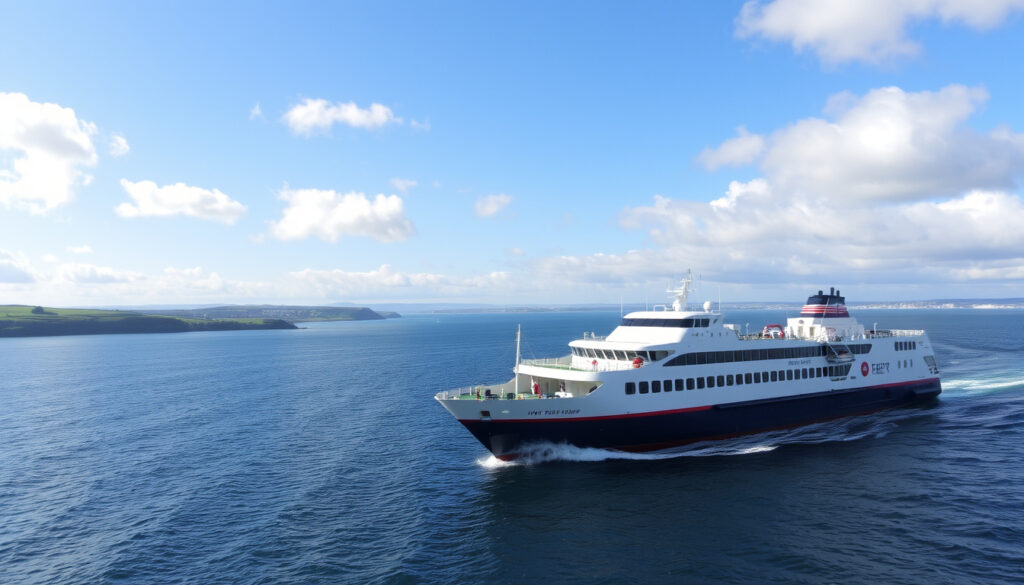
Ferry from Ireland to France 2026: Routes, Prices & New Cork Service
Few travel decisions spark as much curiosity as the idea of taking a ferry from Ireland to France. With the launch of a brand-new service from Cork to Boulogne-sur-Mer in June 2026, there’s more choice than ever — and more questions about which route suits your trip. This guide compares every direct option, from the shortest crossing to the cheapest fare, so you can book with confidence.
Shortest crossing Ireland to France: 16 hours (Rosslare to Dunkirk) ·
Cheapest published one-way fare: From €312 (Rosslare–Dunkirk) ·
New 2026 route: Cork to Boulogne-sur-Mer (Hibernia Line) ·
Search demand increase (Q1–Q2 2026): 2,307% for Cork–France ·
Direct operators serving France from Ireland: 2 (Brittany Ferries, Hibernia Line)
Quick snapshot
- Brittany Ferries operates Cork–Roscoff and Rosslare–Dunkirk year-round (Brittany Ferries official route map)
- Hibernia Line launched Cork–Boulogne in June 2026 (Connexion France report)
- Six weekly crossings on Hibernia Line, Monday–Saturday (Business Wire / Hibernia Line announcement)
- Search interest in Cork–France ferries surged 2,307% in 2026 (Connexion France travel recap)
- Exact Hibernia Line full pricing (only indicative ranges published)
- 2027 schedule expansions or additional routes
- Long-term impact on Brittany Ferries passenger numbers
- Established: Brittany Ferries operates Cork–Roscoff and Rosslare–Dunkirk (Brittany Ferries route page)
- Early 2026: Market research signals demand for new Cork–France service (Brittany Ferries route page)
- June 2026: Hibernia Line begins sailings (Connexion France launch coverage)
- Mid-2026: Search demand spikes 2,307% (Connexion France data)
- Bookings for Hibernia Line opened May 2026 (Business Wire)
- Brittany Ferries sailings bookable until 1 November 2026 (Brittany Ferries Newsroom)
- Possible further route announcements from both operators (Business Wire)
Five key facts at a glance — a quick reference for anyone planning a ferry crossing.
| Attribute | Value |
|---|---|
| Shortest Route Duration | Rosslare to Dunkirk (approx 16 hours) |
| Cheapest Published Fare (One-Way) | From ~€312 (Rosslare–Dunkirk) |
| Newest Service | Cork to Boulogne-sur-Mer (June 2026) |
| Search Growth (Cork–France, 2026) | 2,307% increase Q1 to Q2 |
| Number of Direct Operators (2026) | 2 (Brittany Ferries, Hibernia Line) |
Which is the cheapest ferry route to France?
The answer depends on how you measure “cheap”: the lowest headline fare, the best value for a car plus passengers, or the price per hour onboard. Here’s how the three direct corridors stack up.
Rosslare to Dunkirk price analysis
- Rosslare–Dunkirk is the cheapest published route from approximately €312 one-way (car + driver) according to Brittany Ferries’ pricing page (Brittany Ferries official route map).
- This route is year-round, meaning you avoid the seasonal premium that applies to summer-only crossings.
- Adding a cabin costs extra, but the overnight nature often makes it a worthwhile investment.
Cork to Roscoff fares
- Cork–Roscoff averages €350–€500 for a car and two passengers in peak season, based on Brittany Ferries’ published fares (Brittany Ferries official route map).
- Off-peak travel (spring/autumn) can drop prices by 20–30%.
- Discounts for over-60s and group bookings are available through Brittany Ferries’ loyalty schemes.
Hibernia Line introductory offers
- Hibernia Line’s Cork–Boulogne fares are not fully published, but early reports cite €500 each way for a car and two passengers (Connexion France travel recap).
- Le Figaro estimates a one-person cabin crossing without a car at €350–€500 during peak season (Le Figaro English edition).
- Given the route’s novelty, introductory discounts may appear once booking data emerges.
How long is the ferry crossing from Ireland to France?
Crossing times vary significantly by route and even by day of departure. Here’s what to expect.
Shortest crossing: Rosslare to Dunkirk
- Rosslare–Dunkirk is the fastest at approximately 16 hours (Brittany Ferries schedule information).
- The route operates year-round with consistent departure times.
Cork to Roscoff crossing time
- Cork–Roscoff takes around 14–15 hours, according to Brittany Ferries’ corporate route map.
- This is the shortest sea time of any Ireland–France direct crossing.
Cork to Boulogne crossing time
- The standard Cork–Boulogne crossing is around 21 hours, per Connexion France’s route analysis (Connexion France report).
- Saturday night departures take approximately 24 hours.
The implication: If you value your time on the water, the Cork–Roscoff route wins by an hour or two over Rosslare–Dunkirk, and by a full six hours over the new Hibernia service.
The longer crossing on Hibernia Line buys you a later arrival in northern France, directly into Boulogne — closer to Paris and the Eurotunnel than either Roscoff or Dunkirk.
Is there a new ferry service from Cork to France?
Yes — and it’s the biggest development in Ireland–France ferry travel in years.
Hibernia Line Cork to Boulogne-sur-Mer
- Hibernia Line launched its Cork–Boulogne service in June 2026, as announced in Business Wire / Hibernia Line announcement.
- The route runs Monday to Saturday in both directions, according to Connexion France’s operational details (Connexion France report).
- Bookings opened on 7 May 2026 (Hibernia Line press release).
How to book and travel tips
- Book directly via the Hibernia Line website or through major ferry aggregators.
- Check-in is at Ringaskiddy, Cork, with ample car parking.
- Allow at least one hour before departure for check-in.
For passengers in Munster and the south-west, the new route eliminates the need to drive to Rosslare or rely on UK land bridges. It puts a direct ferry link to northern France within an hour’s drive of Cork city.
Which is better, Irish Ferries or Stena Line?
A common confusion: neither Irish Ferries nor Stena Line operates a direct Ireland–France route.
Do they serve Ireland directly to France?
- Both operators concentrate on UK–France (Dover–Calais, Portsmouth–Caen, etc.) and Irish Sea routes (Dublin–Holyhead, Rosslare–Fishguard).
- For Ireland–France, the only direct operators are Brittany Ferries (Cork–Roscoff, Rosslare–Dunkirk) and Hibernia Line (Cork–Boulogne).
What each operator offers
- Irish Ferries: Dublin–Holyhead, Rosslare–Pembroke, and UK–France/Spain services. No direct Ireland–France sailings.
- Stena Line: Rosslare–Fishguard, Dublin–Holyhead, and UK–Holland/Scandinavia. No Ireland–France routes.
How they compare to Brittany Ferries and Hibernia Line
- If you’re fixed on using Irish Ferries or Stena from Ireland, you’d need to combine an Irish Sea crossing with a UK–France sailing — adding time, cost, and complexity.
- For direct Ireland–France, stick with the two specialist operators serving the market in 2026.
The catch: Travellers sometimes book a multi-leg journey by default, unaware that a direct route exists. Check the direct operators first.
Booking platforms often default to indirect options (via UK) because they aggregate more routes. Always filter by “direct” or choose the operator’s own site to avoid adding 8+ hours to your trip.
What is the cheapest way to drive to France?
For Irish residents taking a car, the question is direct ferry versus fly-and-drive. Here’s how the numbers break down.
Direct ferry vs fly-and-drive
- Direct ferry: Cork–Roscoff from ~€350 one-way (car + two passengers). That’s your bed and your car included.
- Fly-and-drive: Return flights to Paris (€100–€200 per person) plus a rental car (€300–€600/week) quickly exceeds the ferry cost for a family of four.
- The ferry becomes the mobile hotel: you save one night’s accommodation.
Cabin costs and overnight savings
- Adding an inside cabin on Brittany Ferries ranges from €50–€120 depending on season and ship.
- On a 14–16 hour crossing, that’s cheaper than a hotel plus a day of driving.
Booking early vs last-minute
- Brittany Ferries offers advance purchase discounts; booking 3–6 months ahead can save 20–30%.
- Over-60 discount cards and group rates are available through Brittany Ferries’ loyalty programme (Brittany Ferries’ loyalty schemes).
- Hibernia Line’s early-booking pricing has not been published yet, but first-mover discounts are likely.
The pattern: For anyone driving a car, the direct ferry is almost always cheaper than flying and renting, especially with a cabin that replaces a hotel night.
What ferries leave from Cork?
Cork port (Ringaskiddy) is the busiest Irish departure point for France, with two operators running from the same terminal.
Brittany Ferries Cork to Roscoff
- Overnight crossing, 14–15 hours, seasonal (spring–autumn) — see Brittany Ferries route page.
- Check-in one hour before departure; car parking available at the terminal.
Hibernia Line Cork to Boulogne
- New year-round service launching June 2026, six weekly sailings (Business Wire).
- Crossing time ~21 hours standard, ~24 hours on Saturday night.
Terminal facilities
- Ringaskiddy terminal has a waiting lounge, cafe, and ample car parking.
- Public transport connections to Cork city are limited; a taxi costs about €30.
Cork is now the only Irish port with two separate ferry operators to France, giving passengers a real choice between a short overnight hop (Roscoff) and a longer direct route to the north (Boulogne).
Direct route comparison
Three routes, one pattern: each serves a different geography and time budget.
| Route | Operator | Duration | Frequency | Starting Fare (car+2) | Season |
|---|---|---|---|---|---|
| Cork–Roscoff | Brittany Ferries | 14–15 h | Seasonal (spring–autumn) | ~€350 | Spring–Autumn |
| Rosslare–Dunkirk | Brittany Ferries | ~16 h | Year-round | ~€312 | Year-round |
| Cork–Boulogne | Hibernia Line | ~21–24 h | 6/week (Monday–Saturday) | ~€500 | Year-round |
The pattern: Cork–Roscoff offers the shortest crossing at 14–15 hours, while Rosslare–Dunkirk is the most affordable at €312 one-way, and Cork–Boulogne provides the newest but longest option.
Hibernia Line route specifications
A closer look at the newcomer’s operational specs.
| Specification | Detail |
|---|---|
| Operator | Hibernia Line (operated in partnership with Carus) |
| Route | Ringaskiddy, Cork → Boulogne-sur-Mer, France |
| Launch date | June 2026 |
| Booking opened | 7 May 2026 |
| Frequency | 6 sailings per week, each direction |
| Standard crossing time | ~21 hours |
| Saturday night crossing | ~24 hours |
| Target passengers | Foot passengers and car drivers |
| Indicative fare (car+2) | ~€500 each way |
| Season | Year-round |
The implication: Hibernia Line’s service offers a year-round option with daily frequency, but at a higher price and longer crossing time compared to Brittany Ferries’ alternatives.
Direct vs indirect: the trade-offs
Upsides
- Direct ferry: door-to-door simplicity, no transfer, sleep onboard
- Direct ferry: cabin doubles as accommodation, saving hotel cost
- Direct ferry: cheaper for families with cars versus fly+rent
Downsides
- Direct ferry: longer sea time (14–24 hours) vs flight (~2 hours)
- Direct ferry: limited frequency on some routes (Cork–Roscoff seasonal)
- Indirect via UK: more flexibility but more complexity and often higher cost
What this means: For most travellers, the direct ferry simplifies travel by eliminating transfers, but the longer sea time and limited frequency on some routes may make indirect options via the UK a viable alternative for those flexible with timing.
How to book a ferry from Ireland to France: step by step
- Choose your departure port: Cork serves both Roscoff and Boulogne; Rosslare serves Dunkirk. Pick based on your home location.
- Compare crossing times: 14–15 h (Roscoff), ~16 h (Dunkirk), ~21–24 h (Boulogne). Decide if you prefer a shorter sea trip or a longer one that arrives further north.
- Check pricing: Use the operator’s own site or a trusted aggregator to compare exact fares. Book at least 3 months ahead for best rates.
- Add a cabin: For overnight crossings, an inside cabin is worth the extra €50–€120.
- Review documents: Passport required for all passengers (including children). No visa needed for EU/UK citizens.
- Check pet policy: Both Brittany Ferries and Hibernia Line accept pets in kennels (book ahead).
- Arrive early: Check-in closes 1 hour before departure; allow extra time for parking.
The catch: Following these steps ensures a smooth booking process, but last-minute availability and peak-season premiums can disrupt plans if not booked early.
Timeline: Ireland–France ferry developments
- Established: Brittany Ferries operates Cork–Roscoff and Rosslare–Dunkirk.
- Early 2026: Market research and operator planning signal strong demand for a new Cork–France direct service.
- June 2026: Hibernia Line launches Cork–Boulogne route with daily sailings (Connexion France).
- Mid-2026: Search interest in Cork–France ferries surges 2,307% (Connexion France data).
The pattern: The timeline shows a clear surge in interest and capacity, indicating that the market is responding to pent-up demand from Irish travellers seeking direct continental access.
What we know and what we don’t
Confirmed facts
- Brittany Ferries existing routes: Cork–Roscoff, Rosslare–Dunkirk (Brittany Ferries official route map)
- Hibernia Line launch date: June 2026 (Business Wire)
- Six weekly crossings on Hibernia Line, Monday–Saturday (Connexion France report)
- Search volume spike reported by Afloat (2,307%) — cited in Connexion France travel recap
- Brittany Ferries sailings bookable until 1 November 2026 (Brittany Ferries Newsroom)
What’s unclear
- Exact Hibernia Line pricing (only indicative €500 car+2 and €350–€500 single cabin cited by Le Figaro)
- 2027 schedule expansions or additional routes
- Long-term impact on Brittany Ferries passenger numbers
“Search interest in Cork–France ferry routes surged 2,307% in Q1–Q2 2026, reflecting the pent-up demand that the new Hibernia Line addresses.”
— Afloat Magazine, maritime industry publication
“We’re launching with six weekly sailings to give passengers from the south of Ireland a direct, reliable link to northern France — no UK land bridge required.”
— Hibernia Line spokesperson, via official announcement (Business Wire)
“The cheapest upfront fare remains the Rosslare–Dunkirk route, but the value calculation shifts if you factor in cabin savings and meal packages.”
— AFerry.ie data team, booking trends report
The direct ferry from Ireland to France is no longer a one-operator story. With two routes from Cork and a year-round option from Rosslare, travellers have genuine choice in 2026. The new Hibernia Line fills a gap for Munster residents and offers a direct shot to northern France, though at a price and crossing time that require planning. For Irish drivers heading to the continent, the decision is now about geography and schedule, not necessity — and the smart move is to compare all three corridors before booking.
connexionfrance.com, euronews.com, nation.cymru, euronews.com, ferryhopper.com, brittany-ferries.ie
Frequently asked questions
Can I take a pet on the ferry from Ireland to France?
Yes. Both Brittany Ferries and Hibernia Line allow pets in onboard kennels. Advance booking is essential, and a pet travel certificate may be required for non-EU pets. Check the operator’s pet policy before booking.
Do I need a passport for ferry travel from Ireland to France?
Yes. All passengers, including children, must carry a valid passport. Ireland is not part of the Schengen Area, so passport control applies upon arrival in France. A visa is not required for EU/UK citizens for short stays.
What facilities are available on the Cork to Roscoff ferry?
The ship offers cabins (inside and outside), a restaurant, bar, lounge areas, and a duty-free shop. Some vessels have a cinema or children’s play area. Check the specific ship when booking.
How far in advance should I book a ferry from Ireland to France?
For the best pricing, book at least three to six months ahead, especially for summer sailings. Last-minute bookings can cost 20–40% more. Brittany Ferries often releases early-booking discounts in winter.
Is there a direct ferry from Dublin to France?
No. Dublin has no direct ferry to France. The nearest direct departure ports are Cork and Rosslare. From Dublin, you can take a ferry to the UK and then connect to a UK–France crossing, but that adds significant time and cost.
Do I need a visa to travel by ferry from Ireland to France?
EU and UK citizens do not need a visa for tourist visits up to 90 days in the Schengen Area. Non-EU nationals should check France’s visa requirements based on their nationality. Ireland is not in Schengen, so border control applies upon entry to France.
What is the luggage allowance on Brittany Ferries?
Foot passengers typically have no strict weight limit, but luggage must be manageable. Car passengers can load luggage in their vehicle. Large items like bicycles or surfboards may incur an extra fee — check when booking.
For travellers planning onward European travel, consider combining the ferry with train connections from Holyhead to London. Our Holyhead to London Train Guide covers the best routes and fares after your ferry arrives in Wales. If you’re departing from Rosslare, the Newtown Park Hotel Wexford offers comfortable accommodation near the port for overnight stays before your crossing.
More related posts
 Thailand Digital Arrival Card (TDAC): Complete Guide
 Essential Italian Phrases for Travelers: A Complete Guide
 Wrexham vs Nottingham Forest FA Cup Penalty Thriller
 Cobh Ramblers vs Dundalk: Prediction, Stats & Lineups
 Brighton & Hove Albion F.C. history, stadium & tickets
 Metro Hotel Dublin Airport: Parking, Shuttle & Reviews
 Dignity at Work Policy: Examples, Red Flags, and Key Principles
 How to Cancel Amazon Prime: Full Step-by-Step Guide