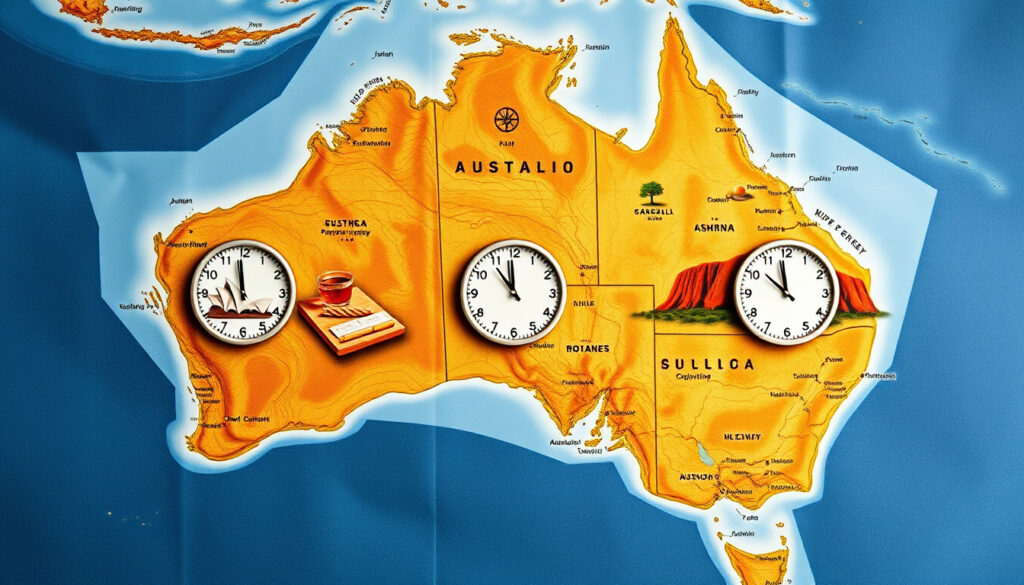
What Time Is It in Australia? Time Zones & Current Times
Anyone who’s tried to call a friend in Sydney or check a flight time to Perth has run into the same puzzle: Australia doesn’t have one time, it has several. Figuring out what time it is in Australia means untangling a system of three standard zones, half-hour quirks, and states that opt out of daylight saving entirely. This guide gives you the current times for major cities and explains why the clock works differently depending on where you’re standing.
Australia Time Zones: 3 ·
UTC Offsets: AEST UTC+10, ACST UTC+9:30, AWST UTC+8 ·
DST Period: October to April (most states except WA, NT, QLD) ·
Population: ~26 million
Quick snapshot
- Australia has three main standard time zones: AWST (UTC+8), ACST (UTC+9:30), and AEST (UTC+10) Australia.com (Official Tourism)
- DST begins first Sunday in October and ends first Sunday in April 24 Time Zones
- Whether DST will be adopted in all states in future
- DST clocks spring forward in October; fall back in April 24 Time Zones
- Next DST change: first Sunday in April 2026 (clocks back) World Time Server
Key facts about Australia’s time zones are compiled below.
| Label | Value |
|---|---|
| Capital city time zone | AEST (Canberra) |
| Number of standard time zones | 3 |
| Smallest time zone | Lord Howe Island (UTC+10:30) |
| DST start | First Sunday in October |
| DST end | First Sunday in April |
What time is it in Australia just now?
Australia’s current time depends on which part of the country you’re asking about. The nation spans three standard time zones: Australian Western Standard Time (AWST, UTC+8), Australian Central Standard Time (ACST, UTC+9:30), and Australian Eastern Standard Time (AEST, UTC+10) World Time Server. When daylight saving is active, the eastern and central zones shift forward by one hour, creating AEDT (UTC+11) and ACDT (UTC+10:30) Wikipedia – Time in Australia.
The most reliable way to check the exact current time is through a dedicated time service such as Timeanddate.com (world clock authority) or time.is (real-time clocks). These sites adjust automatically for DST and show the offset for each city.
A business caller dialling Sydney from London during Australian DST faces an 11-hour difference, not 10. That one hour shift can mean missed meetings or early-morning wake-up calls if you don’t check the current offset.
The implication: Australia operates on different clocks by region, and the UTC offset you see on a world clock is only correct if it accounts for DST status in that specific state at that specific date.
What time is it in major Australian cities?
Six major cities, six different answers depending on the season. Here’s the breakdown.
Sydney
- Standard time: AEST (UTC+10)
- Daylight saving: AEDT (UTC+11), observed from first Sunday in October to first Sunday in April World Time Server
- DST is observed in New South Wales
Brisbane
- Standard time: AEST (UTC+10)
- No DST — remains at UTC+10 year-round Wikipedia – Time in Australia
- Queensland does not observe daylight saving
Perth
- Standard time: AWST (UTC+8)
- No DST — remains at UTC+8 year-round Wikipedia – Time in Australia
- Western Australia does not observe daylight saving
NSW (New South Wales outside of Broken Hill)
- Uses AEST (UTC+10) standard; AEDT (UTC+11) during DST
- DST is observed World Time Server
Queensland
- Uses AEST (UTC+10) year-round
- No DST
Gold Coast
- Follows Queensland time: AEST (UTC+10) year-round
- No DST
The pattern: The DST divide creates a real-time mismatch. During summer, Sydney and Brisbane are both nominally in AEST, but Sydney jumps forward to AEDT while Brisbane stays put — so at 2pm in Brisbane, it’s already 3pm in Sydney. A traveller driving north from Sydney to Brisbane crosses no official time zone line but gains an hour during DST months.
Is Australia 12 hours ahead or behind?
The short answer: no. Australia’s offset from GMT/UTC ranges from 8 to 11 hours depending on the time zone and season World Time Server. The “12 hours ahead” idea is a rough approximation that doesn’t match any actual zone.
Time difference from UK
- During UK winter (GMT): Sydney is 11 hours ahead (AEDT) or 10 hours ahead (AEST)
- During UK summer (BST): Sydney is 9 hours ahead (AEST) or 8 hours ahead (AWST Perth)
- Adelaide is 10.5 hours ahead during UK winter (ACDT), shifting to 9.5 hours during UK summer
Time difference from US East Coast
- During US EST (UTC-5): Sydney is 16 hours ahead (AEDT) or 15 hours ahead (AEST)
- During US EDT (UTC-4): Sydney is 15 hours ahead (AEDT) or 14 hours ahead (AEST)
- Perth during US EST: 13 hours ahead (AWST, no DST)
The catch: Instead of memorising a fixed number, you need to know both the Australian state’s current DST status and the caller’s time zone offset. The difference shifts by up to 4 hours across the year for a single city pair.
| City | Standard UTC Offset | DST Offset | DST Observed? |
|---|---|---|---|
| Sydney | UTC+10 (AEST) | UTC+11 (AEDT) | Yes |
| Melbourne | UTC+10 (AEST) | UTC+11 (AEDT) | Yes |
| Brisbane | UTC+10 (AEST) | — | No |
| Perth | UTC+8 (AWST) | — | No |
| Adelaide | UTC+9:30 (ACST) | UTC+10:30 (ACDT) | Yes |
| Darwin | UTC+9:30 (ACST) | — | No |
| Hobart | UTC+10 (AEST) | UTC+11 (AEDT) | Yes |
| Canberra | UTC+10 (AEST) | UTC+11 (AEDT) | Yes |
Australia’s DST patchwork means that during summer, Adelaide is only half an hour behind Sydney instead of the usual 30-minute offset from standard time. But for a business operating across Sydney, Brisbane, and Perth — common in mining, finance, and logistics — the time gap widens to three hours during DST periods, not two.
Australia has 12 distinct time zone designations when including daylight saving variants and minor zones, making it one of the more complex countries for time-keeping.
Zeitverschiebung.net (time zone data aggregator)
During daylight saving, AEST becomes AEDT at UTC+11:00, while ACST becomes ACDT at UTC+10:30.
Wikipedia – Time in Australia (encyclopedic reference)
Confirmed facts
- Australia has three standard time zones Australia.com (Official Tourism)
- DST is observed in NSW, Victoria, Tasmania, ACT, and South Australia World Time Server
- Queensland, Western Australia, and Northern Territory do not observe DST World Time Server
- Lord Howe Island operates at UTC+10:30 Wikipedia – Time in Australia
What’s unclear
- Whether DST will be adopted in all states in future
For anyone booking international calls, scheduling remote work, or planning travel across Australian states, the message is clear: check the DST status of each city you’re connecting with. A single wrong guess about whether it’s DST or standard time can shift a meeting by a full hour. For travellers crossing from Queensland into New South Wales during summer, the sudden one-hour jump can catch even experienced drivers off guard.
Frequently asked questions
What time zone is Sydney in?
Sydney operates on Australian Eastern Standard Time (AEST, UTC+10) during winter and Australian Eastern Daylight Time (AEDT, UTC+11) during daylight saving months, which run from October to April World Time Server.
Does Australia have daylight saving?
Yes, but only in New South Wales, Victoria, Tasmania, the Australian Capital Territory, and South Australia. Queensland, Western Australia, and the Northern Territory do not observe DST World Time Server.
What states do not observe DST?
Queensland, Western Australia, and the Northern Territory remain on standard time year-round World Time Server.
Is Australia 10 hours ahead of the UK?
Not always. During UK winter, Sydney is 11 hours ahead (AEDT) or 10 hours ahead (AEST). During UK summer, Sydney is 9 hours ahead (AEST). Perth is 8 hours ahead of the UK during UK winter and 7 hours during UK summer World Time Server.
How many time zones does Australia have?
Australia has three standard time zones, but with daylight saving variants and minor zones like Lord Howe Island (UTC+10:30), the total reaches 12 distinct designations Zeitverschiebung.net.
What is the time difference between Sydney and Perth?
Two hours during standard time (Sydney UTC+10, Perth UTC+8). During DST, the difference widens to three hours because Sydney moves to UTC+11 while Perth stays at UTC+8 World Time Server.
Does Australia use a 12-hour or 24-hour format?
Australian clocks typically use a 12-hour format with am/pm, though 24-hour notation appears in transport timetables, military, and some digital displays. The time zone abbreviations (AEST, AEDT, etc.) are standard across both formats.
What is the current time in Melbourne?
Melbourne uses AEST (UTC+10) standard or AEDT (UTC+11) during DST. The current time can be checked at Timeanddate.com Melbourne clock.
More related posts
 Midleton Very Rare 2024: Complete Guide & Verified Updates
 Sources of Vitamin D: Top Foods, Sunlight, and Supplements
 Houses for Sale in Trim: 2025 Guide to Trim Property Market
 Carlos Alcaraz Net Worth 2026: Earnings, Endorsements & Cars
 Leeds vs Newcastle Lineups: Confirmed Starting XIs (Jan 2026)
 Coming to America 2: Cast, Reviews, and Sequel Status (2025)
 How to Create a New Gmail Account: Step-by-Step
 Joe and the Juice: Danish Expansion to Ireland & Oil Scandal