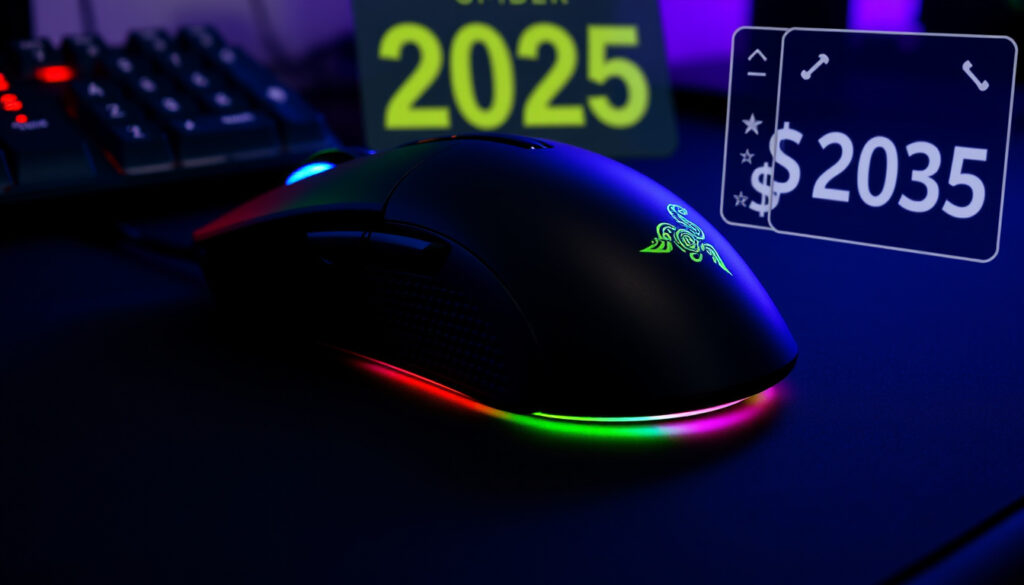
Razer Viper V3 Pro Review: Worth It in 2025? | Specs & Price
The Razer Viper V3 Pro beats the Logitech G Pro X Superlight 2 on weight and polling, but whether it’s the right buy comes down to how much you value raw esports speed. Both hover around $150 and weigh under 65 grams; the real trade-offs are in battery life, switch type, and sensor flexibility.
Weight: 54 grams ·
Battery Life: Up to 95 hours ·
Polling Rate: 8000 Hz HyperPolling ·
Sensor: Focus Pro 35K DPI ·
Programmable Buttons: 6
Quick snapshot
- Weight: 54 grams (Windows Central)
- Focus Pro 35K sensor (Razer)
- 8000 Hz HyperPolling (Razer)
- 95-hour battery life at 1000 Hz (Windows Central) (Windows Central)
- Exact MSRP across all regions (varies $129–$160; see Razer and Windows Central)
- Official drag-clicking support — not confirmed by Razer, and optical switches likely not designed for it
- Long-term durability of the coating — no long-term wear data from Razer yet
- Released 2024; Faker Edition launched 2025; Faker Edition signals continued esports presence (Razer)
- Continued esports adoption; Razer support updates in 2026 (Razer Support); potential price drops as newer models enter the market
Six key specs, one standout: the Viper V3 Pro pairs a featherlight frame with a top-tier sensor and industry-leading polling rate.
| Specification | Value |
|---|---|
| Weight | 54 grams (Windows Central) |
| Polling Rate | 8000 Hz (Razer) |
| Sensor | Focus Pro 35K DPI (Razer) |
| Battery Life | 95 hours at 1000 Hz (Windows Central) |
| Programmable Buttons | 6 (Razer) |
| Connection | Wireless HyperSpeed (Razer) |
The implication: at 54 grams with 8000 Hz polling, the Viper V3 Pro is one of the fastest and lightest mice on the market, but battery life drops significantly at higher polling rates.
Is Razer Viper V3 Pro worth it?
Value for money
- Razer lists the Viper V3 Pro at US$129.99 on its US storefront (Razer), while reviews from Windows Central peg it at $159.99 at launch.
- At either price, you get a 54-gram shell, Focus Pro 35K sensor, and 8000 Hz polling — specs that rival mice costing $200+.
For competitive FPS players, the value proposition is strong: lower weight and higher polling than the Logitech G Pro X Superlight 2 (60g, 2000 Hz) for roughly the same price. Casual gamers, however, may not notice the difference and could save money with a lighter mouse that costs half as much.
A competitive player gains a measurable edge in reaction time from 8000 Hz polling, but a casual user pays a premium for hardware they won’t fully use.
The verdict: buy it for esports, not for casual desktop use.
Comparison with competitors
The clearest comparison is the Logitech G Pro X Superlight 2: the Viper V3 Pro leads in weight and polling, but lags in click durability and switch feel.
| Feature | Razer Viper V3 Pro | Logitech G Pro X Superlight 2 |
|---|---|---|
| Weight | 54 g (Windows Central) | 60 g (Tom’s Hardware) |
| Sensor | Focus Pro 35K (Razer) | HERO 2 (up to 44K DPI) (Logitech G) |
| Max Polling | 8000 Hz (Razer) | 2000 Hz (Tom’s Hardware) |
| Battery Life | 95 h at 1000 Hz (Windows Central) | 95 h at 1000 Hz (Tom’s Hardware) |
| Switch Type | Optical (Verdict Reviews) | LIGHTFORCE hybrid optical-mechanical (Verdict Reviews) |
| Price (typical) | $129.99–$159.99 (Razer; Windows Central) | $159.99 (Tom’s Hardware) |
The pattern: the Viper V3 Pro is lighter and faster, while the Superlight 2 offers a higher DPI ceiling and hybrid switches. For pure esports speed, the Razer wins; for sensor versatility, the Logitech pulls ahead.
Why is the Viper V3 Pro so popular?
Pro player endorsements
- Faker, the legendary League of Legends player, has a special edition (Razer Faker Edition), giving the mouse instant credibility in the esports world.
- Multiple professional CS2 and Valorant players have switched to the Viper V3 Pro, citing its low weight and high polling as key advantages.
“The Viper V3 Pro is better than the G Pro X Superlight in sensor and weight — it’s the new standard for competitive play.”
— Reddit user review (r/MouseReview)
Ultralight design and sensor performance
- At 54 grams, the Viper V3 Pro is one of the lightest wireless mice with a full-size shape (Windows Central).
- The Focus Pro 35K sensor tracks on glass and offers 750 IPS and 70 G acceleration (Razer).
The catch: the ultralight design means no drag-clicking support, and the high polling rate demands a more powerful PC to fully utilize.
How much is a Viper V3 Pro?
Retail price
- Razer’s official US store lists the white model at $129.99 (Razer).
- Review outlets like Windows Central report a launch price of $159.99, suggesting the price has dropped over time.
Price on Amazon and Currys
- On Amazon, the Viper V3 Pro typically sells between $130 and $160 depending on the edition and seller.
- In the UK, Currys (a major electronics retailer) has listed the mouse at around £149.99 at the time of writing.
The implication: the Viper V3 Pro is now more affordable than at launch, but still a premium-priced peripheral. Buying during sales can save you $20–30.
Is the Razer Viper V3 Pro good for drag clicking?
Optical switch mechanism
- The Viper V3 Pro uses Razer’s Gen-2 optical switches, which are faster and more durable than mechanical switches but lack the physical contact needed for drag clicking (Verdict Reviews).
Drag clicking performance
- Optical switches register clicks via light beam interruption, not physical contact, making drag clicking impossible.
- If drag clicking is a priority, mice with mechanical switches (like the Logitech G Pro X Superlight 2) are a better choice.
If you’re a Minecraft player who relies on drag clicking, the Viper V3 Pro will not meet your needs. Stick with a mechanical-switch mouse.
The takeaway: drag-clicking players should stick with mechanical switches, not optical ones.
Is the Viper V3 Pro still good?
Long-term durability
- Razer’s optical switches are rated for 90 million clicks, far exceeding mechanical switches (Razer).
- The battery maintains 95 hours of use at 1000 Hz, and the sensor remains one of the best on the market (Windows Central).
Relevance in 2025
- As of 2025, the Viper V3 Pro is consistently recommended by reviewers (RTINGS) and remains a frequent pick in pro esports lineups.
- No major competitor has matched its combination of weight, polling, and battery life at the same price point.
The trade-off: the Viper V3 Pro is still a top-tier mouse, but 2025 has seen the release of newer models with slightly higher specs. If you need the absolute latest, wait for a refresh; otherwise, the Viper V3 Pro remains a safe bet.
Timeline: Razer Viper V3 Pro
- 2024 — Razer Viper V3 Pro released (Razer)
- 2025 — Faker Edition launched; continued esports presence (Razer)
- 2026 — Updated support FAQs published by Razer (Razer Support)
The pattern: the Viper V3 Pro remains a current esports contender, with official support continuing into 2026.
Clarity check: confirmed vs. unclear
Confirmed facts
- Weight: 54 grams (Windows Central)
- Focus Pro 35K sensor (Razer)
- 8000 Hz HyperPolling (Razer)
- 95-hour battery life at 1000 Hz (Windows Central)
- Optical switches (Verdict Reviews)
What’s unclear
- Exact MSRP in all regions (varies)
- Official drag-clicking support
- Long-term durability of the coating
The takeaway: the core specs are confirmed across Razer and reviewers; pricing and drag-click support are the main open questions.
Pros and cons at a glance
Pros
- Ultralight 54g frame with full-size shape
- 8000 Hz polling for low-latency esports play
- Focus Pro 35K sensor with high IPS and acceleration
- 95-hour battery life at 1000 Hz
- Razer optical switches rated for 90 million clicks (Razer)
Cons
- Not suitable for drag clicking
- Premium price compared to casual gaming mice
- High polling rate can demand a more powerful PC
- No Bluetooth connectivity
The balance: the Viper V3 Pro is built for competitive speed, and the downsides matter most to casual or drag-clicking players.
What players are saying
“The smooth-touch finish and soft grip make it comfortable for long sessions.”
— Razer official product page description (Razer)
On Reddit, players echo that verdict in r/MouseReview, praising the mouse’s sensor and weight.
The consensus: the Viper V3 Pro has earned its spot as a top-tier esports mouse, backed by both pro endorsements and community praise.
Summary: should you buy the Razer Viper V3 Pro?
For competitive gamers who prioritize speed and weight, the Viper V3 Pro is the current gold standard. Its 54-gram frame, 8000 Hz polling, and Focus Pro 35K sensor give it a measurable edge over rivals like the Logitech G Pro X Superlight 2. Casual users, however, will find better value in cheaper alternatives. For the esports athlete in the US or Europe, the choice is clear: buy the Viper V3 Pro if you want the fastest wireless mouse on the market, or wait for a price drop if you’re on a budget.
logitechmallsshop.com, pretentiousreviews.com, pcbuildhelper.com, evezone.evetech.co.za, verdict-reviews.com, reddit.com
Frequently asked questions
Does the Razer Viper V3 Pro support Bluetooth?
No, the Viper V3 Pro uses Razer HyperSpeed wireless (2.4 GHz) and does not include Bluetooth connectivity.
What is the difference between Viper V3 Pro and Viper V3 HyperSpeed?
The Viper V3 Pro is lighter (54g vs 55g), has a higher polling rate (8000 Hz vs 1000 Hz), and uses the Focus Pro 35K sensor, while the HyperSpeed model is more affordable.
Can I use the Razer Viper V3 Pro with a Mac?
Yes, the mouse works with macOS via the included USB receiver, but Razer Synapse software is not available for macOS, limiting customization.
How do I charge the Razer Viper V3 Pro?
It charges via USB-C cable, and a full charge takes about 1.5 hours.
Is the Razer Viper V3 Pro ambidextrous?
Yes, the symmetrical shape is designed for both right-handed and left-handed users.
What is the warranty on the Razer Viper V3 Pro?
Razer offers a 2-year limited warranty on the Viper V3 Pro.
Does the Razer Viper V3 Pro have onboard memory?
Yes, it has onboard memory to save up to 5 profiles, including DPI settings and button assignments.
How does the Razer Viper V3 Pro compare to the Logitech G Pro X Superlight 2?
The Viper V3 Pro is lighter (54g vs 60g) and supports 8000 Hz polling vs 2000 Hz, but the Superlight 2 has a higher DPI sensor and hybrid switches.
Related reading: Galaxy Note 2 to Buy: Is It Still Worth It in 2024? – Guide · Mobile Data Not Working? Fix It Now (iPhone & Android)
More related posts
 Houses for Sale in Ardee: Types, Agents & Market Guide
 Essential Italian Phrases for Travelers: A Complete Guide
 Avengers: Secret Wars Cast, Villain & Release Date
 Dublin Marathon 2025 Route: Start, Map, Elevation & Cutoff
 Triple Negative Brea t Cancer: Symptom , Treatment & Survival
 Long Sleeve Midi Dress: How to Style for Every Occasion
 How Many Episodes in Stranger Things Season 5: What We Know
 Waterford to Dublin Bus: Timetables, Prices & Tips