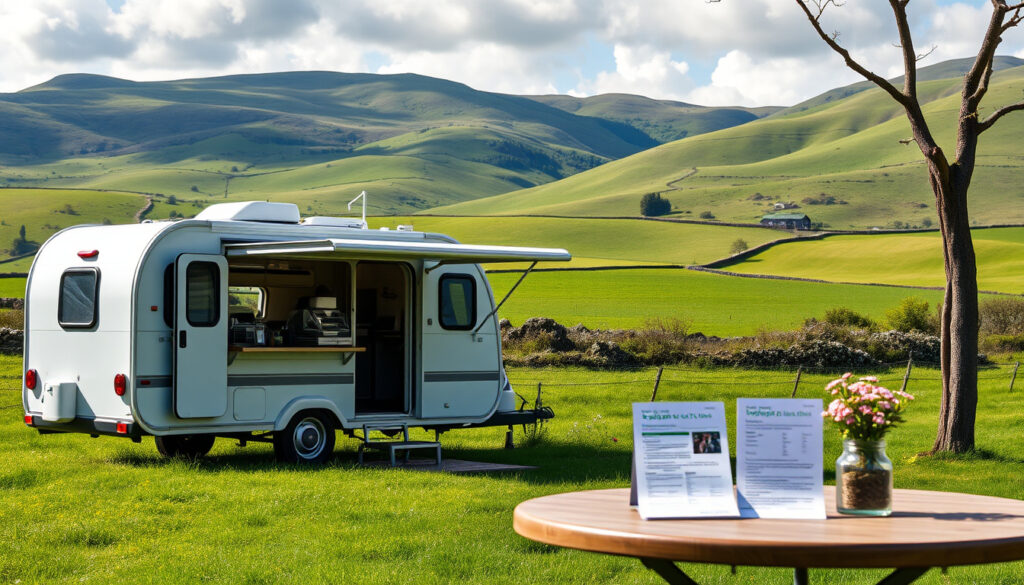
Coffee Trailer for Sale Ireland: Cost & Licence Guide
There’s a particular kind of daydream that involves a converted trailer, a shiny espresso machine, and the smell of fresh coffee drifting across a busy Irish market square. It’s an appealing picture, but before you start browsing DoneDeal, it’s worth understanding what that dream actually costs and how the numbers really stack up.
Used coffee trailer price range (Ireland): €4,300–€10,950 · New fully-kitted trailer range: €5,000–€18,000 · First-year coffee shop failure rate: ~60% · Mobile coffee profit margin: 50%–80%
Key facts at a glance
- Lowest used trailer price (DoneDeal, 2024): €4,300
- Highest used trailer price (Adverts.ie, 2024): €10,950
- Fully-kitted new trailer range: €5,000–€18,000
- FSAI registration required: Yes, for all food businesses (RGI-registered installer (the official register of gas installers in Ireland))
- Registration lead time: At least 28 days before opening (RGI-registered installer (the official register of gas installers in Ireland))
- LPG gas system certification: Must be installed by an RGI-registered installer (the official register of gas installers in Ireland)
- Coffee shop failure rate (first year): Approximately 60%
- Average profit margin mobile coffee van: 50%–80%
- Most profitable drink: Specialty coffee drinks
- Top 5 coffee orders: Latte, cappuccino, espresso, americano, flat white
- Top 5 drinks overall (Ireland): Latte, cappuccino, espresso, americano, flat white
What does a used coffee trailer actually cost in Ireland?
The used market for coffee trailers in Ireland is surprisingly active, with prices that vary much more than you might expect. Listings on DoneDeal show asking prices for used coffee trailers starting at around €4,300, while similar listings on Adverts.ie reach up to €10,950 depending on condition and equipment. That’s a wide spread, and the difference usually comes down to three things: the trailer’s age, the quality of the coffee equipment installed, and whether it’s ready to trade or needs work before it can pass inspection.
If you’re looking for a more complete picture, Food Trailers Marketplace (a dedicated vendor for food trailer sales in Ireland) lists fully-kitted new trailers between €5,000 and €18,000. The upper end of that range usually includes custom fit-outs, commercial-grade espresso machines, running water, and compliance-ready electrical and gas systems.
A cheaper second-hand trailer can look like a bargain, but if it needs new equipment, rewiring, or a gas system upgrade to meet FSAI standards, you can quickly spend the difference between that €4,300 listing and a more expensive, ready-to-go unit. Budget for inspection and repairs before you commit.
There’s also a long tail of specialist listings. Some dealers and brokers focus exclusively on catering trailers, and their prices tend to reflect a higher level of fit-out and warranty coverage. If you’re comparing across platforms, check whether the trailer comes with a food safety certificate and an up-to-date gas safety record — those documents can save you weeks of delays and hundreds of euros in re-certification fees.
The practical takeaway: don’t fixate on the headline price alone. Instead, work out the total cost of getting the trailer to a fully compliant, trading-ready state. That includes any repairs, equipment upgrades, licensing fees, and the registration process with the health authorities.
Coffee trailer for sale near Dublin and other locations
Dublin and the greater Leinster area typically have the most active market for coffee trailers, simply because of the density of events, markets, and commuter routes. Listings on DoneDeal and Adverts.ie frequently show trailers located within an hour of Dublin, often priced between €5,000 and €8,000 — a sweet spot for buyers who want a working trailer without paying the premium for a brand-new build.
If you’re outside Dublin, the market is thinner but still present. Cork, Galway, and Limerick regularly have listings on the same platforms, though you may need to travel further to view a trailer that genuinely fits your budget and requirements. A useful rule: when viewing a used trailer, bring someone with mechanical and electrical experience, or budget for a professional inspection. That €200 inspection fee can easily save you from a €3,000 repair bill.
Beyond the big Irish platforms, Food Trailers Marketplace (an Irish-focused vendor resource for coffee trailer buyers) publishes guides that walk through the typical equipment needed and the costs associated with each fitting.
Do you need specific licenses to run a coffee trailer in Ireland?
Yes — and it’s not optional. Every food business in Ireland, including a mobile coffee trailer, must register with the Food Safety Authority of Ireland (FSAI, the national food safety regulator). According to Food Trailers Marketplace (a vendor resource for Irish food trailer startups), this registration must be completed at least 28 days before you open. That’s a hard legal requirement, not a suggestion.
The FSAI registration covers the food safety aspects of your operation: how you store ingredients, handle milk, maintain temperature, manage waste, and keep the trailer clean. Inspectors can visit without notice, and if they find hygiene failures, you can face fines, closure orders, or even prosecution.
On top of FSAI registration, coffee trailers that use gas — and most do, for hot water and heating — must have their LPG system installed and certified by an RGI-registered installer (the official register of gas installers in Ireland). This certification needs to be renewed periodically, and insurance companies will almost certainly want to see it before they issue public liability cover.
- FSAI registration: Mandatory for all food businesses, including mobile trailers. Apply at least 28 days before opening.
- RGI gas certification: Required for any LPG system. Must be installed by a registered gas installer.
- Public liability insurance: Practically essential, particularly if you trade at markets or events that require it.
- Waste disposal and water supply: You’ll need access to clean water and a plan for waste water disposal — both are checked during inspection.
- Local authority permissions: Certain locations (e.g., some public parks or streets) require a casual trading permit from the relevant council.
Some councils handle casual trading licences separately. For example, Cork City Council (the local authority governing casual trading) requires a licence for trading on public streets and in certain public spaces. If you plan to work events, the event organiser will also typically ask for proof of insurance and FSAI registration before they accept your booking.
The registration process itself is straightforward, but the inspection standards are real. If your trailer doesn’t have proper hand-washing facilities, a suitable water supply, or a compliant gas system, you won’t get signed off until it does. That’s where the hidden costs of a cheap trailer show up.
Are there any coffee trailers for sale in Ireland specifically for events?
The short answer is yes — the market clearly distinguishes between basic food trailers (often used for chips or burgers) and coffee-specific builds. Coffee trailers need more than just a counter and a few shelves. They require a commercial espresso machine, a grinder, a water tank, a waste water tank, a fridge for milk, and often a generator or battery system for power. These extras significantly raise the price but also make the trailer capable of trading at higher volume.
Listings on DoneDeal and Adverts.ie confirm this split. A bare-bones trailer with minimal equipment might list for €4,300, while a coffee-specific build with a proper espresso setup typically starts around €7,000 and climbs to €10,950 or higher. If you see a trailer priced unrealistically low, ask what equipment is included — there’s a big difference between “coffee trailer” and “trailer that could technically sell coffee.”
For events specifically, some sellers add extras that make event trading easier: built-in awnings, counter serving hatches, menu boards, and even branded signage. These features don’t necessarily add huge resale value, but they save you the time and cost of fitting them yourself.
| Feature | Basic trailer | Event-ready coffee trailer |
|---|---|---|
| Price range (used) | €4,300–€5,500 | €6,000–€10,950 |
| Coffee equipment | Minimal or none | Commercial espresso machine, grinder, fridge |
| Power system | None (requires hookup) | Built-in generator or battery bank |
| Awnings & serving hatch | Optional | Usually included |
| FSAI-ready | Needs work | Usually compliant |
That table shows the distinction most buyers miss: the cheapest “coffee trailer” often isn’t a coffee trailer at all. The implication: if you’re buying for events, look for the equipment list and compliance paperwork before you compare prices, because a low headline price usually means you’ll spend thousands more getting it event-ready.
How much money can you actually make with a coffee trailer in Ireland?
The honest answer: the margins can be excellent, but the failure rate is sobering. Industry data from CBI (a business analytics source tracking hospitality performance) and specialist food-service research indicates that approximately 60% of coffee shops — including mobile operations — close within the first year. That’s not because coffee isn’t profitable; it’s because many operators underestimate the combination of location dependence, seasonality, and upfront investment.
On the positive side, the average profit margin for a mobile coffee van in Ireland is reported to be between 50% and 80%. Coffee itself has a very high markup — a latte that costs roughly €0.50–€0.70 in materials typically sells for €3.20–€4.00. The most profitable items are specialty coffee drinks, which is why the Adverts.ie listings and Food Trailers Marketplace (a vendor resource for Irish food trailer startups) always recommend building your menu around espresso-based drinks rather than filter coffee alone.
The top 5 coffee orders in Ireland — latte, cappuccino, espresso, americano, and flat white — all fall into that higher-margin category. If you’re not comfortable making these quickly and consistently, your trailer will struggle, no matter how good the location is.
Are there any coffee trailers for sale in Ireland that come fully equipped?
Yes — and “fully equipped” is the right phrase to search for. Terms like “turnkey,” “ready to run,” or “business-ready” appear on DoneDeal and Adverts.ie when sellers are offering a trailer with all the equipment needed to start trading immediately. These typically include:
- Commercial espresso machine and grinder
- Refrigeration for milk and perishables
- Water tank and waste water tank
- Basic electrical system (or generator)
- Gas system with certification
- Cup holders, storage, and serving counter
A genuinely ready-to-trade trailer is rare on the used market. Many sellers describe their trailer as “fully equipped” when it actually has just the basics. Always ask for photos of the interior, a list of all included equipment, and — critically — the current gas safety certificate and FSAI registration status. If either is missing, factor in the cost and time to get it sorted.
From a budgeting perspective, a fully equipped used trailer might cost €7,000–€10,950, but it removes the guesswork and the weeks of downtime that come with fitting out a cheaper trailer yourself. For someone with limited cash but a tight launch timeline, that premium often pays for itself in saved labour and faster start-up.
Where are the best places to find coffee trailers for sale in Ireland?
The main marketplace platforms dominate the Irish used coffee trailer market. DoneDeal tends to have the widest range of prices, while Adverts.ie often has more detailed listings with photos. For new builds and specialised advice, Food Trailers Marketplace (a dedicated vendor for food trailer sales in Ireland) offers both trailers and guidance.
Beyond the well-known platforms, consider these channels:
- Facebook Marketplace: Good for local finds and private sellers, but verify quality carefully.
- Specialist catering equipment dealers: They often have trailers that aren’t listed publicly.
- Event organiser networks: Ask vendors at markets and festivals — many upgrade their trailers and sell privately.
- Trade shows: Occasionally, demo units are sold after shows at a reduced price.
Whatever channel you use, treat every listing with healthy scepticism until you’ve seen the trailer in person and verified its compliance paperwork. A good trailer is an investment in a business; a cheap one is often a repair bill waiting to happen.
What are the weaknesses of a coffee shop business?
The most glaring weakness is the failure rate. Industry data shows approximately 60% of coffee shops close within their first year. That statistic applies broadly, including mobile operations like coffee trailers. The reason is rarely bad coffee — it’s a combination of high overheads, staff turnover, and over-reliance on repeat local customers.
For mobile coffee trailers specifically, weaknesses include weather dependency and event-based trading. A rainy string of weekends can hit revenue hard. Unlike a fixed café, a trailer cannot build a steady commuter trade if its location changes frequently. Seasonality also bites: the summer festival season might generate 70% of annual revenue, leaving the winter months lean.
Overestimating daily sales is another common pitfall. Many first-time operators assume they’ll sell 200 cups a day from the start, when the reality is closer to 50–80 cups per day at a good location. That gap between expectation and reality often drains cash reserves before the business finds its feet.
What is trending in coffee shops?
The Irish coffee scene has moved beyond basic order lists. Cold brew, oat milk, and specialty single-origin blends have grown significantly in popularity. According to Food Trailers Marketplace (a vendor resource for Irish food trailer startups), operators who offer plant-based milk options and cold brew see higher average transaction values.
Sustainability is another key differentiator. Customers increasingly ask about local roasting, compostable cups, and waste reduction. Trailers that actively market their eco-friendly credentials — like using compostable takeaway cups and sourcing from Irish roasters — tend to attract more loyal customers and better event bookings.
Tech innovation is also making inroads. Mobile ordering apps and loyalty programmes can increase repeat trade, especially for mobile operators who park in the same spots regularly. Though the upfront cost of a simple ordering app is modest, the convenience factor can boost daily sales by 10–15% in areas with high footfall.
adverts.ie, donedeal.ie, donedeal.ie, donedeal.co.uk, etsy.com, donedeal.ie, iomst.ie, donedeal.ie
Frequently asked questions
How much does a used coffee trailer cost in Ireland?
Based on current DoneDeal and Adverts.ie listings, used coffee trailers in Ireland typically range from €4,300 to €10,950. The price depends on age, condition, equipment, and compliance certification.
Do I need to register with the FSAI to run a coffee trailer?
Yes. Every food business in Ireland, including mobile coffee trailers, must register with the Food Safety Authority of Ireland at least 28 days before opening. FSAI registration is mandatory and non-negotiable.
What is the most profitable item to sell from a coffee trailer?
Specialty coffee drinks — lattes, cappuccinos, flat whites — are the highest-margin products. The top 5 coffee orders in Ireland are latte, cappuccino, espresso, americano, and flat white.
Is running a coffee trailer in Ireland profitable?
Mobile coffee vans report average profit margins of 50% to 80%. However, approximately 60% of coffee shops fail in the first year, so profitability depends heavily on location, consistency, and cost control.
What equipment do I need for a coffee trailer?
At minimum, you need a commercial espresso machine, grinder, refrigerator for milk, water tank, waste water tank, and a gas system installed by an RGI-registered installer. A generator or battery system is also needed unless you have access to a hookup.
Can I convert a regular food trailer into a coffee trailer?
Yes, but you’ll need to install the necessary coffee equipment, plumbing, gas systems, and possibly power infrastructure. The cost of conversion can quickly exceed the difference between a basic trailer and a ready-to-run coffee build.
Where can I find coffee trailers for sale near Dublin?
DoneDeal and Adverts.ie are the main platforms, with many listings within an hour of Dublin. Specialist sellers like Food Trailers Marketplace also list new and ready-to-use trailers. Check Facebook Marketplace for private sellers in the Leinster area.
How can I finance a coffee trailer purchase?
Options include personal savings, small business loans from Irish credit unions, and equipment finance from specialist lenders. Some sellers also offer structured payment plans for new builds.
Do I need a special driver licence to tow a coffee trailer?
If the trailer’s gross vehicle weight exceeds 750 kg, you may need a Category BE licence to tow it. Check with the Road Safety Authority for the specific weight of your trailer.
Can I run a coffee trailer year-round in Ireland?
Yes, but winter months may see reduced footfall at outdoor locations. Many operators supplement with indoor events, Christmas markets, and private catering to maintain income year-round.
What type of coffee machine is best for a mobile trailer?
A compact, commercial-grade espresso machine with a built-in water tank is ideal for mobile use. Brands like La Marzocco, Nuova Simonelli, and Rancilio are common in Irish coffee trailers.
How do I get insurance for a mobile coffee business?
You’ll need public liability insurance and possibly contents insurance for the equipment. Specialist insurers like Arachas or Campion Insurance offer policies tailored to mobile food businesses in Ireland.
Related reading
For more detail on compliance and equipment, see the Food Trailers Marketplace buying guide (an Irish-focused walkthrough of what to check before purchase). For current listings, browse DoneDeal and Adverts.ie. You might also find our guide on Credit Union Near Me: Your Guide to Borrowing in Ireland useful for financing your trailer purchase, and Health and Safety Courses in Ireland for meeting compliance requirements.
More related posts
 Dublin Mail Centre Dublin 12 – Contact, Location & Tracking Help
 Cite This For Me vs ChatGPT: Which Citation Tool Wins
 Leeds vs Newcastle Lineups: Confirmed Starting XIs (Jan 2026)
 Road Tax Ireland Rates: CO2 Bands & Costs
 Suzuki Swift for Sale: What Buyers Should Know
 High Street Medical Centre: Locations, Services & Reviews
 The Weir Brendan Gleeson: Dublin 2025 Plot, Cast, Reviews
 Storm Benjamin Ireland Rainfall: Impact and Climate Facts