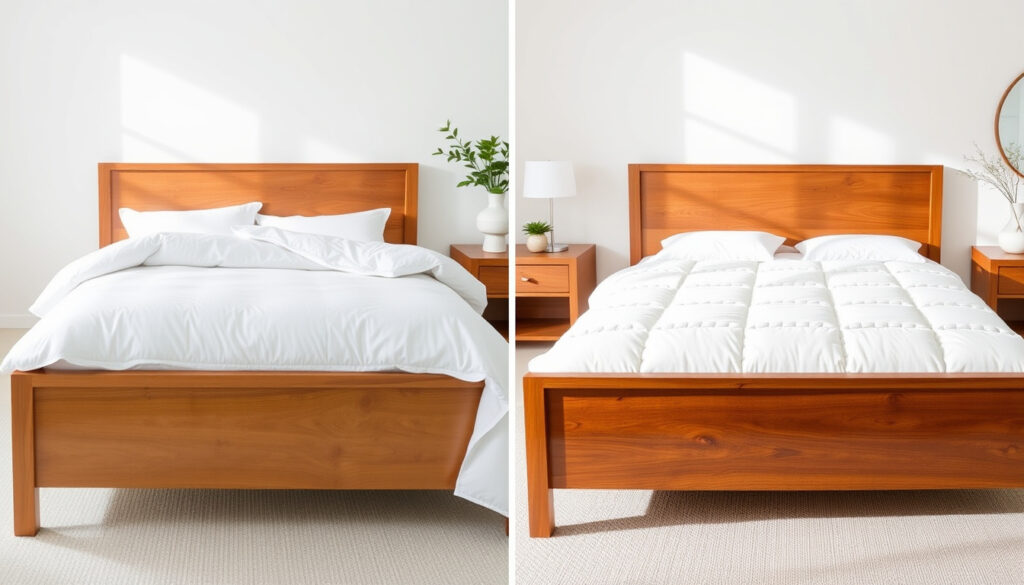
Duvet vs Comforter: What’s the Difference and Which Is Better
Few bedding decisions spark as much confusion as the choice between a duvet and a comforter, whether you’re shopping for a new bed setup or trying to figure out why European hotels seem to have it all figured out. The difference comes down to more than just a name, and understanding the construction, cleaning, and cultural habits that separate these two bed toppers will help you pick the one that actually fits your sleep.
Duvet fill: Down or feathers (common) ·
Comforter fill: Synthetic fibers (common) ·
Cover: Removable duvet cover for duvet, sewn outer for comforter ·
Weight: Duvets often lighter, comforters heavier
Quick snapshot
- Soft insert used with a cover (ettitude bedding journal)
- Removable cover for easy washing (U’linen washing guide)
- Often filled with down or feathers (Casper bedding blog)
- Lighter and more flexible (Tom’s Guide bedding comparison)
- Popular in Europe (The Modern Dane bedding guide)
- All-in-one sewn piece (ettitude bedding journal)
- No separate cover needed (Forbes shopping guide)
- Often filled with synthetic fibers (Casper bedding blog)
- Thicker and heavier (Good Housekeeping bedding review)
- Popular in North America (The Modern Dane bedding guide)
- Both are bed toppers (ettitude bedding journal)
- Both provide warmth (Tom’s Guide bedding comparison)
- Both come in various weights and sizes (Good Housekeeping bedding review)
- Both can be used as the main bedding layer (Forbes shopping guide)
- Duvets have been used in Europe for centuries (The Modern Dane bedding guide)
- Comforters gained popularity in the US in the 20th century (Cosmopolitan lifestyle article)
- Duvet covers became mainstream in the 1950s–60s (The Modern Dane bedding guide)
Six key differences, one pattern: duvets prioritise modularity and washability, while comforters favour simplicity and a ready-made look.
| Feature | Duvet | Comforter |
|---|---|---|
| Origin | Europe | North America |
| Typical fill | Down, feathers, wool, synthetic | Synthetic (polyester), down alternative |
| Cover | Removable duvet cover | Sewn outer fabric, no cover |
| Washing | Wash cover only; insert cleaned less often | Whole piece must be laundered |
| Lifespan | Often longer due to cover protection | Shorter because the fill is exposed to dirt |
| Cost | Higher upfront (insert + cover sold separately) | Lower upfront, single purchase |
What is the difference between a duvet and a comforter?
What is a duvet?
A duvet is a two-part bedding system: a soft, flat insert — typically filled with down, feathers, or wool — plus a removable cover that works like a giant pillowcase. The insert is designed to be used inside the cover, which is usually closed with a zipper or buttons (U’linen washing guide). This separation means the outer layer can be removed and washed frequently while the fill stays protected.
Duvets are common across Europe, where they are the default bedding layer in most homes and hotels. The word itself comes from the French for “down,” and the system has been used for centuries as a lightweight, warm alternative to layered blankets.
What is a comforter?
A comforter is a single, stitched piece of bedding with filling distributed evenly inside and sewn into place. There is no removable cover — the outer fabric is sewn shut around the fill. Comforters are typically used as-is, placed directly on top of a fitted sheet, and often sold as part of a matching set with pillow shams and bed skirts (Cosmopolitan lifestyle article).
Comforters are the standard in North America, where they are available in a wide range of colors, patterns, and weights. They are designed to be a complete, ready-to-use bedding layer straight out of the package.
Duvet vs. comforter: key features
- Construction: Duvet = insert + cover; Comforter = single sewn piece (Forbes shopping guide)
- Fill: Duvets often use down or feathers; comforters lean synthetic (Casper bedding blog)
- Flexibility: Duvet covers can be swapped for different colors or textures without replacing the whole bed (MATTEO bedding blog)
- Look: Comforters tend to hang farther over the sides of the bed, creating a more finished, all-in-one appearance (Good Housekeeping bedding review)
Duvet buyers get modularity and easier cleaning, but they pay for two pieces. Comforter buyers get simplicity and a lower upfront cost, but they sacrifice the ability to wash just the outer layer.
The implication: your choice depends on whether you value convenience of care (duvet) or convenience of purchase (comforter).
Is a duvet better than a comforter?
Duvet vs comforter for winter
Duvets are often described as thicker and loftier than comforters, which can improve warmth by trapping more air in the fill (Tom’s Guide bedding comparison). A duvet with a high-fill-power down insert can be significantly warmer than a synthetic comforter of similar thickness. For cold climates, a duvet system allows you to layer the insert weight — light for autumn, heavy for deep winter — without replacing the whole bed.
Comforters, by contrast, are often lighter and thinner, which can leave you adding extra blankets in winter (Tom’s Guide bedding comparison). However, heavyweight comforters are available and can be just as warm, though they tend to be bulkier to launder.
Comforter vs duvet for hot sleepers
Duvets have an advantage here because the cover can be removed and swapped for a lighter, breathable fabric — like percale cotton or linen — while the insert stays in place. That means hot sleepers can keep the same duvet insert year-round and just change the cover for better airflow. Comforters offer no such modularity: if the fill is too warm, you have to replace the whole thing.
Some sources note that duvets can be warmer than comforters because of their loft and fill properties (Casper bedding blog), so hot sleepers should look for a lightweight down or synthetic duvet insert with a low fill power.
Which is easier to clean?
This is where the duvet system shines. The removable cover can be unzipped and tossed in the washing machine as often as needed — weekly, if you like — while the insert stays clean and protected. Comforters, on the other hand, require washing the entire bulky piece, which can be difficult to fit in a home machine and may take hours to dry (Good Housekeeping bedding review).
A duvet cover that can be washed weekly means allergens, dust mites, and sweat get removed from the surface you sleep against. A comforter that gets washed twice a year traps those same particles against your skin for months.
What this means: if you sleep hot, sweat at night, or have allergies, the duvet’s washable cover gives you a hygiene advantage that a comforter cannot match.
Why do Americans use comforters instead of duvets?
Do Europeans use comforters or duvets?
In Europe, the duvet is the standard. Most households use a duvet insert with a removable cover, and the term “comforter” is rarely used in everyday shopping (The Modern Dane bedding guide). The duvet system aligns with European preferences for layered, modular bedding that can be adjusted per season. It also reflects a cultural emphasis on washability — duvet covers are changed and laundered frequently, often as part of a weekly routine.
What makes European style bedding so popular?
European bedding has gained a following in the US for its clean, minimalist look and practical benefits. The duvet cover acts as a protective barrier, extending the life of the insert. Because the cover can be swapped out, you can change the look of your bedroom without buying a whole new bed topper. This modular approach is increasingly popular among design-conscious shoppers who want flexibility (MATTEO bedding blog).
Why do Europeans use two comforters? What is the Scandinavian sleep method?
The Scandinavian sleep method involves each person using their own duvet — typically a twin-size insert — even when sharing a bed. This avoids the “blanket tug-of-war” because each sleeper controls their own warmth and coverage. The practice is widespread in Sweden, Norway, Denmark, and Finland, and it has gained attention globally as a simple solution for couples with different temperature preferences. The method relies on duvets, not comforters, because duvet inserts are available in single sizes and can be paired with individual covers.
The catch: this method works best with duvets because they are designed to be used singly. A standard American comforter is usually a full/queen/king size meant to be shared, which defeats the purpose.
Do you use both a duvet and a comforter?
Does a comforter replace a duvet?
Yes, in most cases a comforter replaces a duvet. They serve the same primary function — the top layer of warmth on a bed — so using both is redundant. If you have a duvet with a cover, you do not need a comforter on top of it, and vice versa.
Can you use a duvet and comforter together?
Some people layer a duvet and a comforter for extra warmth in very cold conditions, but this is uncommon and usually unnecessary. Most bedding guides recommend choosing one system based on your cleaning preferences, temperature needs, and aesthetic taste. Using both at once can be uncomfortably warm and adds bulk that makes bed-making harder.
The trade-off: if you already own a comforter and want the washability of a duvet, you can buy a duvet cover and use it over your comforter — effectively converting it into a duvet-like system. Just be aware that comforters are often larger and less square than duvet inserts, so the fit may not be perfect.
Do hotels use duvet or comforter?
What bedding do hotels prefer?
Many hotels, especially in Europe and upscale chains worldwide, use duvets. The reason is practical: duvet covers can be removed and laundered between guests, while the insert itself stays clean longer. This allows hotels to maintain a crisp, white bedding look without replacing the entire topper after every stay. Housekeeping can quickly swap a duvet cover in minutes, which is not possible with a sewn-shut comforter (Peacock Alley bedding guide).
Why do hotels use duvets?
Hotels choose duvets for hygiene, efficiency, and cost control. A duvet cover can be washed at high temperatures and replaced instantly if stained. A comforter that gets stained or soiled requires the whole piece to be sent out for cleaning, which is more expensive and takes longer. For hotels that prioritize cleanliness and turnover speed, the duvet system is the clear winner.
The pattern: hotels optimize for laundry logistics, not aesthetics. The duvet system gives them that.
Upsides
- Duvet: removable cover for easy washing, protects the insert, extends lifespan, allows seasonal flexibility by swapping inserts
- Duvet: cover can be changed for different colors/styles without buying a new bed topper
- Comforter: simpler to use, no assembly required, ready out of the package
- Comforter: lower upfront cost, often sold as part of a matching set
Downsides
- Duvet: higher upfront cost (insert + cover sold separately), requires effort to put the cover on
- Duvet: insert can shift inside the cover if not properly secured
- Comforter: harder to clean because the whole piece must be laundered
- Comforter: less flexible — you cannot change the outer look without replacing the entire piece
Confirmed facts vs. what’s unclear
Confirmed facts
- Duvets have removable covers; comforters are sewn closed (ettitude bedding journal)
- Duvets are more common in Europe; comforters are more common in the US (The Modern Dane bedding guide)
- Duvet covers can be washed separately, making routine cleaning easier (U’linen washing guide)
What’s unclear
- Which system provides better sleep quality over the long term — no definitive study exists
- Cost comparison over time depends on how frequently you wash and replace each component
- Whether duvets are universally warmer than comforters depends on fill type, fill weight, and construction quality
- Comforters are often sold as part of a coordinated bedding set, but this is not universal and depends on the brand (Cosmopolitan lifestyle article)
What this means: the decision between duvet and comforter is not scientifically settled, but practical considerations dominate.
“Duvets allow for easy cleaning because you can remove and wash the cover.”
— Bedding expert, The Spruce bedding expert
“The main difference is that a duvet is typically covered in a removable duvet cover, while a comforter is often used without a cover.”
— The Modern Dane bedding guide
For the average shopper, the choice between a duvet and a comforter is not about which is “better” — it is about which trade-offs you are willing to make. The duvet gives you washability, flexibility, and a longer lifespan, but it costs more upfront and requires a cover. The comforter gives you simplicity and a lower price, but it is harder to clean and less adaptable. For anyone who sweats at night, has allergies, or wants to change their bedroom look without buying a new bed topper, the duvet system is the clear recommendation. For anyone who wants a one-and-done purchase and does not mind washing the whole piece, a comforter is the simpler path.
Frequently asked questions
What is a duvet cover?
A duvet cover is a removable fabric shell that slides over a duvet insert. It is typically closed with a zipper, buttons, or ties and can be removed and washed separately from the insert.
Can you wash a duvet like a comforter?
You can wash a duvet insert, but it is bulky and requires a large-capacity machine. The advantage of a duvet is that you can wash the cover frequently and only clean the insert occasionally, unlike a comforter, which must be washed as a single piece.
How do I choose between a duvet and a comforter?
Consider your priorities: if you want easy cleaning, seasonal flexibility, and a longer-lasting bed topper, choose a duvet. If you want a lower upfront cost, a ready-to-use piece, and a coordinated look, choose a comforter.
Are duvets warmer than comforters?
Duvets can be warmer because they are often loftier and use high-fill-power down, which traps more air. However, warmth depends on the specific fill type and weight of each product, not just the category.
Do duvets need a duvet cover?
Yes, duvets are designed to be used with a cover. The cover protects the insert from dirt, sweat, and wear, and it is the part that gets washed regularly.
Can I use a duvet without a cover?
Technically yes, but it is not recommended. Without a cover, the duvet insert will get dirty quickly and is difficult to clean. The cover also adds comfort and style.
What is the best fill for a duvet or comforter?
Down and feathers offer the best warmth-to-weight ratio and breathability. Synthetic fills (polyester, down alternative) are cheaper, hypoallergenic, and easier to care for. Wool is a natural option with good temperature regulation.
Why are duvets so expensive compared to comforters?
Duvets require two separate purchases — the insert and the cover — which raises the total cost. High-quality down inserts are also more expensive to produce than synthetic comforters.
More related posts
 The Day of the Jackal (TV Series) Episodes: List & Season 2
 Duchess of Kent: Illness, Funeral, Family & Conversion Explained
 Dublin Airport Arrivals Tomorrow: Live Terminal 1 & 2
 Man City vs AFC Bournemouth Stats: H2H Record & Analysis
 Tree of Life Meaning: Symbolism Across Cultures and Religions
 When Can I Claim Tax Back for 2025? Ireland Tax Dates
 Led Face Mask Ireland – Top Picks and Buying Guide
 Trinity College Dublin Book of Kells: Tickets & Visitor Guide